-
Loving the Lake
Buried deep by Cache Owner now-we-are-nine, a lake hide holds out watery hands.
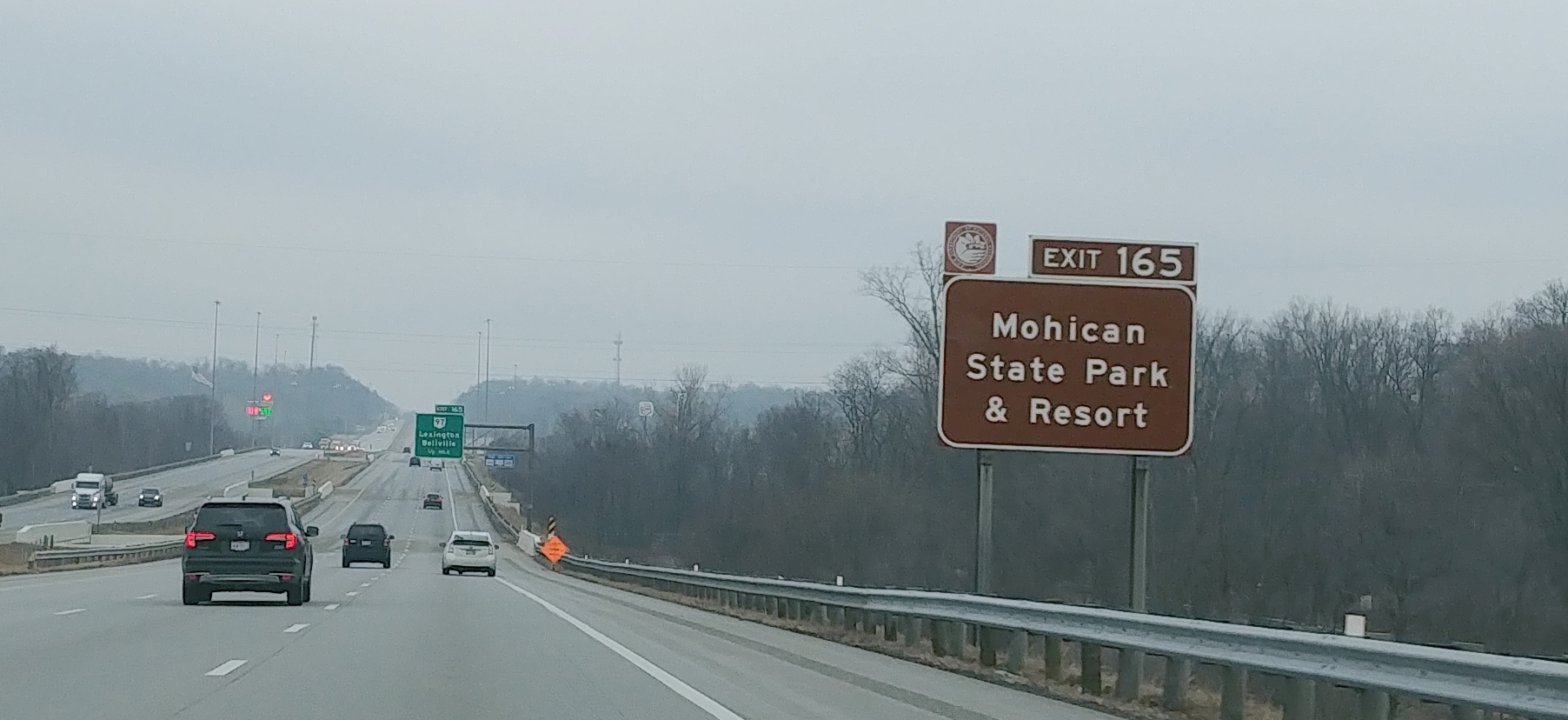
The highway to Mohican hurtles north, where the richness of game roasting over Delaware fires once lingered. As the Erie tribes of this area were scattered and wiped out by Iroquois sweeping down from New York, the Delaware migrated in along the Clear Fork, paying rental tribute to the Six Tribes.
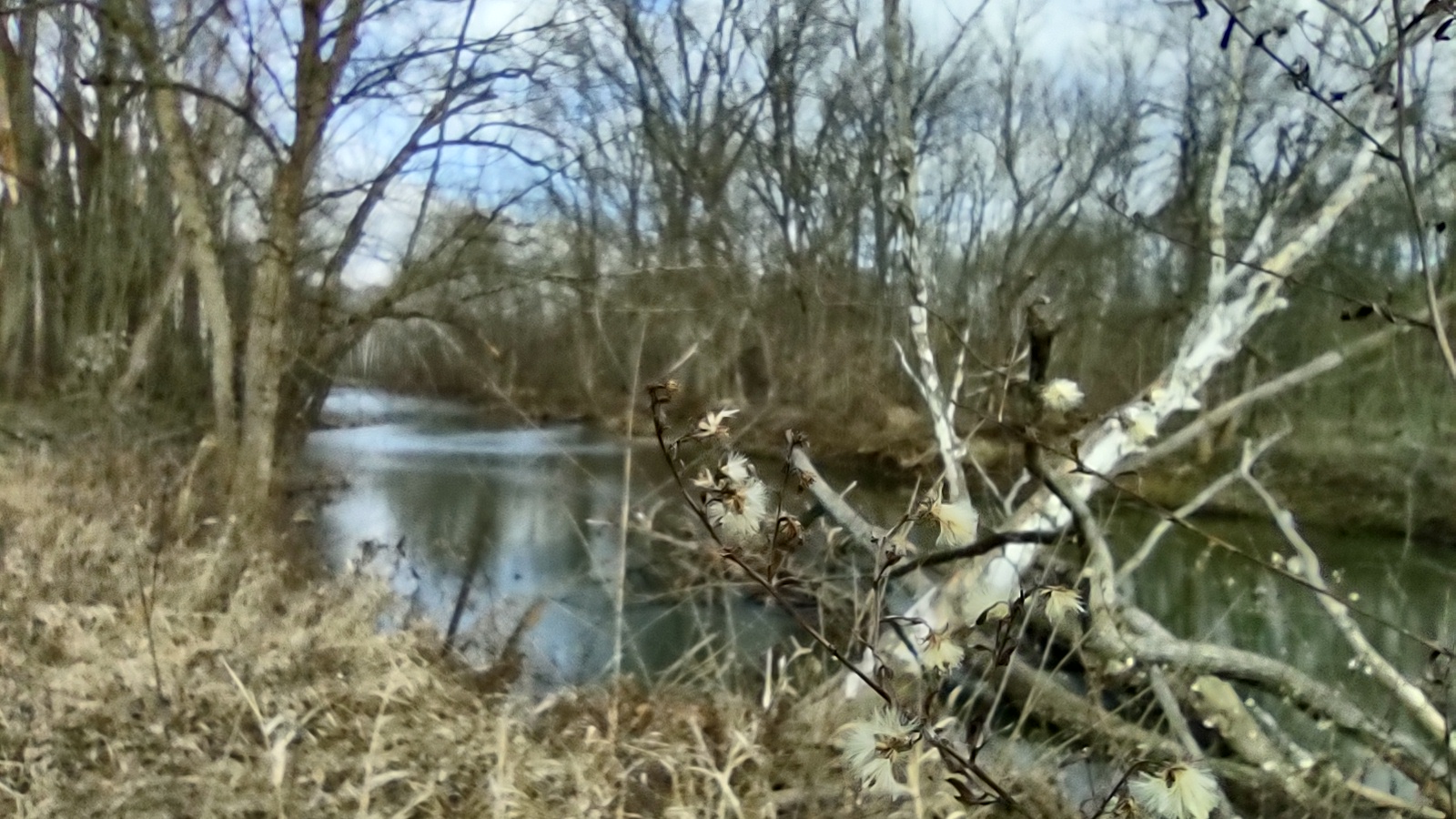
Crossing our path, the Clear Fork River mirrors shadowy, willow bark canoes, slipping across 300 years.
As post-War-of-1812 treaties kicked in, the Delawares moved northwest, in the headwinds of a settler hurricane. Johnny Appleseed came with them, if you happen to find an unexpected apple tree in the woods.
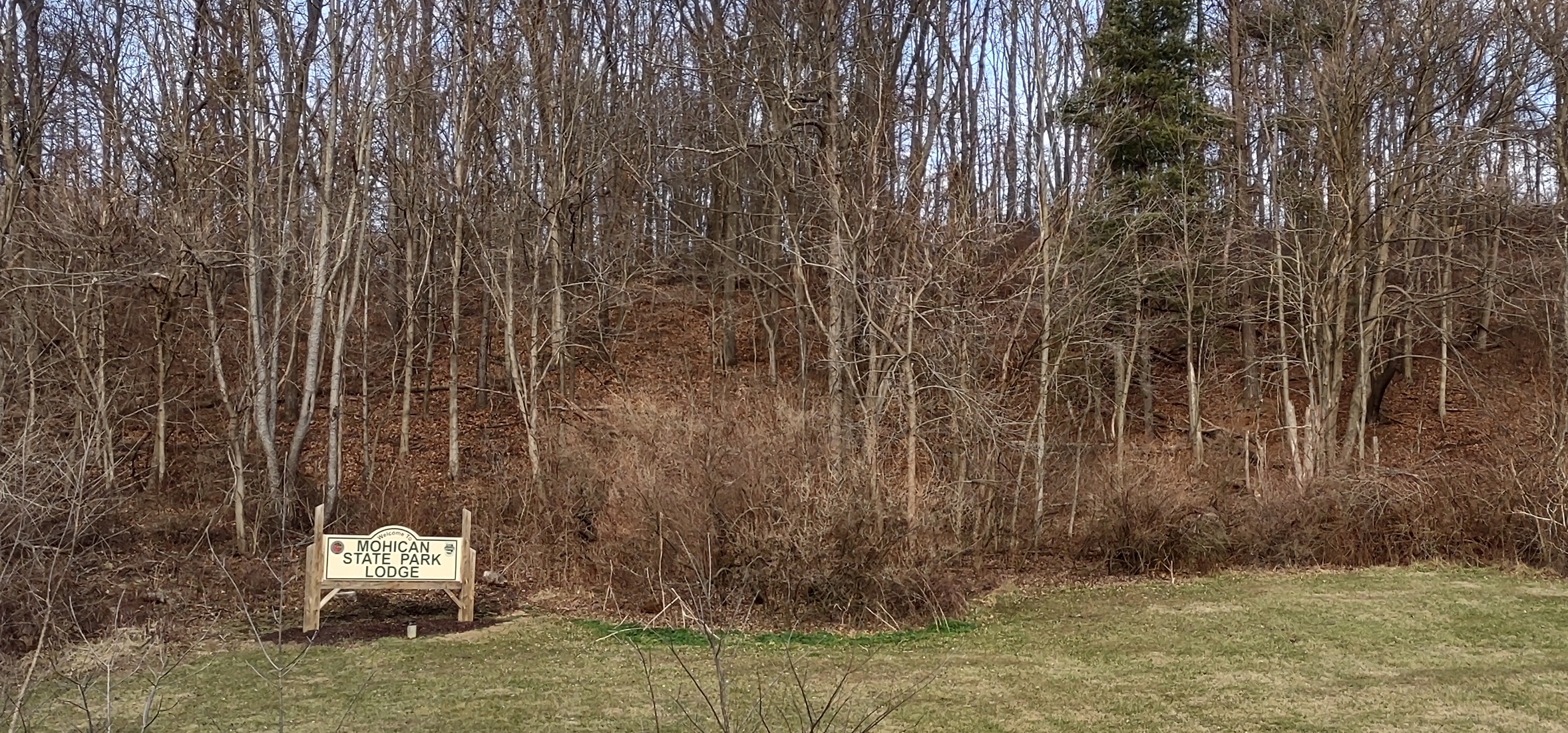
Now 70 years old, Mohican State Park shepherds acres and acres of maple, oak, tulip, hemlock, beech, ash, sycamore, willow, buckeye, hawthorn, and dogwood trees, as they scatter from the ridges, down the slopes, and through the bottomland, quietly doing what trees do.
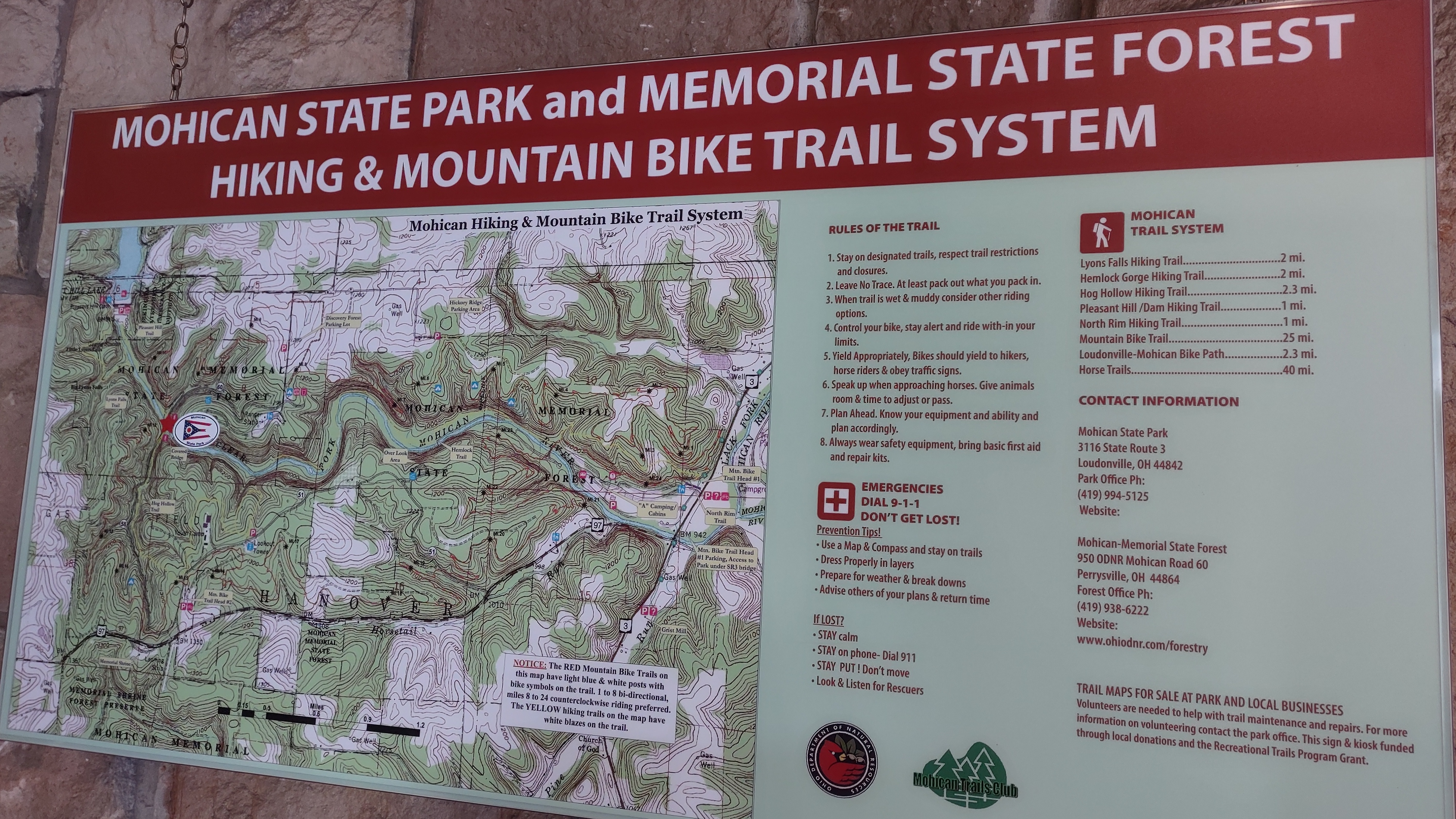
With a balance as finely tuned as a hummingbird, forest rangers manage human and forest interactions, offering freedom, beauty, refuge, and play, with nothing to plug in except wildness, opportunity, and adventure. Did we just define geocaching?
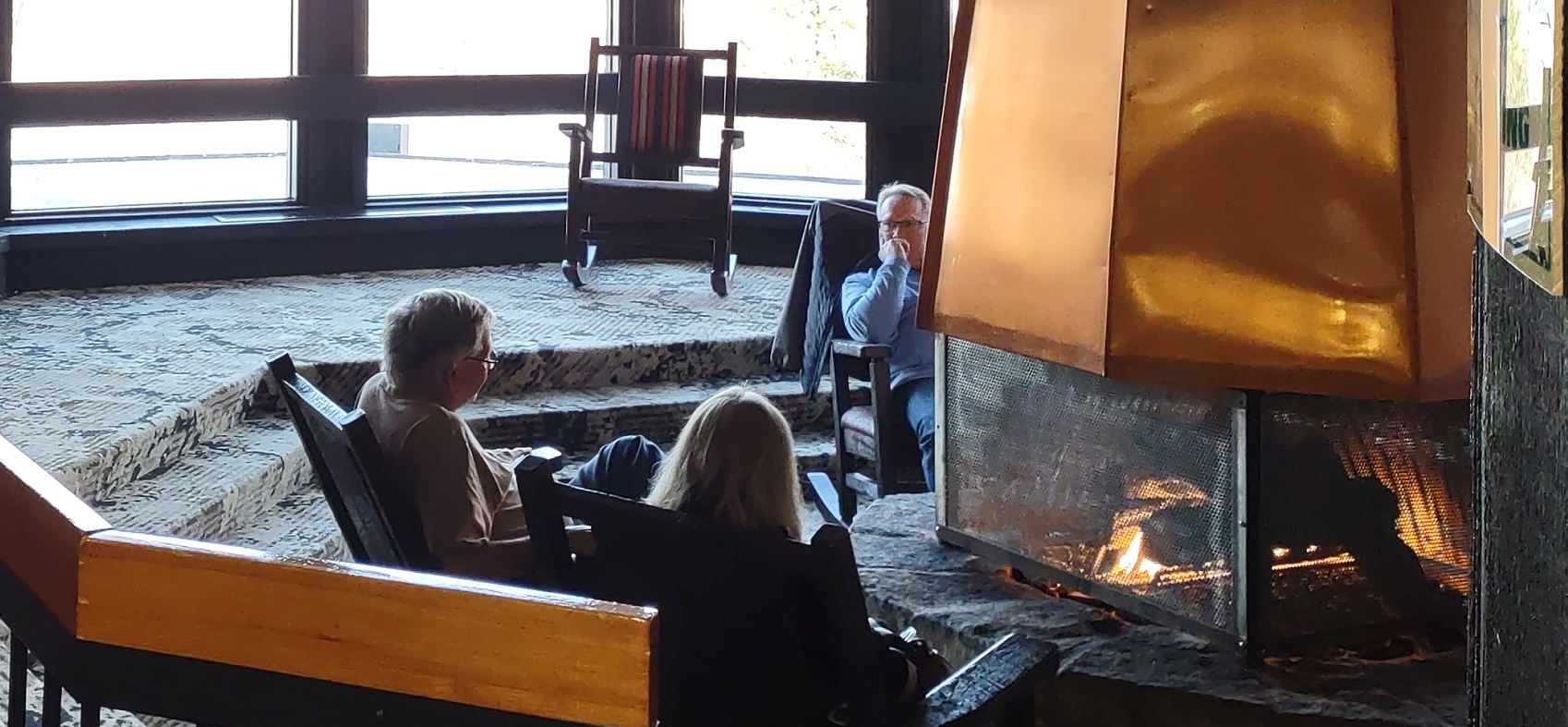
Past finders sign the log with affectionate stories of anniversaries, birthdays, weddings, reunions, and friend-meets at the Lodge. If someone wants to correlate geocaching with happy people, that’s okay with us.
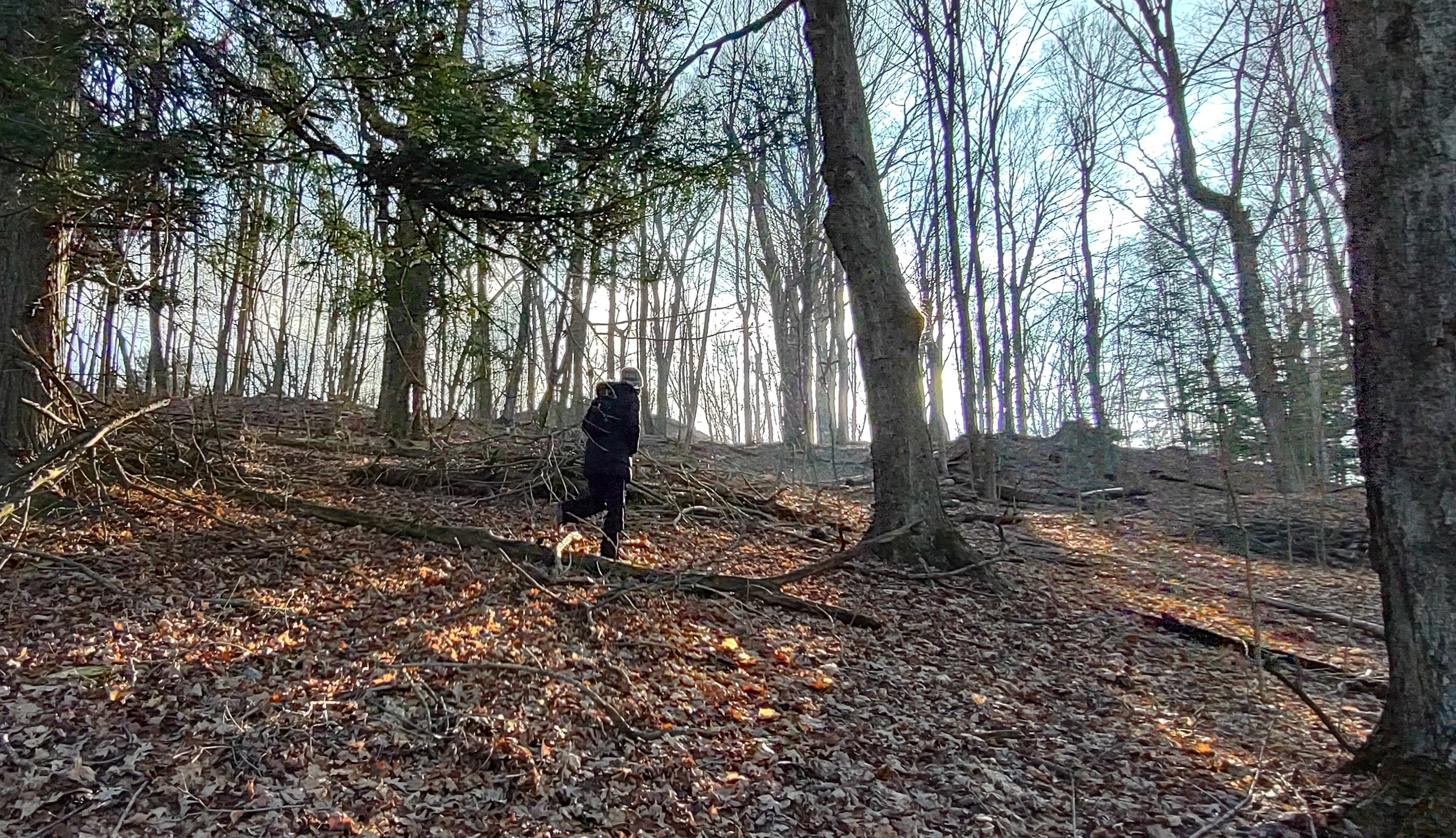
Our hunt launches, as coordinates compel. Slowly sinking sun sends wordless warning.
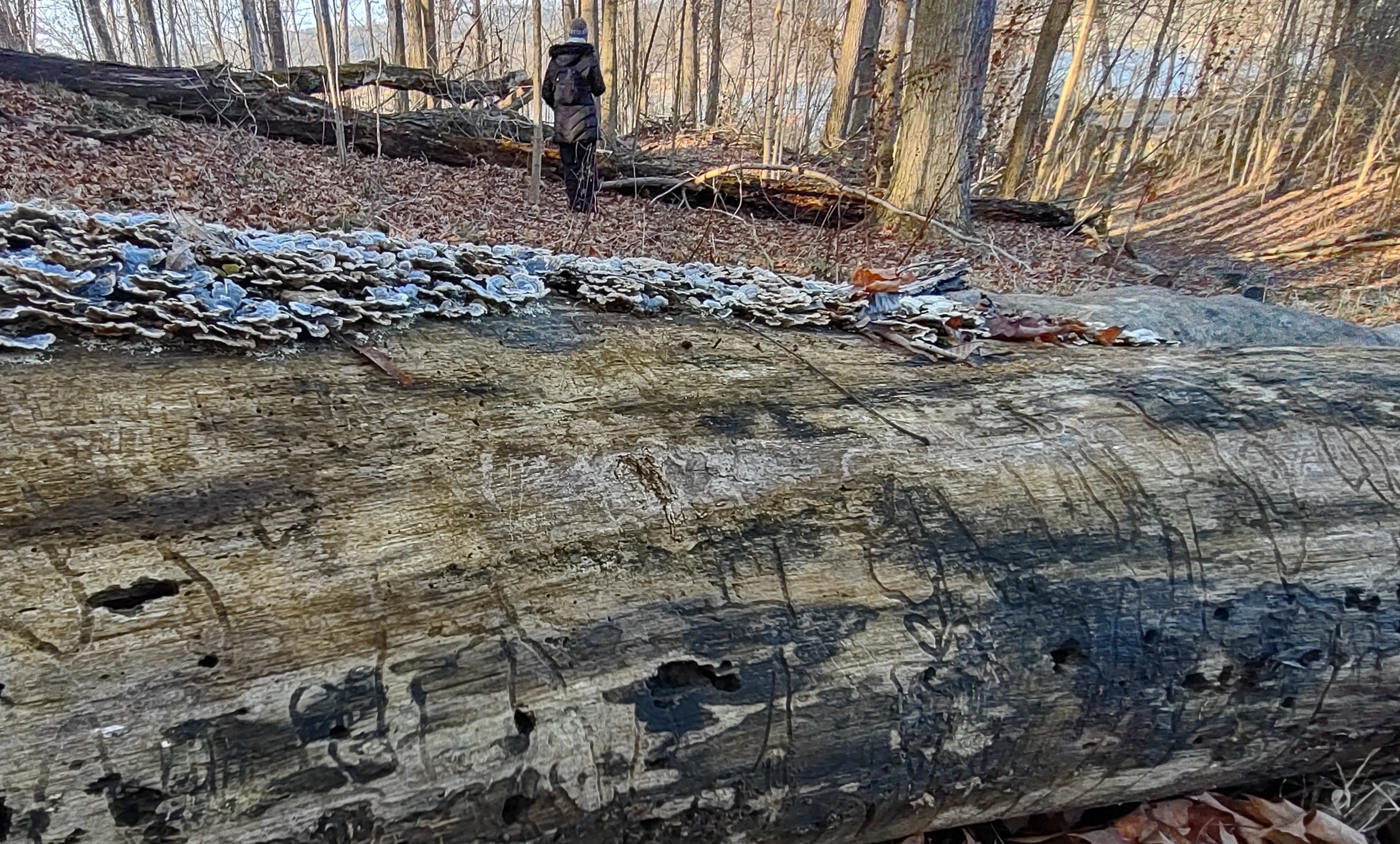
Small creatures leave grafitti, or, 4,000 years earlier, hieroglyphics. Blue shelf fungi astonishes with dancing swirl of design. Crystal lake adds to the symphony.
There’s something odd about finding a roaster kettle cover in the woods under a log. Something oddly satisfying.
We leave a trackable in return, that most sacred trust of Cache Nation. As the travel bug leaves each cache, visits with the finder for awhile, hitches a ride, and finds a new cache to call home, perfect strangers connect, play, laugh, and retell the story.
-
Through the Woods to Switzer Creek We Go
Placed by Cache Owner sugarbabies12 six years ago, a woods-and-creek cache promises to deliver.
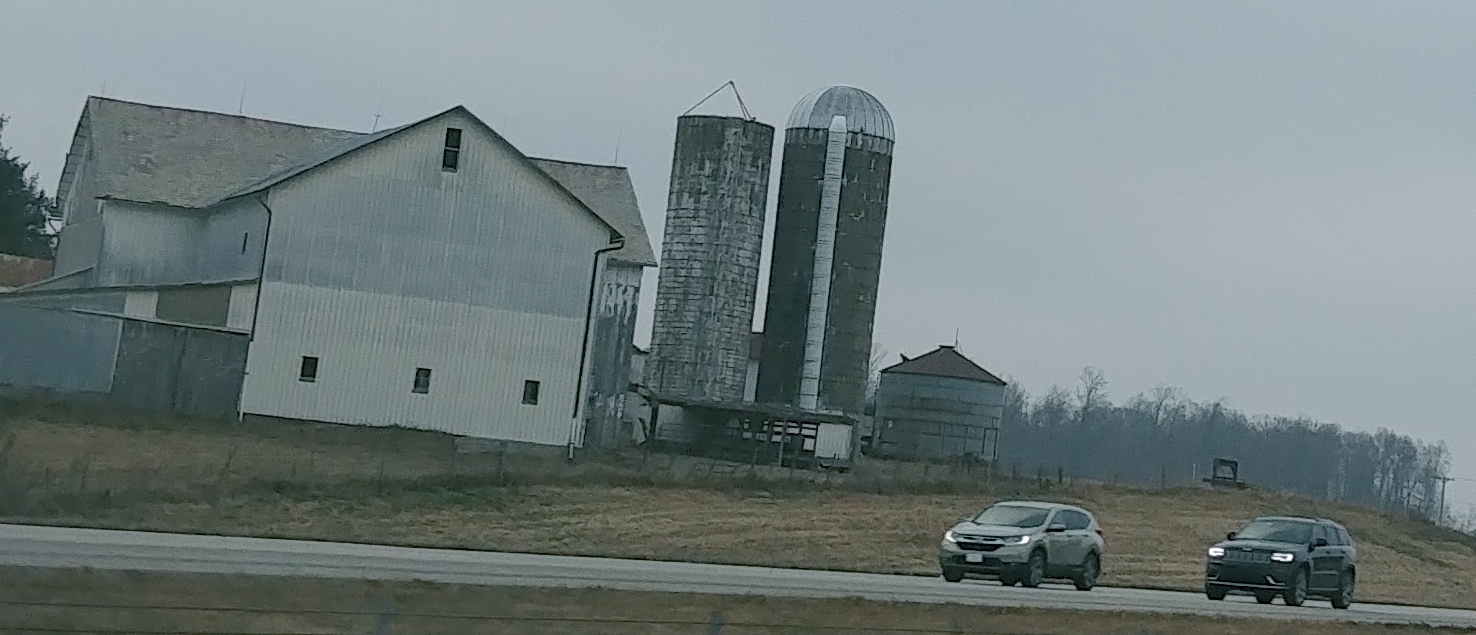
Winter’s coat is cold and cloudy. Rising beside our northbound freeway, aging silos do not let us forget from whom and where good food comes.
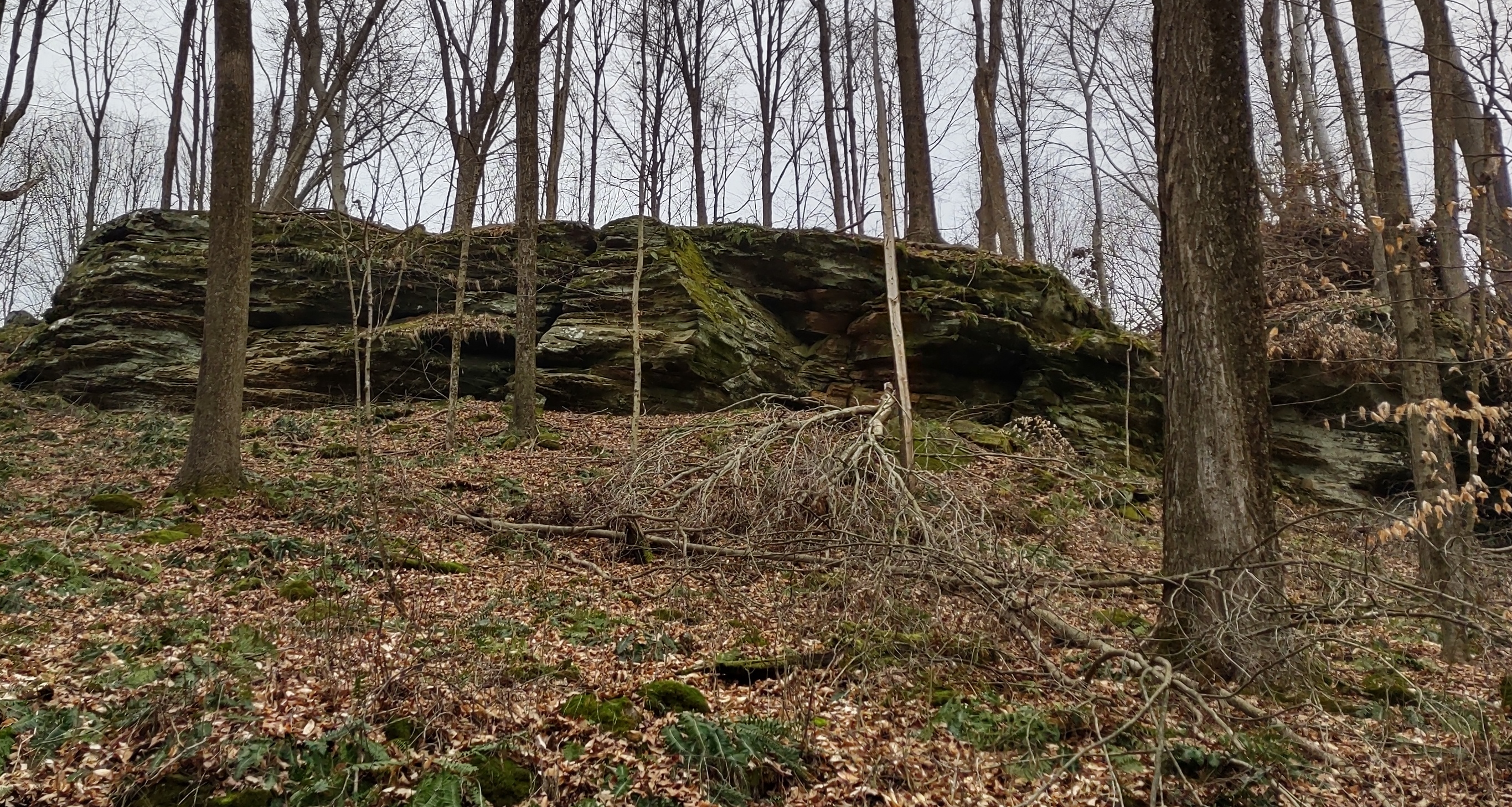
Bubbling forth in majestic rocks and rills, Mohican country leads east.
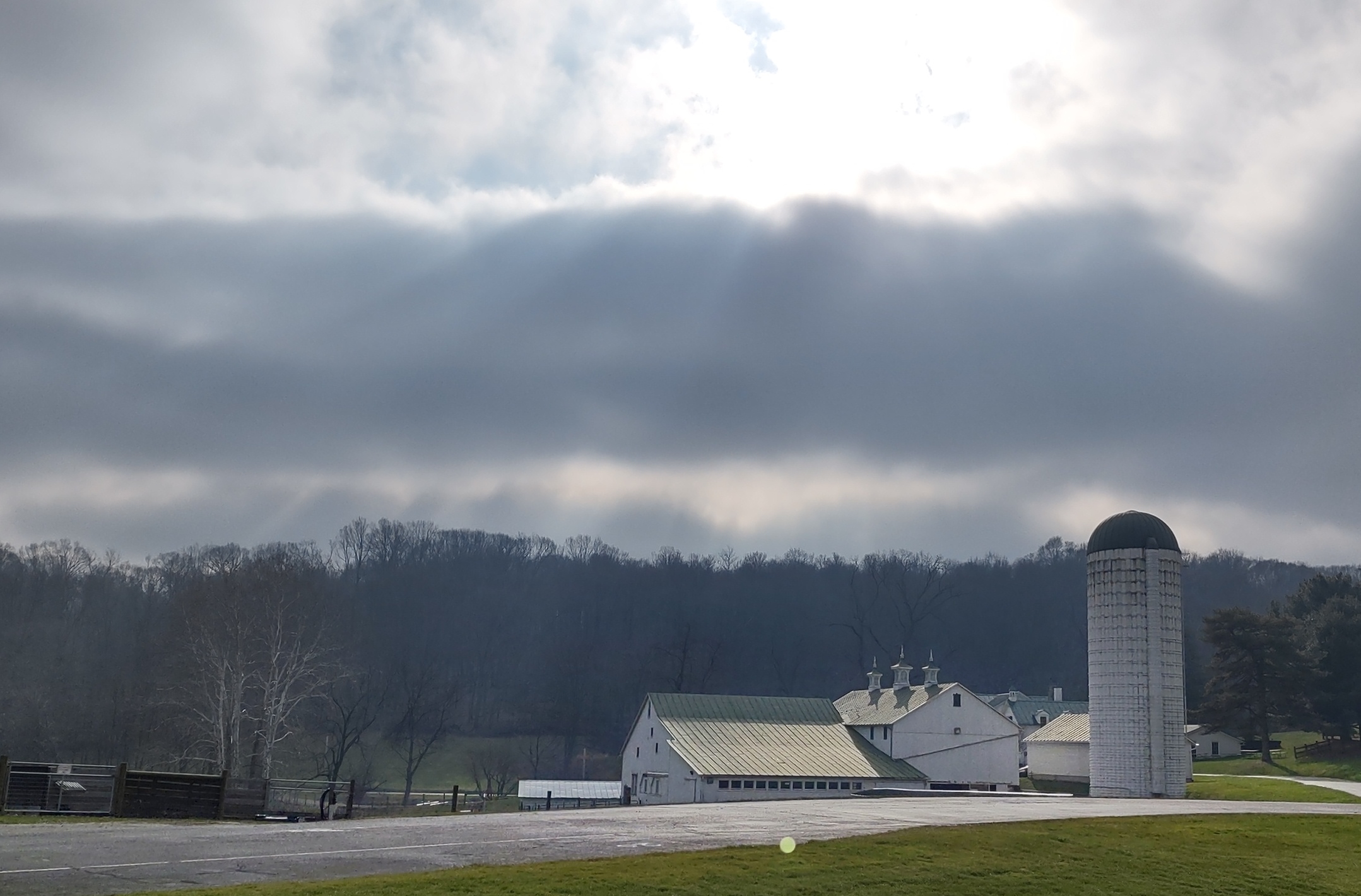
Our geodetour winds through Malabar Farm State Park, where Louis Bromfield morphs from carefully scripted novelist to gritty, weather-beaten Ohio farmer.
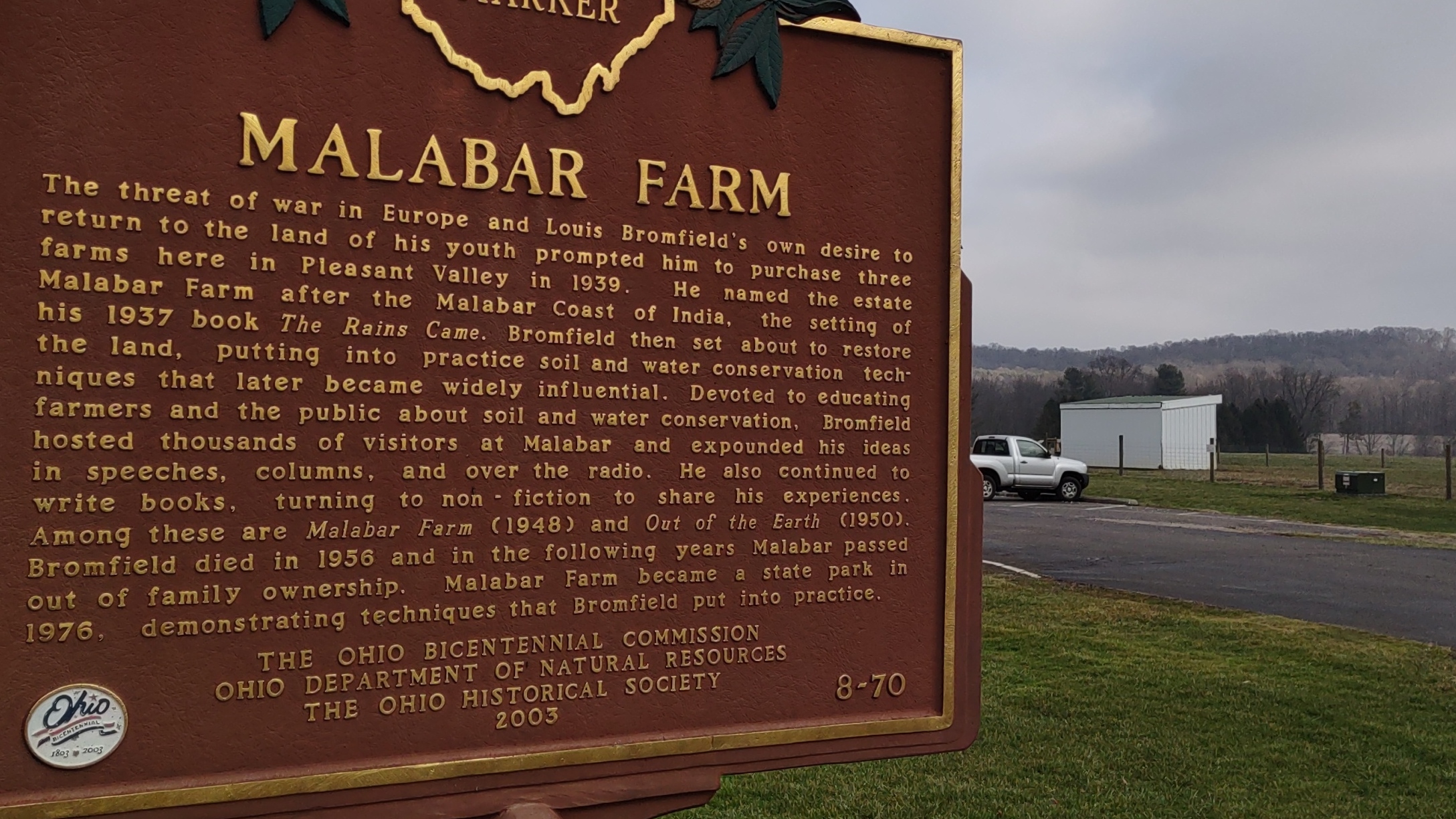
After driving ambulance through flying bullets in WWI, living the Paris life for ten years, and studying small farming methods in India, Louis finds his roots are still deep in the soil of the land, values, and culture of his childhood. The hills of the Mohican Valley call him home.
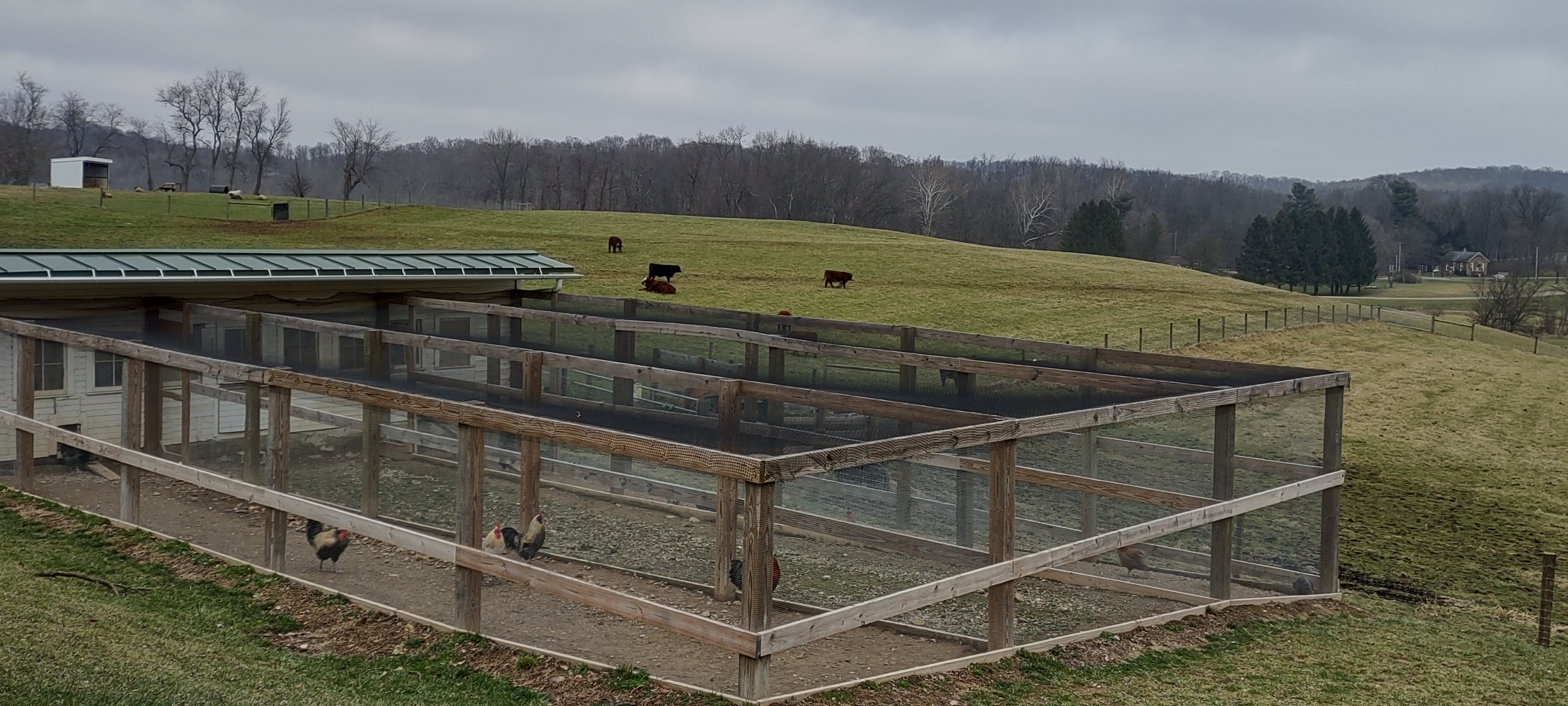
Determined to convince his farming neighbors to shepherd rather than starve their soil, he demonstrates rotational grazing, cover cropping, and no-till planting to restore and regenerate land.
Twenty years after his death in 1956, his farm becomes an Ohio State Park.
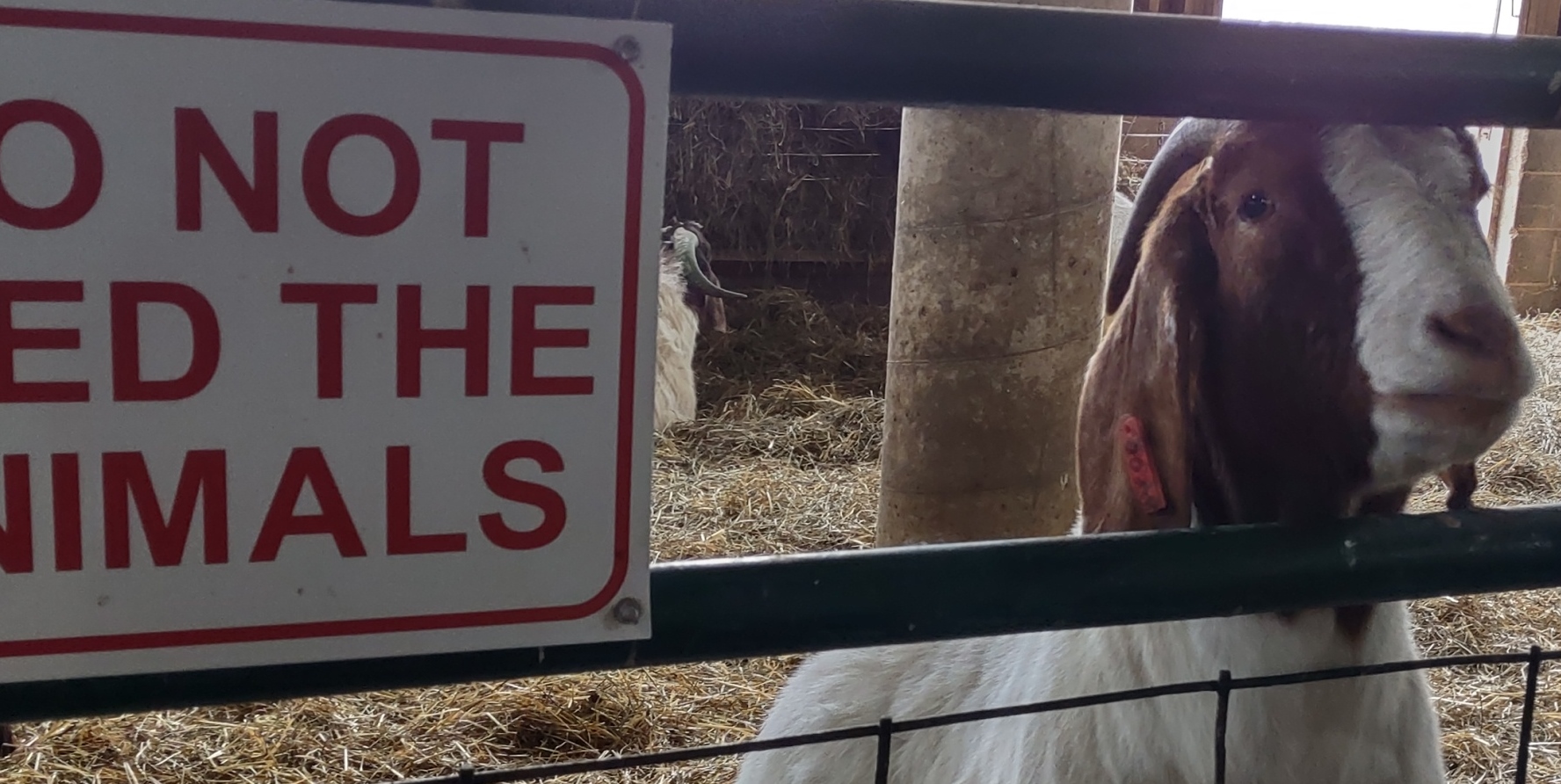
The house full of movie star memories, barn brimming with comradely critters, trails high in the rocky forest, waterfalls and caves created for small feet to explore, all shelter under the arm of state protectors.

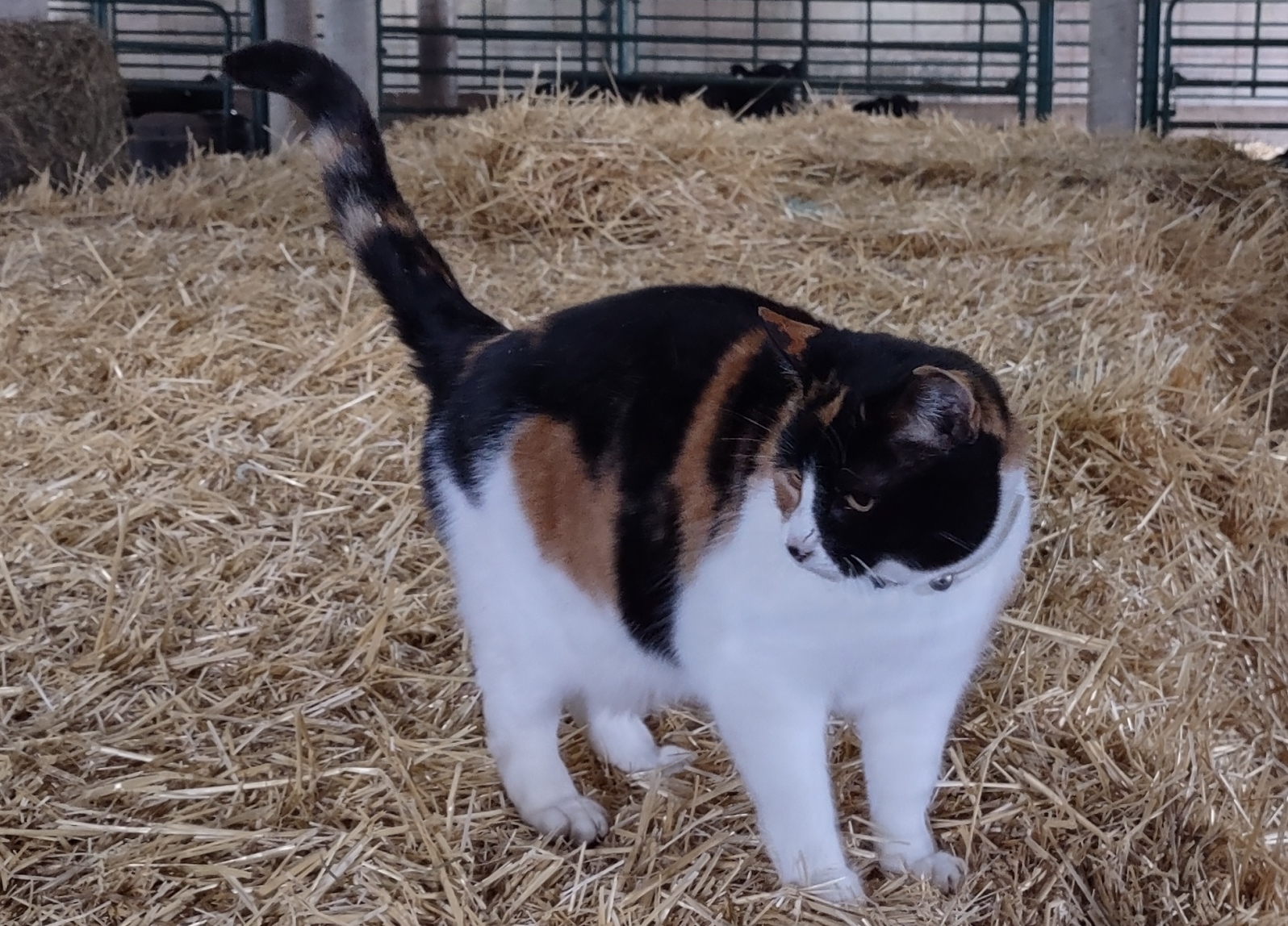
Children and adults wander, contemplating a reality not choreographed by content producers or web masters. Rumble of purring, brightness of hay, scent of nesting cows, warmth of inquisitive nose harmonize into one deep, long breath.
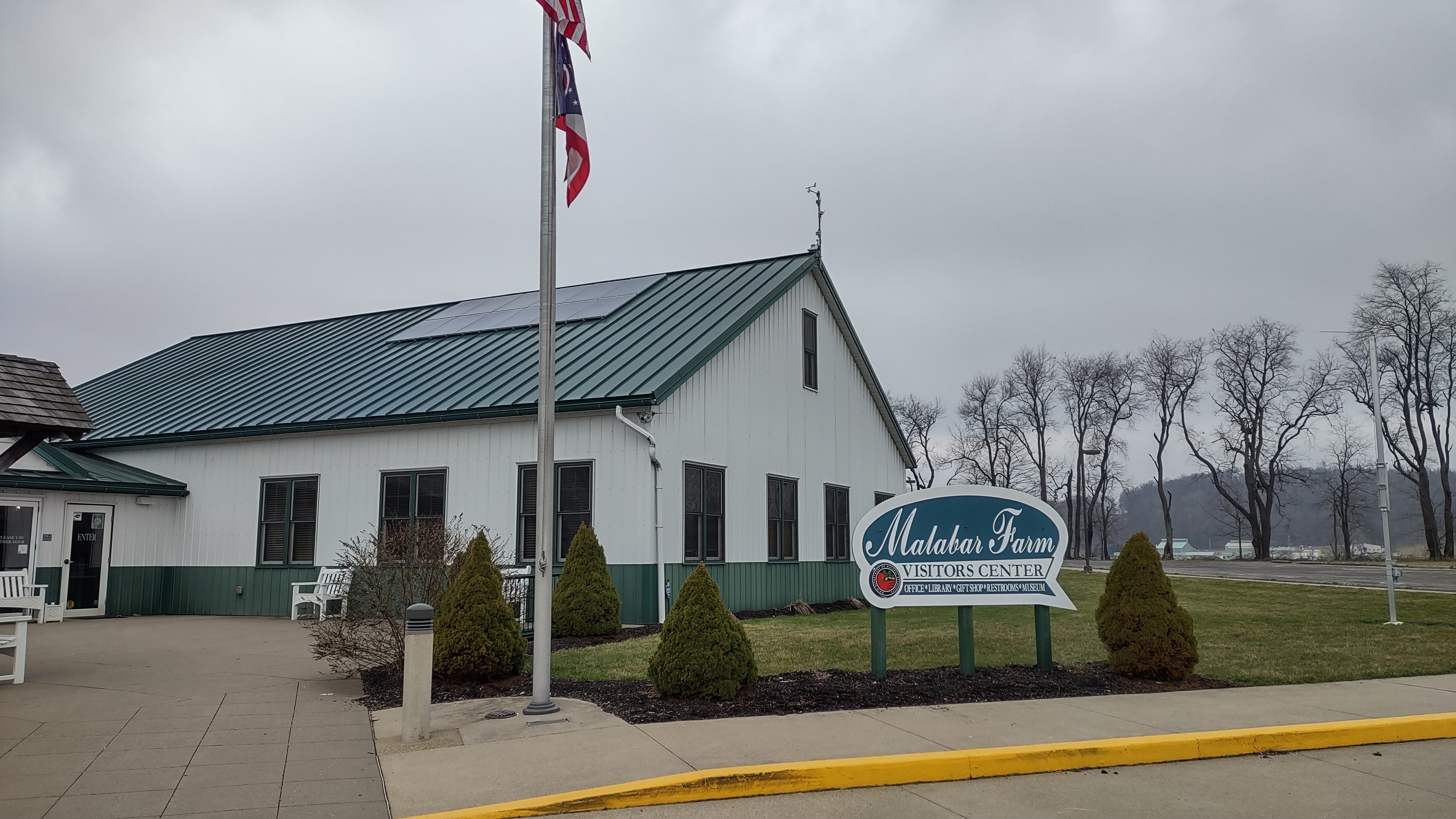
The Visitors Center combines a volunteer foundation with state park management, in serendipitous weaving of local and state. The third generation of stewards on this land did not forget Louis when they designed his visitor center. The concrete foundation is built using fly ash, a by-product of coal-fired power generation. Floors are made from rubber scraps recycled from commercial construction.

Forests are saved by using small lumber scraps glued together for main structural beams, instead of large single trees. Structural insulated panels are used instead of framing lumber. Reversing the mindset of pioneer farmers taming the land, park staff now apply collective genius to nourishing and guarding fragile ecosystems.

Inside the Visitor Center, Poncho presides. Going the way of all parrots, the old one finally died, and a much chattier one is now in charge. You will know if you are spending too much time not looking at him.
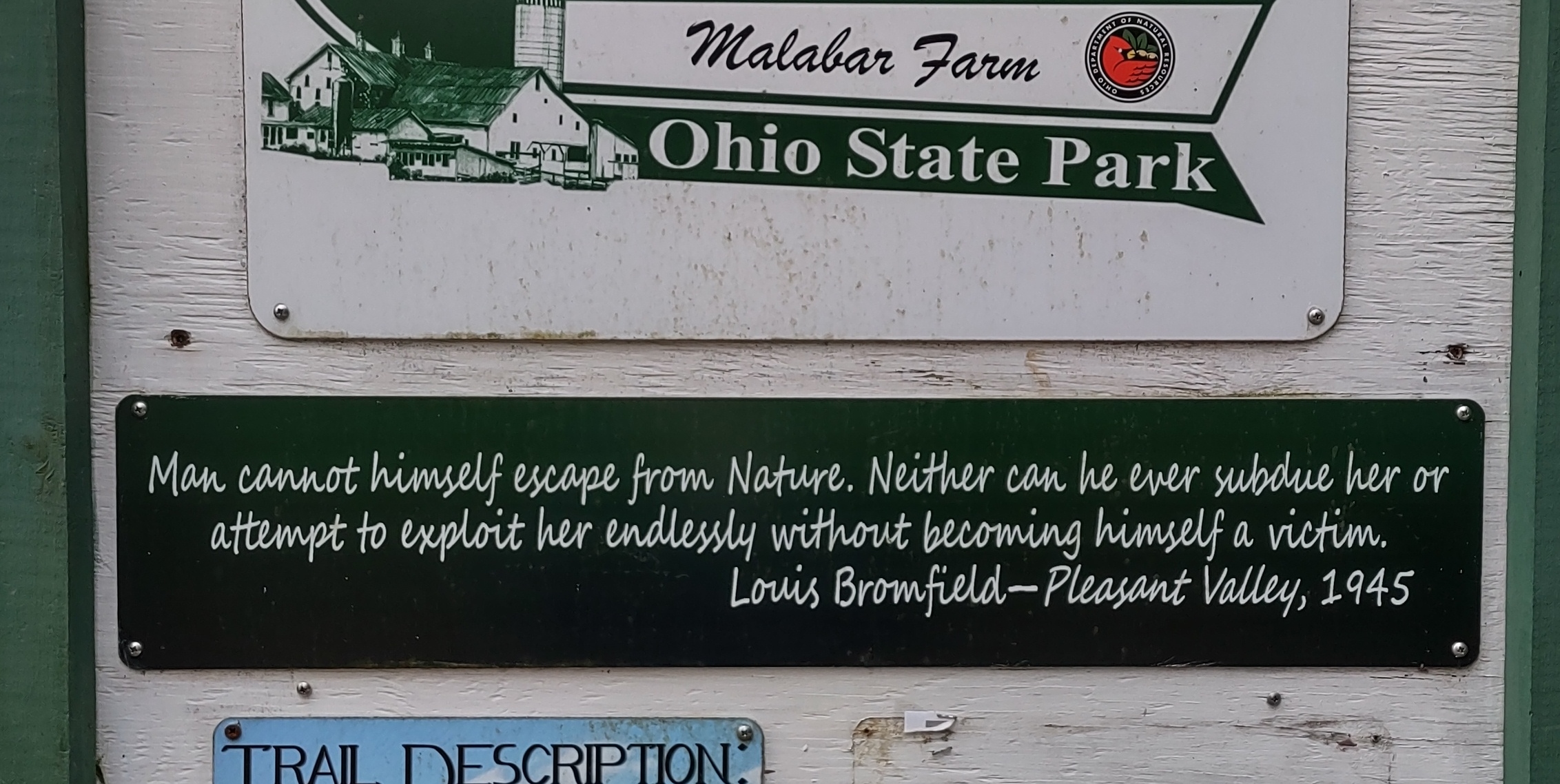
Louis does not let us leave without an admonition, or is it a premonition?
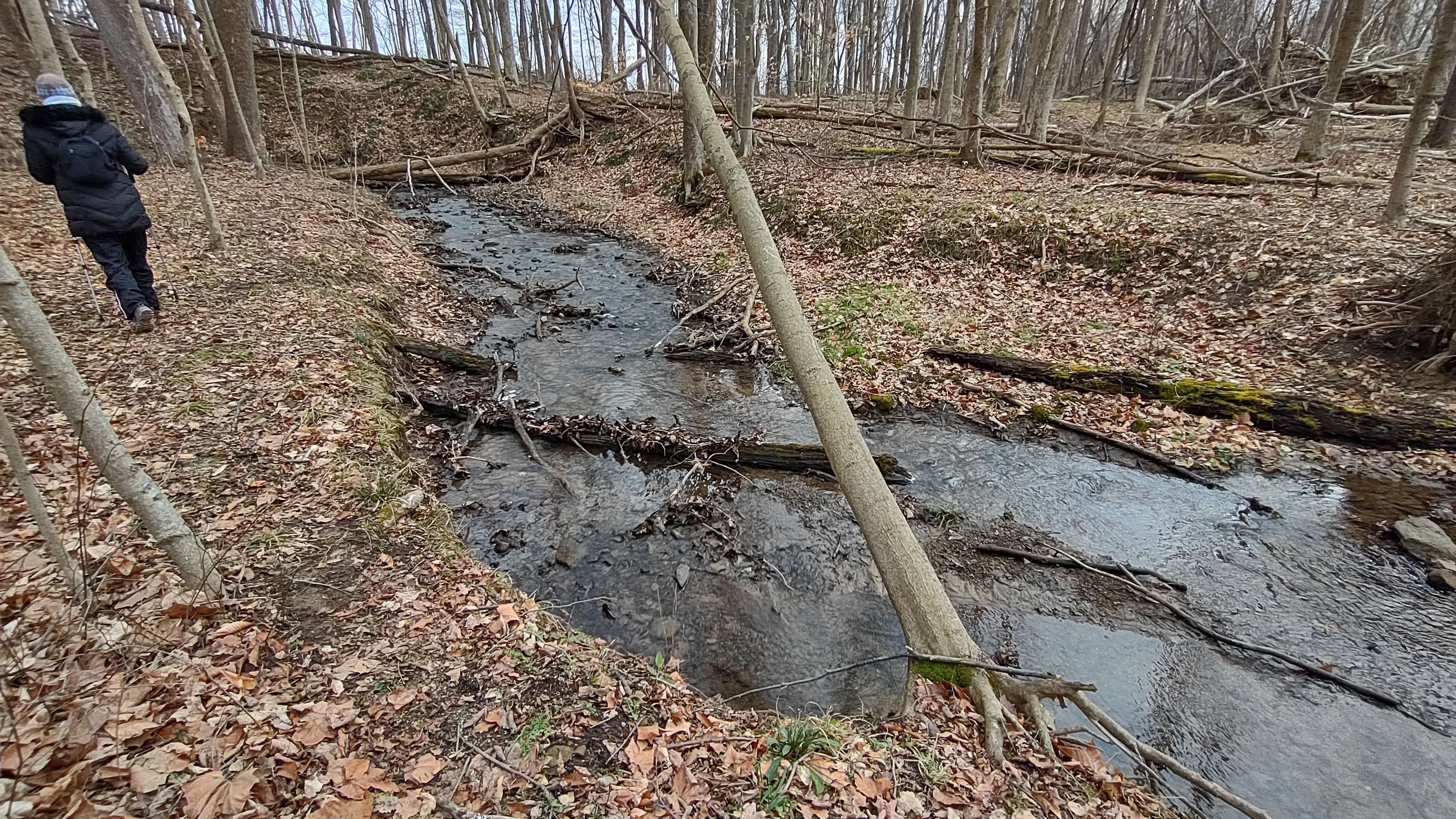
We will follow Switzer Creek south as it journeys from the farm to Pleasant Hill Lake. Waypoints form a dot-to-dot maze playing tag with satellite signals beaming from space . . .
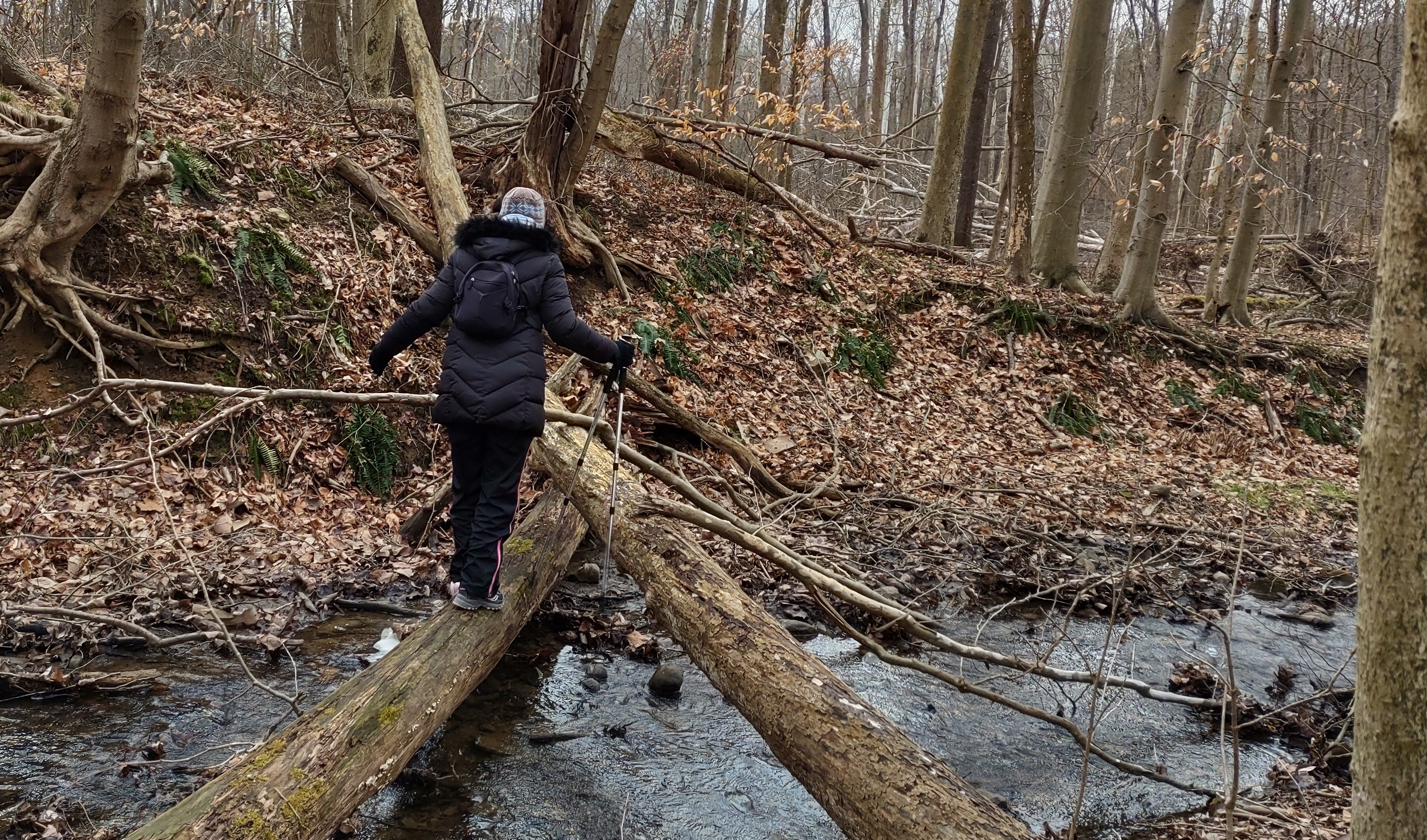
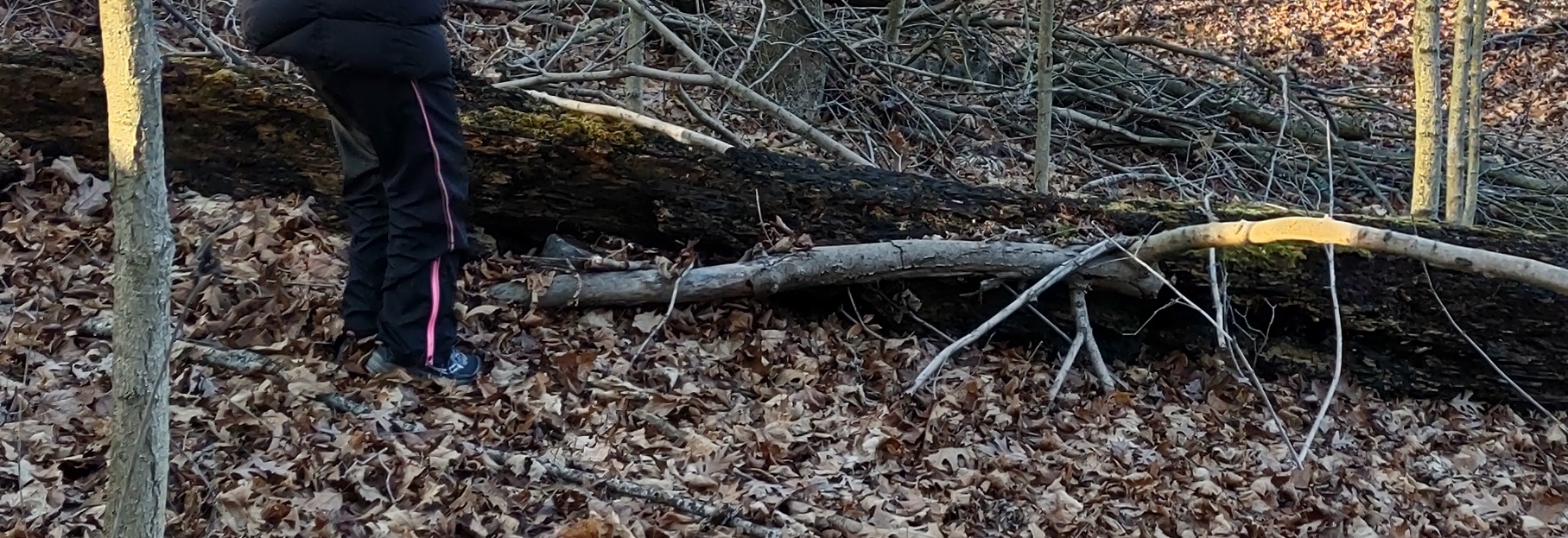
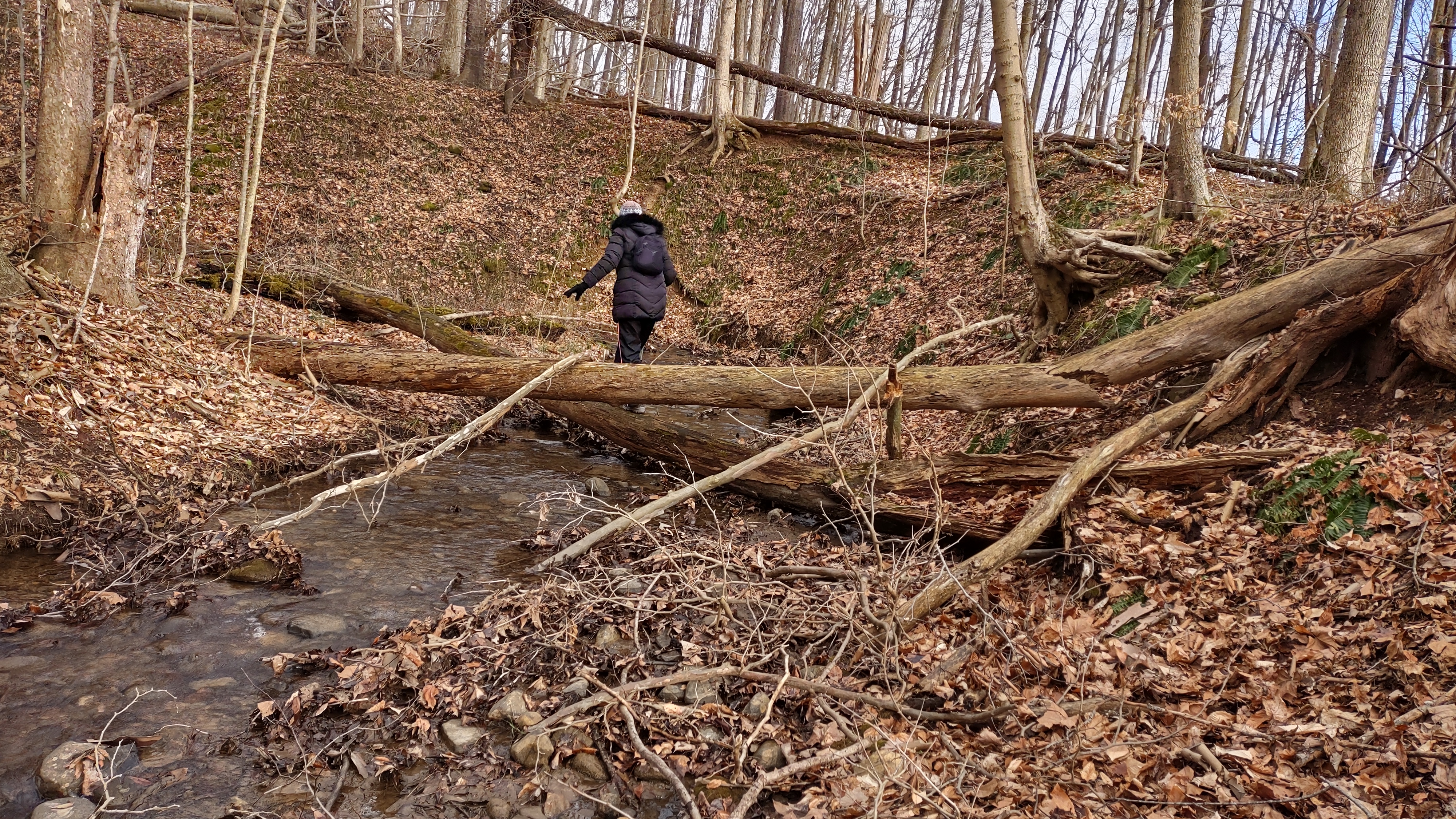
but the creek must be crossed to reach the next dot. Cold, cold water laps below, a fallen trunk escorts us, criss-crossed by tornado-flung barriers. Towering above, trees gaze and grin at the two-leggeds.
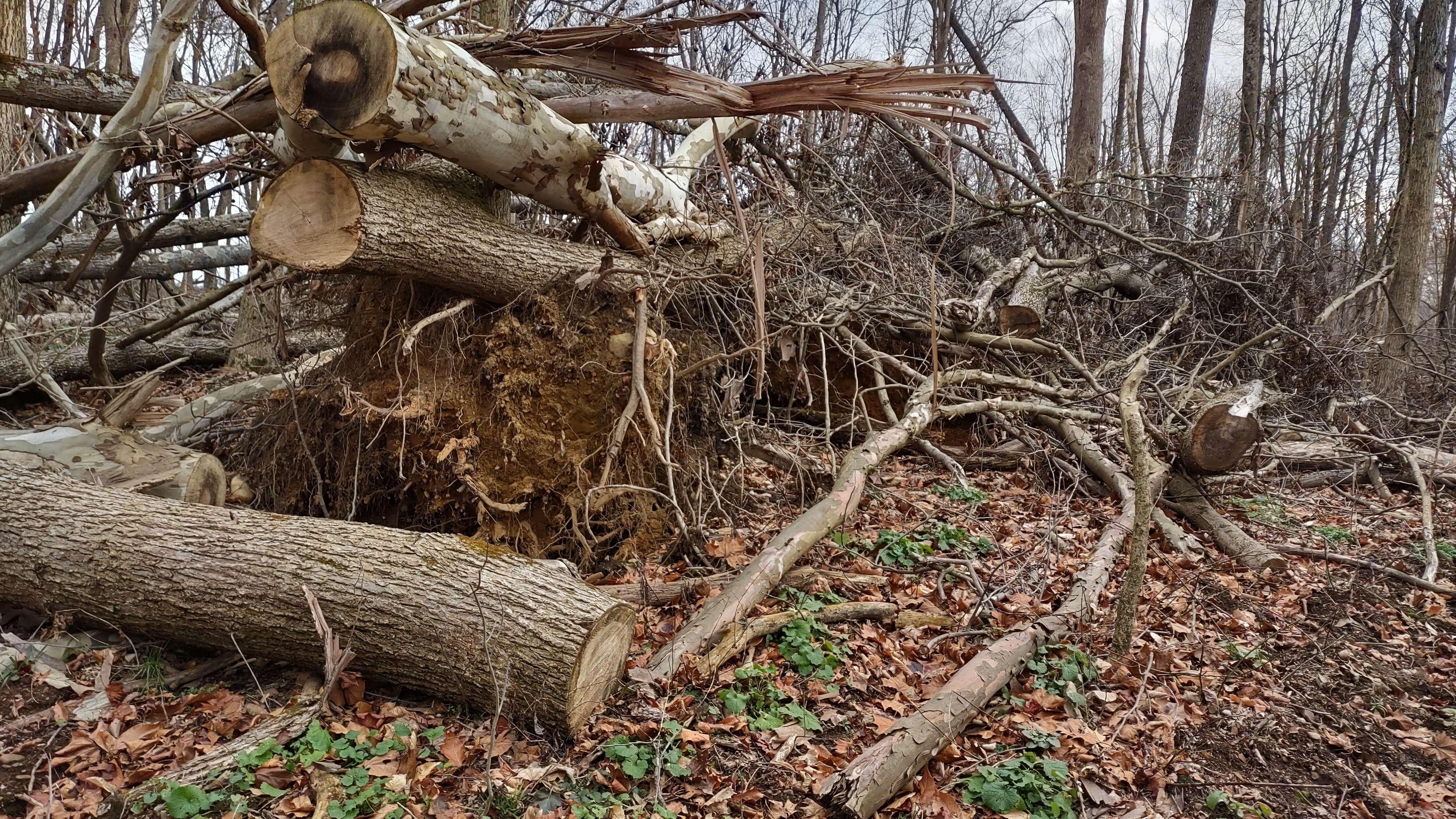
On the other side, unexpected ravage of forest rises.
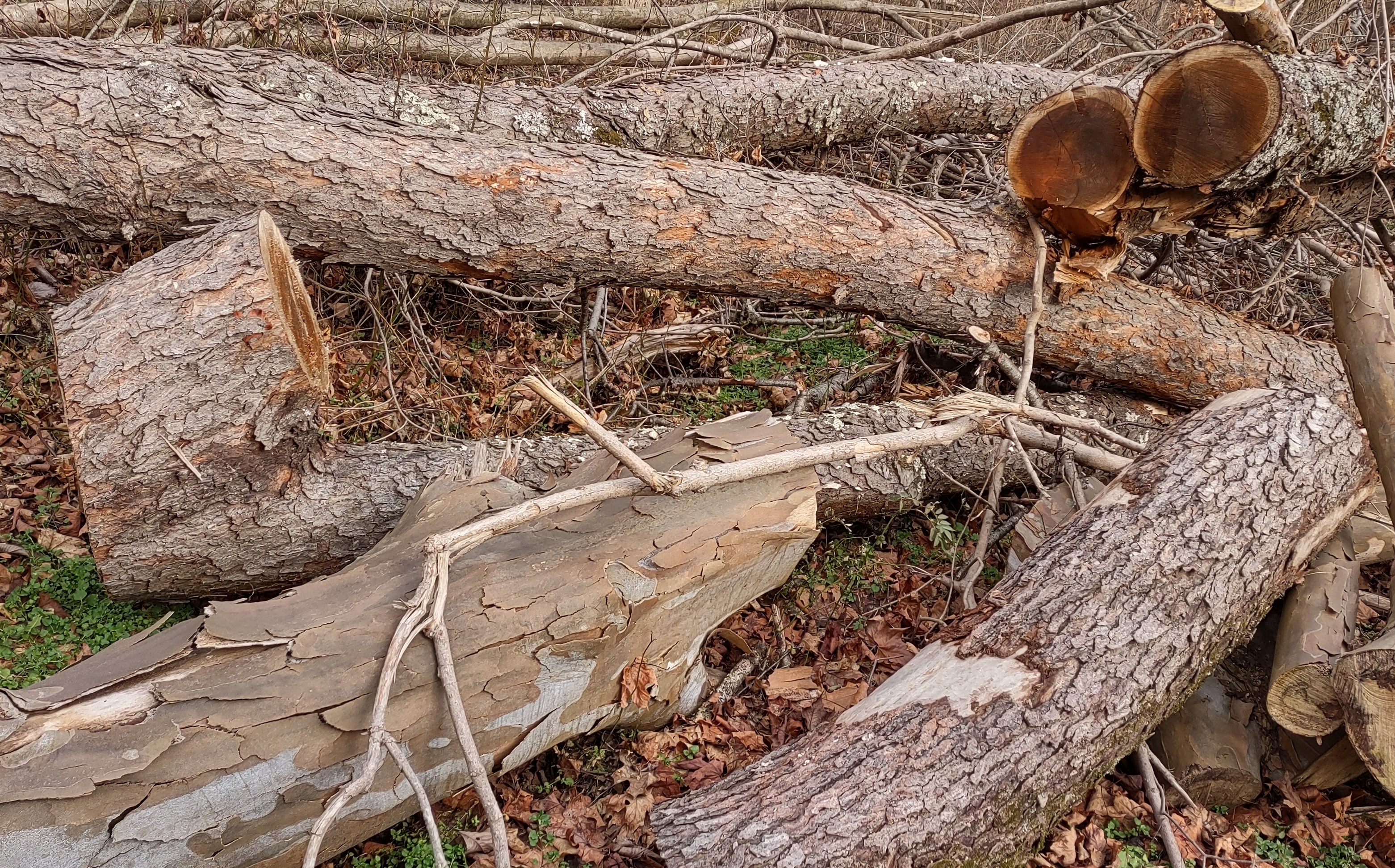
Battlefield graveyard sits silent over the departed.
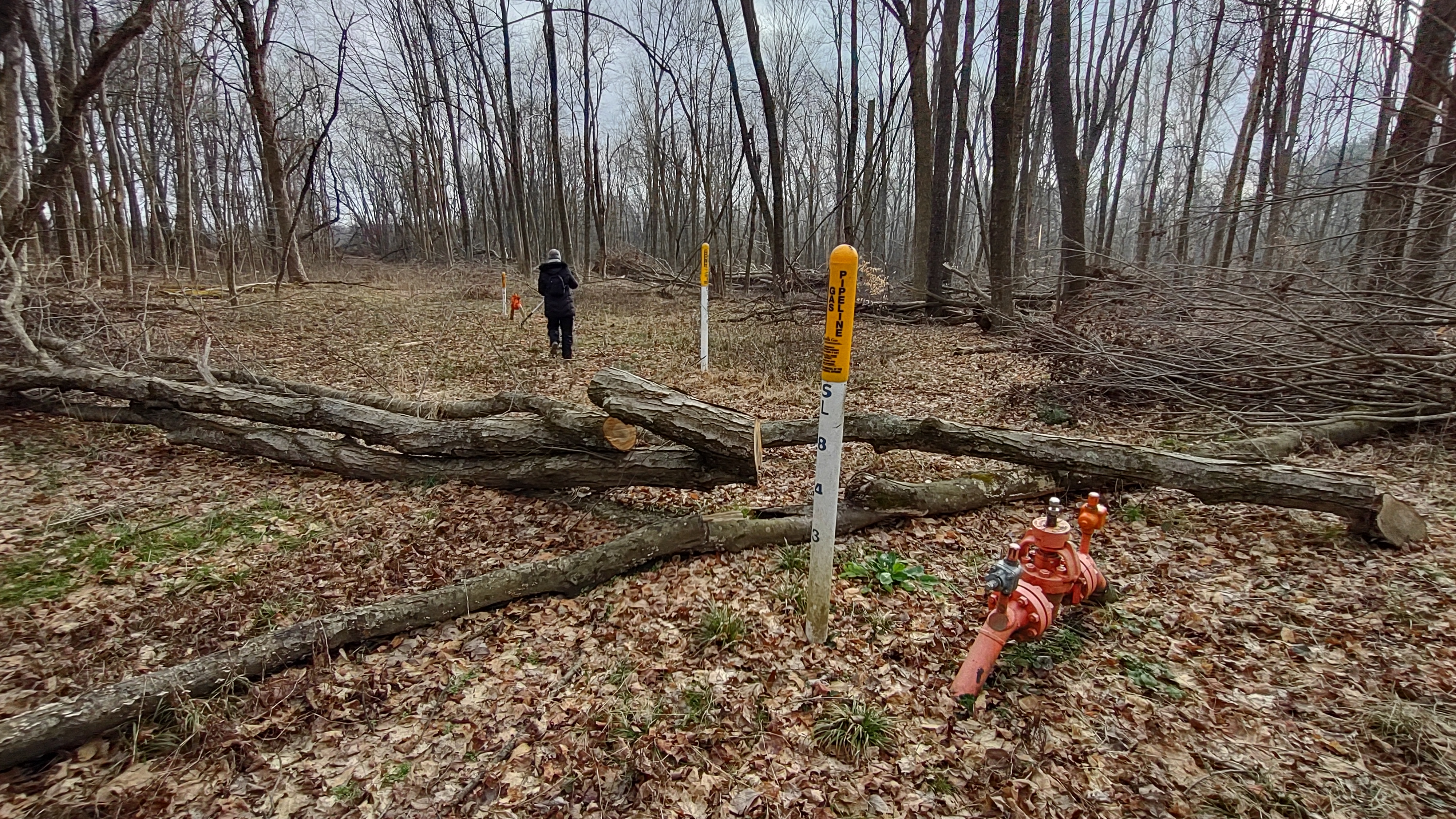
The mind stays on the hunt, while the soul studies messengers thrusting through the forest floor. As drilling and fracking blanket the eastern map of Ohio in red dots, fracturing deeprock shale formations to release natural gas and petroleum, township and county officials add up the payoff.
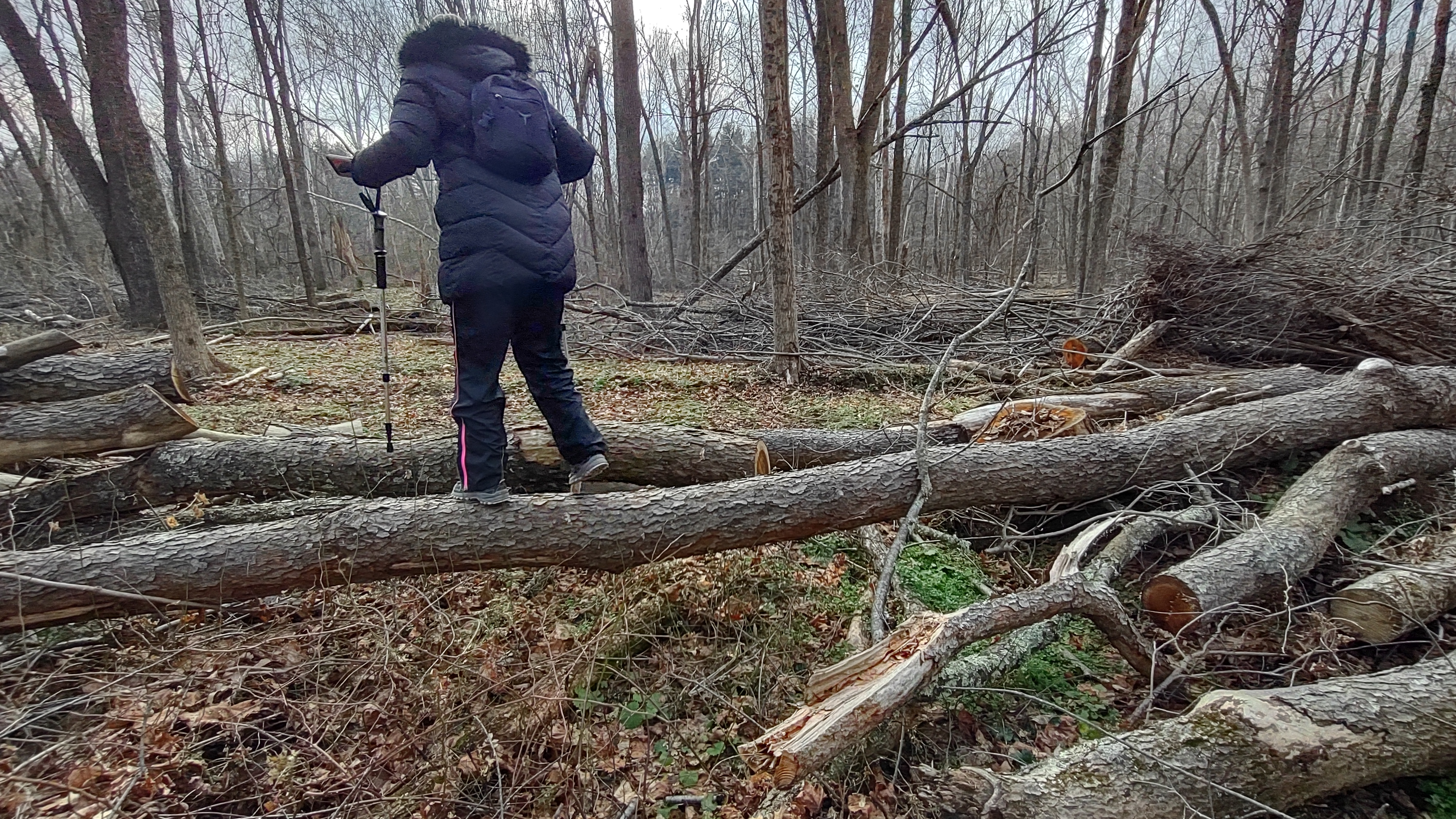
In an eerie recall of Wyandot and Shawnee villages watching forest hunting grounds topple over and die, rural residents and suburban homeowners recoil in horror as water contaminates with fracking waste and becomes undrinkable.
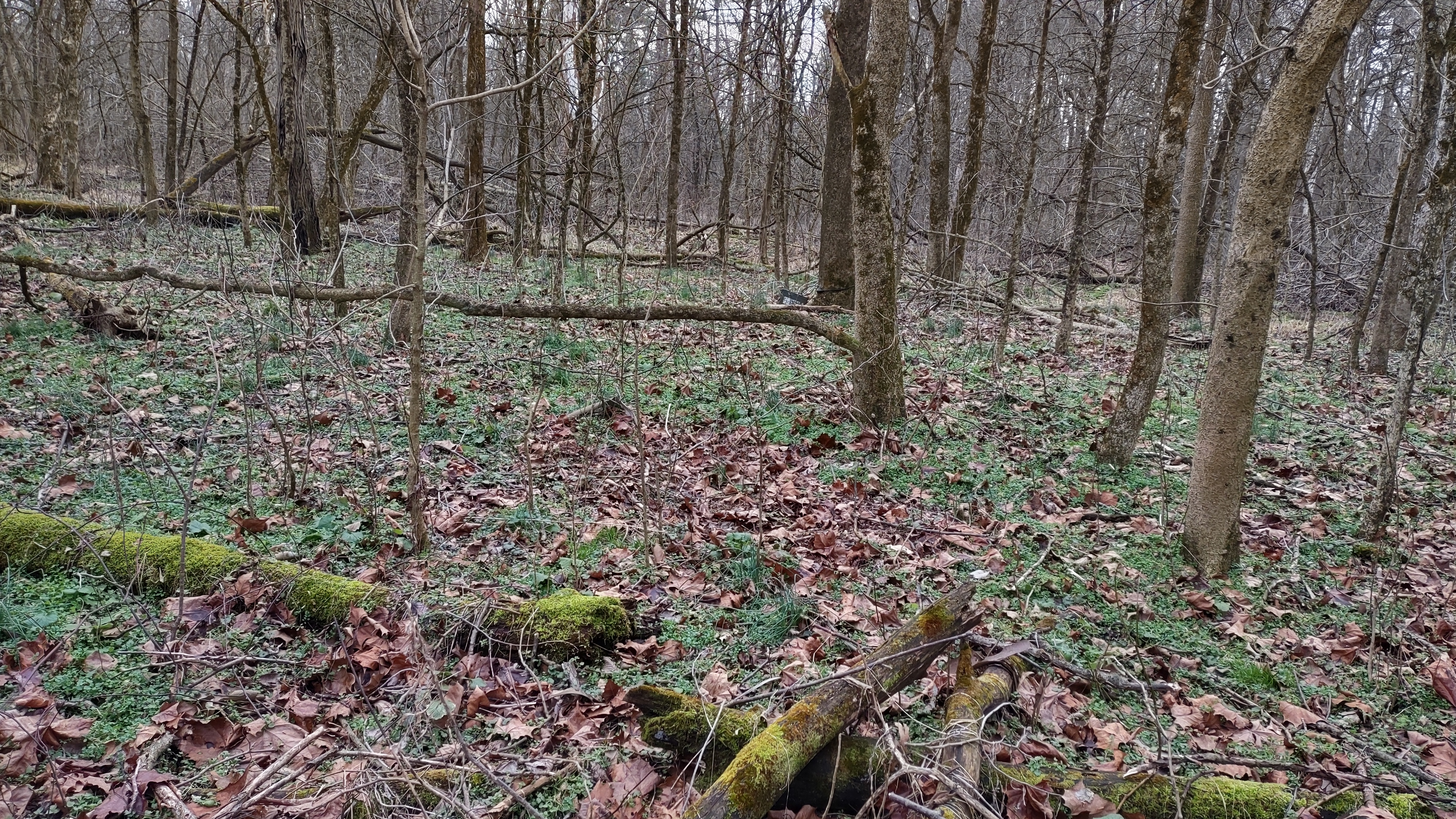
Across the trail, untouched woodland interlaces in wordless invitation. Moss, winter grass, and sleep-tousled leaves enfold, guarding a waiting prize.
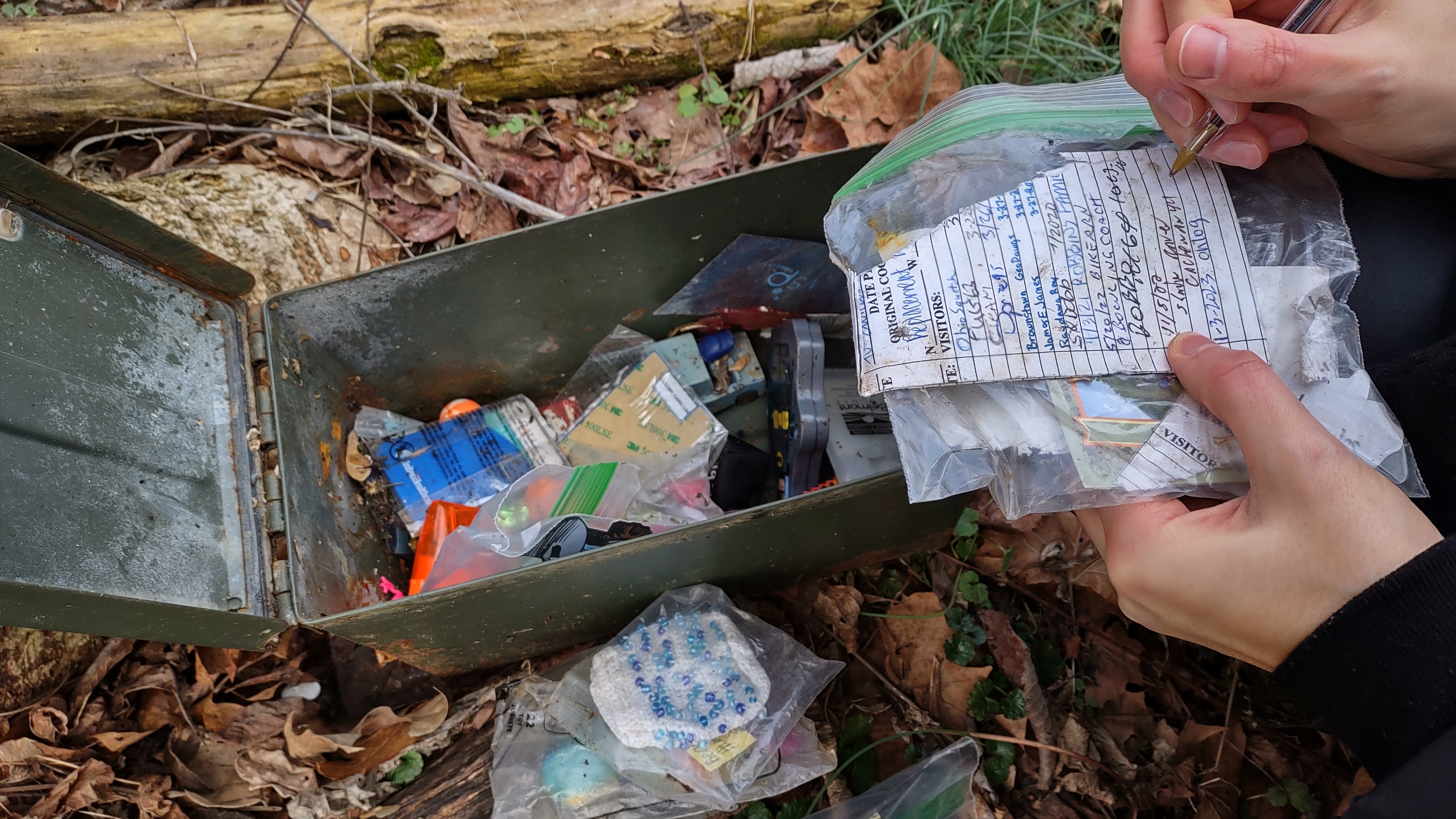
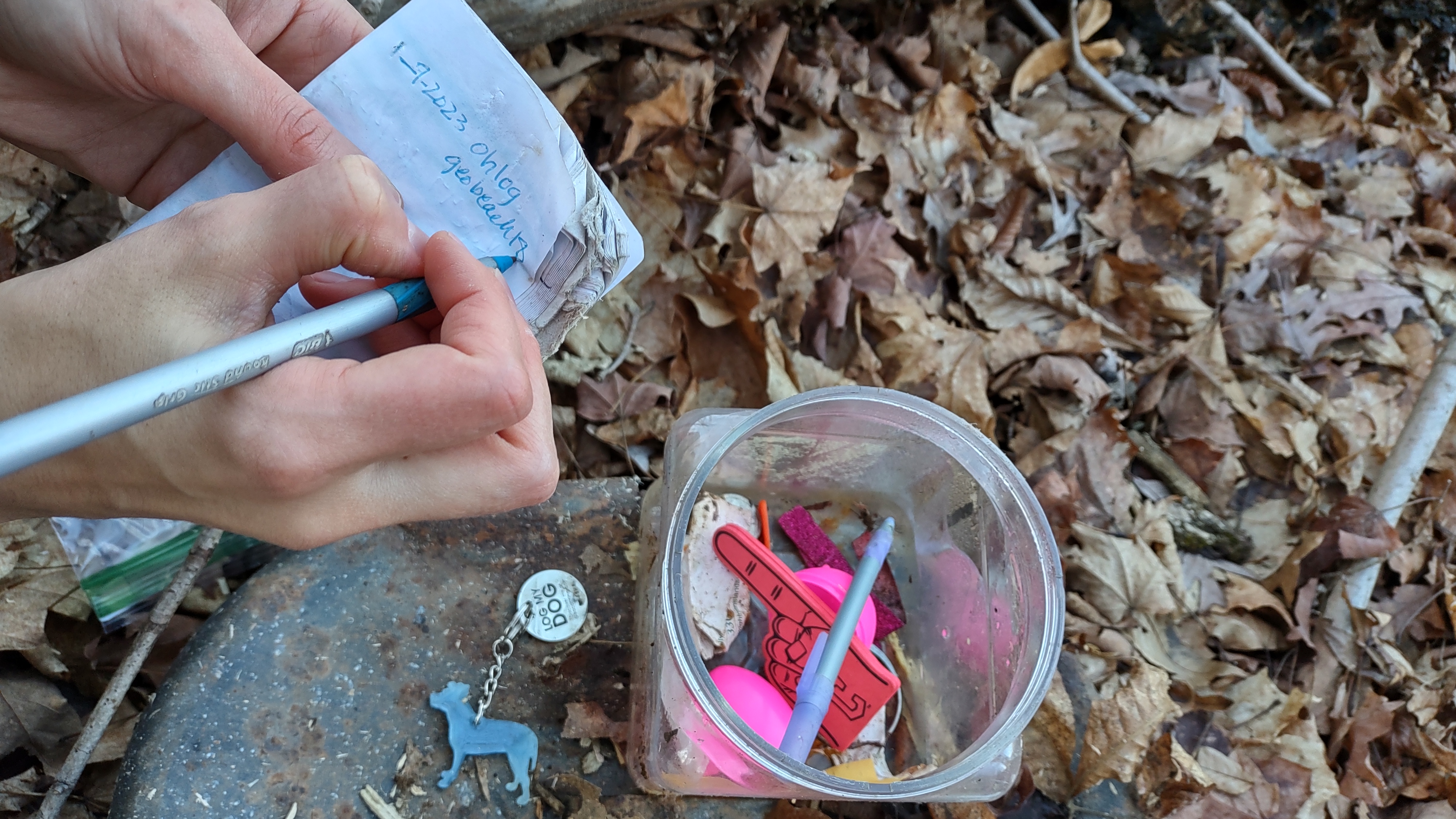
With those who have found before, we see, witness, and sign, touched by the deepening story of years behind this cache, and all such hidden treasures.
Held in the gentle palms of earth, sky, water, and wood, hearts recalibrate, hope restores, play returns.
-
Up Ferguson Way
Placed by Cache Owner Scook in 2002, twenty summers and winters have given this cache some stories to tell.
As we turn northbound, the city awakens, sparkling with droplets of humanity going about their brand new day. Short winter sunlight hides bashfully behind blankets of frozen air. The geomap slowly unfolds toward Malabar Farm State Park.
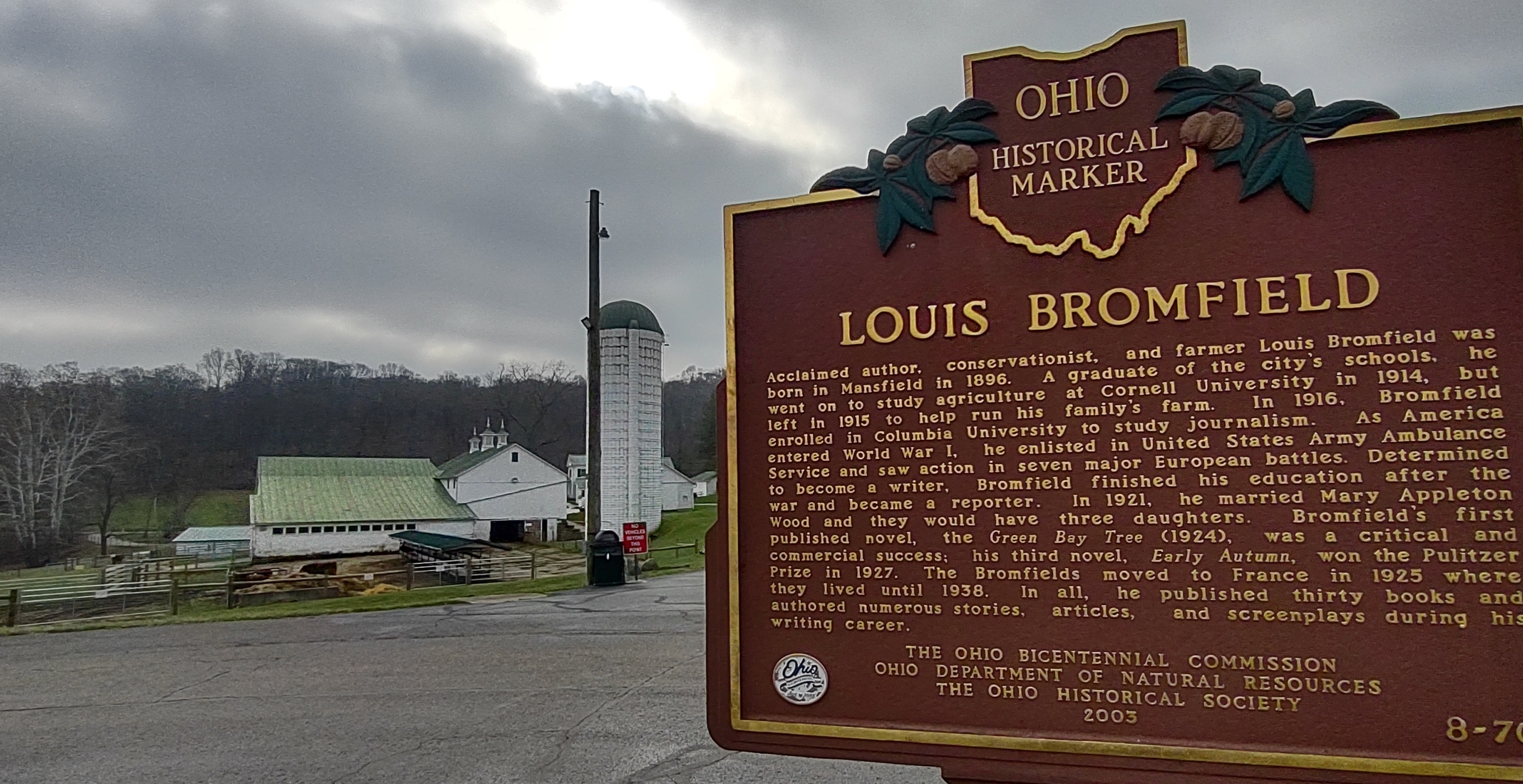
Louis Bromfield’s home welcomes us. Born in 1896, Louis served as an ambulance driver in WWI, lived in France for 10 years, then returned to his hometown of Mansfield. His dream mansion came to life when he bought the old Ferguson Place.

Here Louis created the TV and movie scenes which made others famous and him wealthy. Hollywood screen players of the 1950s came for cow milking, corn husking, and egg gathering, while Louis wrote their scripts. As new TV watchers across America migrated from family and outdoors to the next packaged production, actors on the TV screens came to Malabar, in search of slowly dimming rural identity. E.B. White visited in 1948, and, not quite speechless, wrote, “Sailors, trumpeters, mystics, actors, all of them wanting to drive the tractors, all of them eager to husk the corn, some of them sipping their drinks till morn . . .”

Inside the Visitor Center, we locate the old Ferguson Place in the hills of Malabar, where our trail will climb up and up.
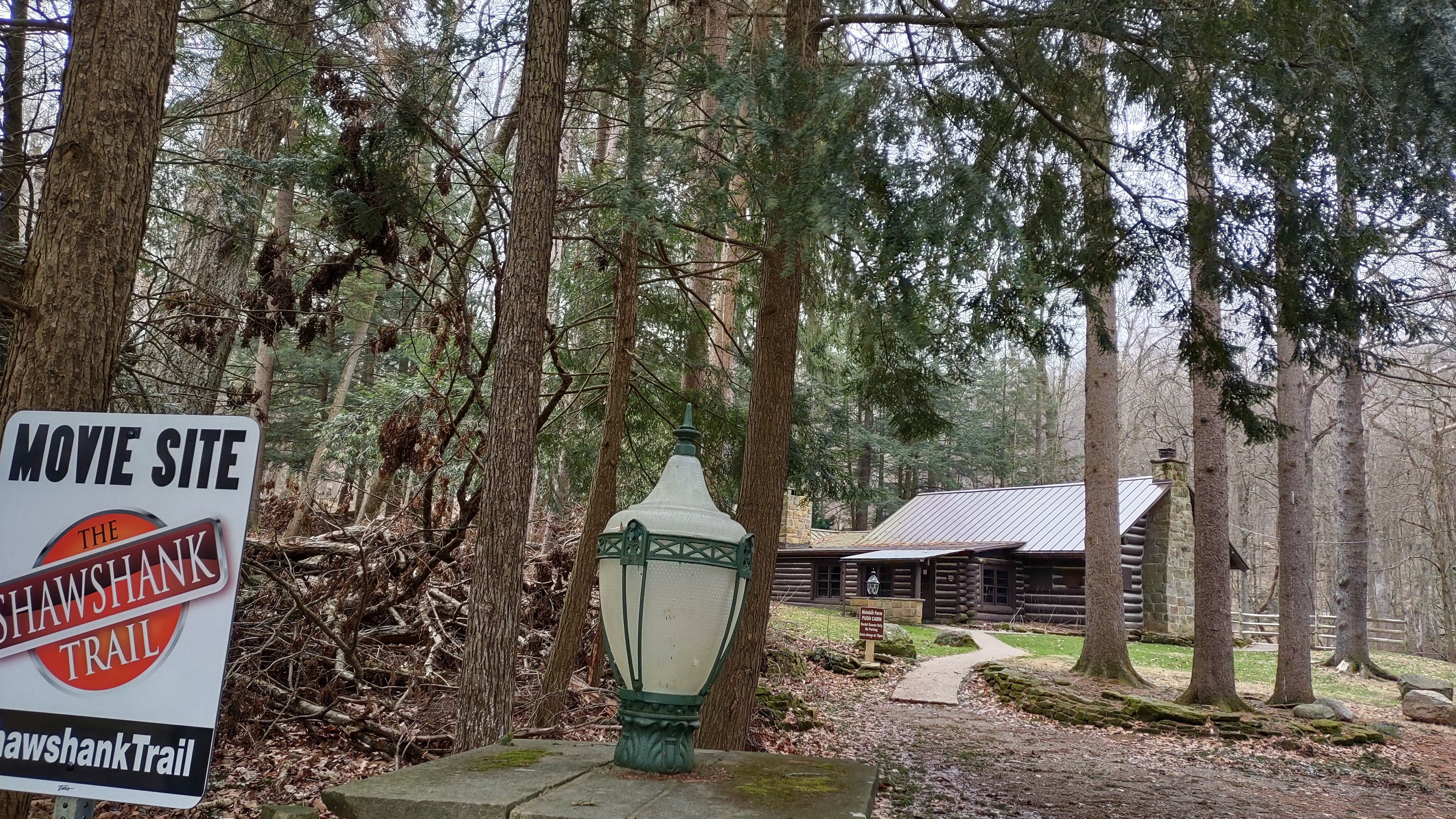
At the trail head, a cabin nestles off the path. Forty years after Louis’ death, the movies come back to his farm. Not movie buffs ourselves, we still love the title, Shawshank Redemption. Every cache gives a golden opportunity to redeem ourselves one more time. We found it.
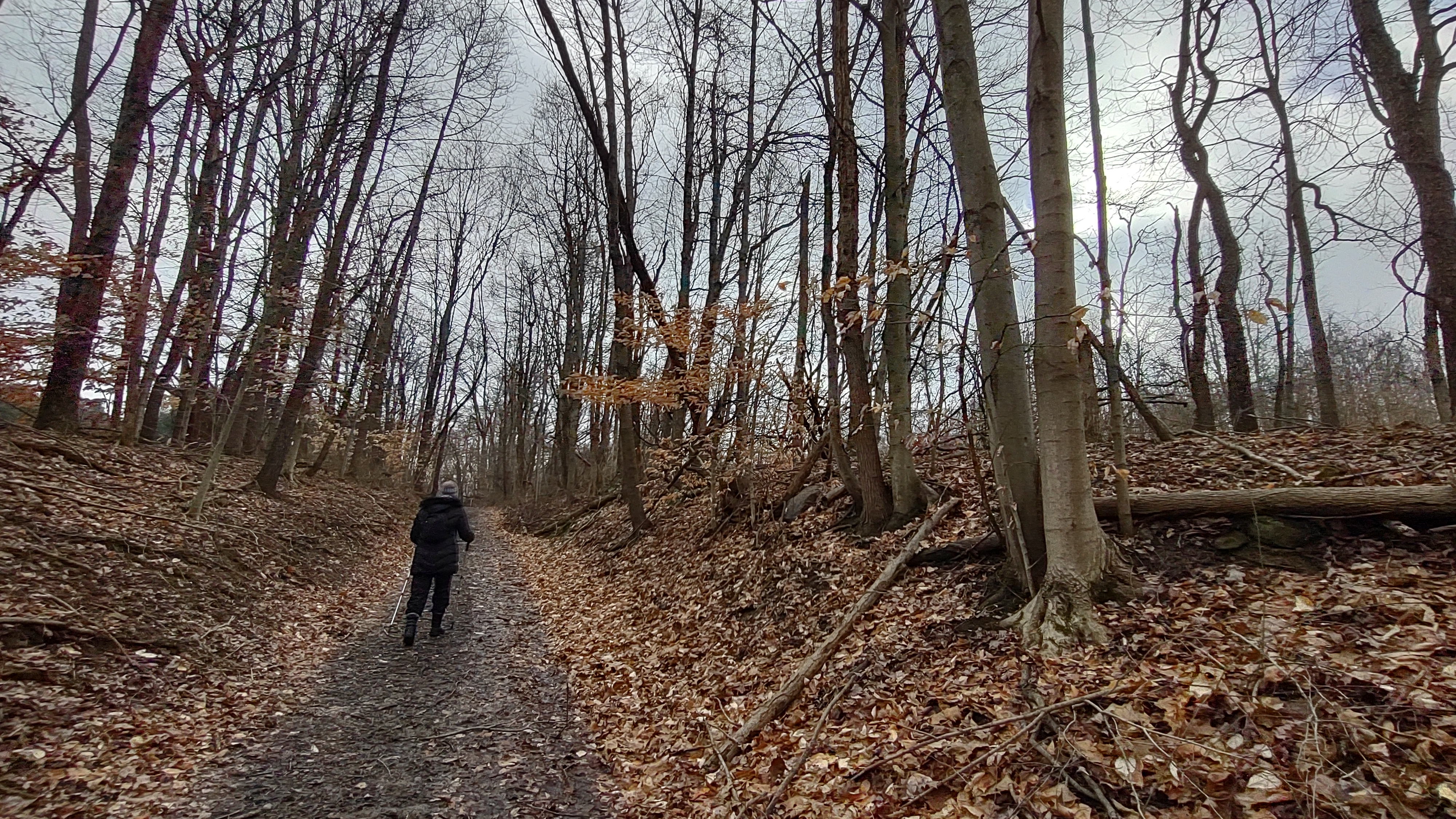
Our cache description hums a lilting refrain, written by Louis 75 years ago in Pleasant Valley. We follow his footprints.
You approach the Ferguson place by a steep, half-ruined road through the forest, a road worn deep, where even the outcropping sandstone is rutted with ancient wheel tracks.
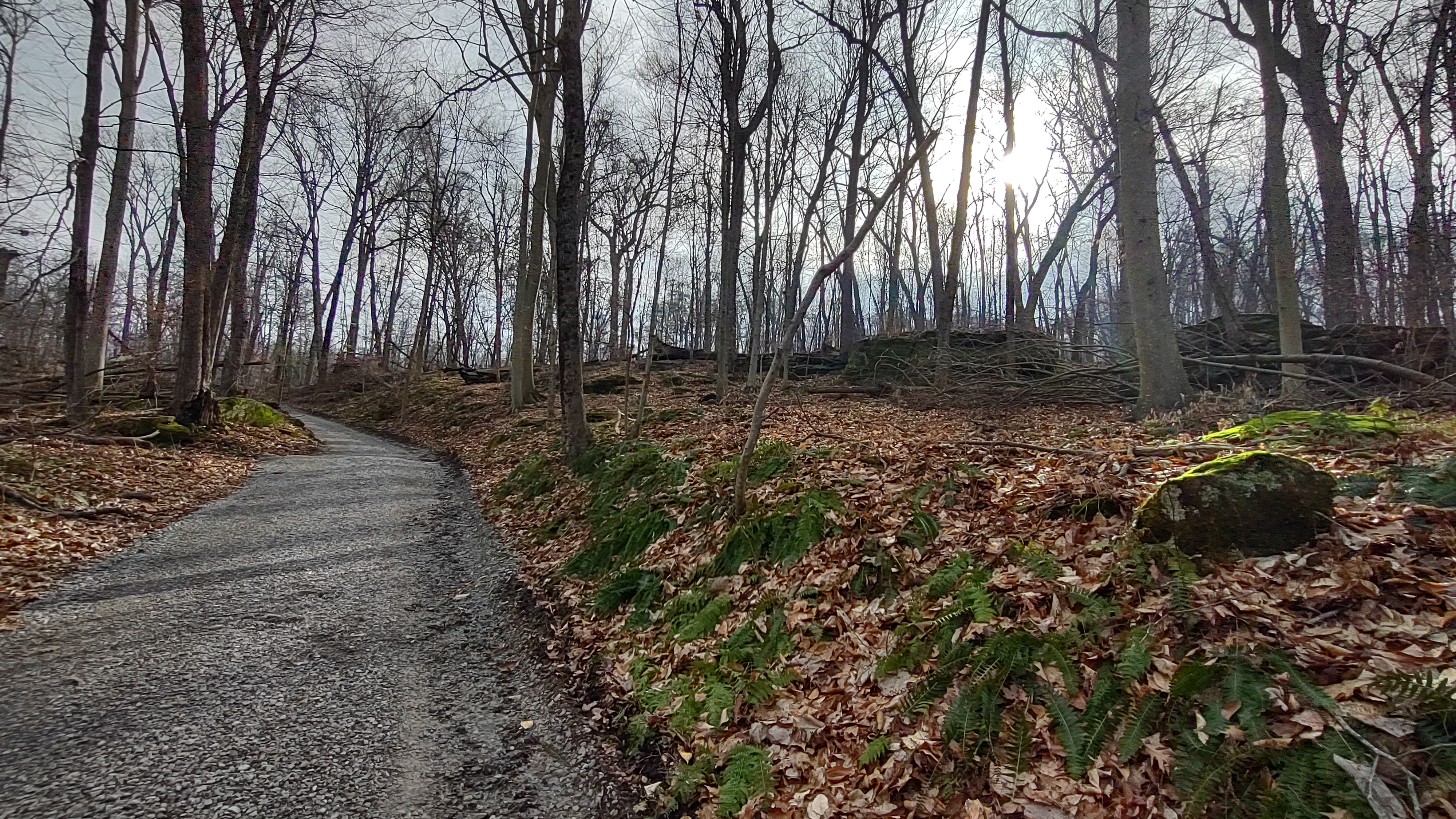
On its damp shaded banks grow ferns and carpet of the loveliest of all spring flowers.
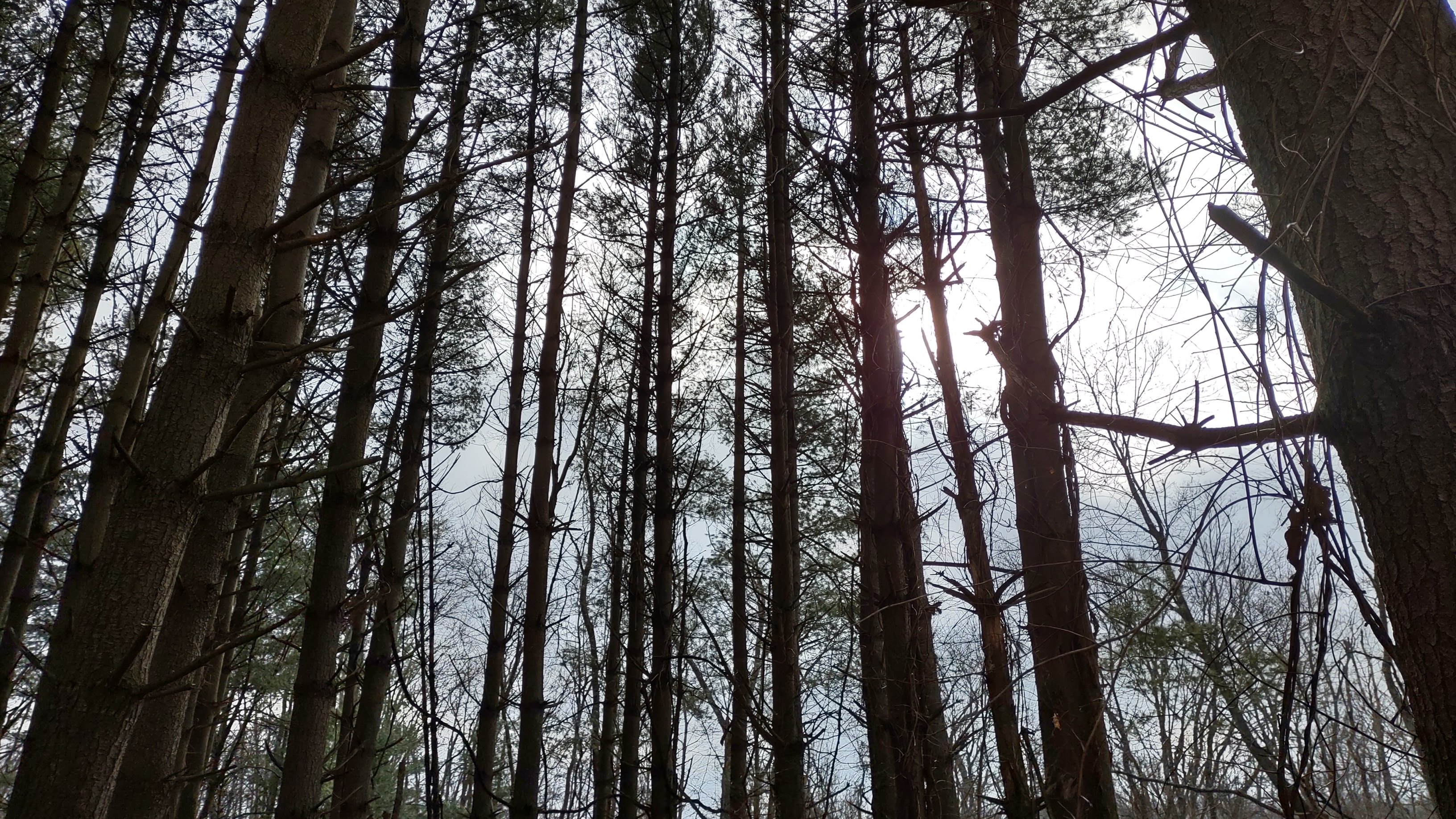
Overhead the trees join their branches so that the whole road is a tunnel laced with wild grapevines where light itself is the color of watery depths.
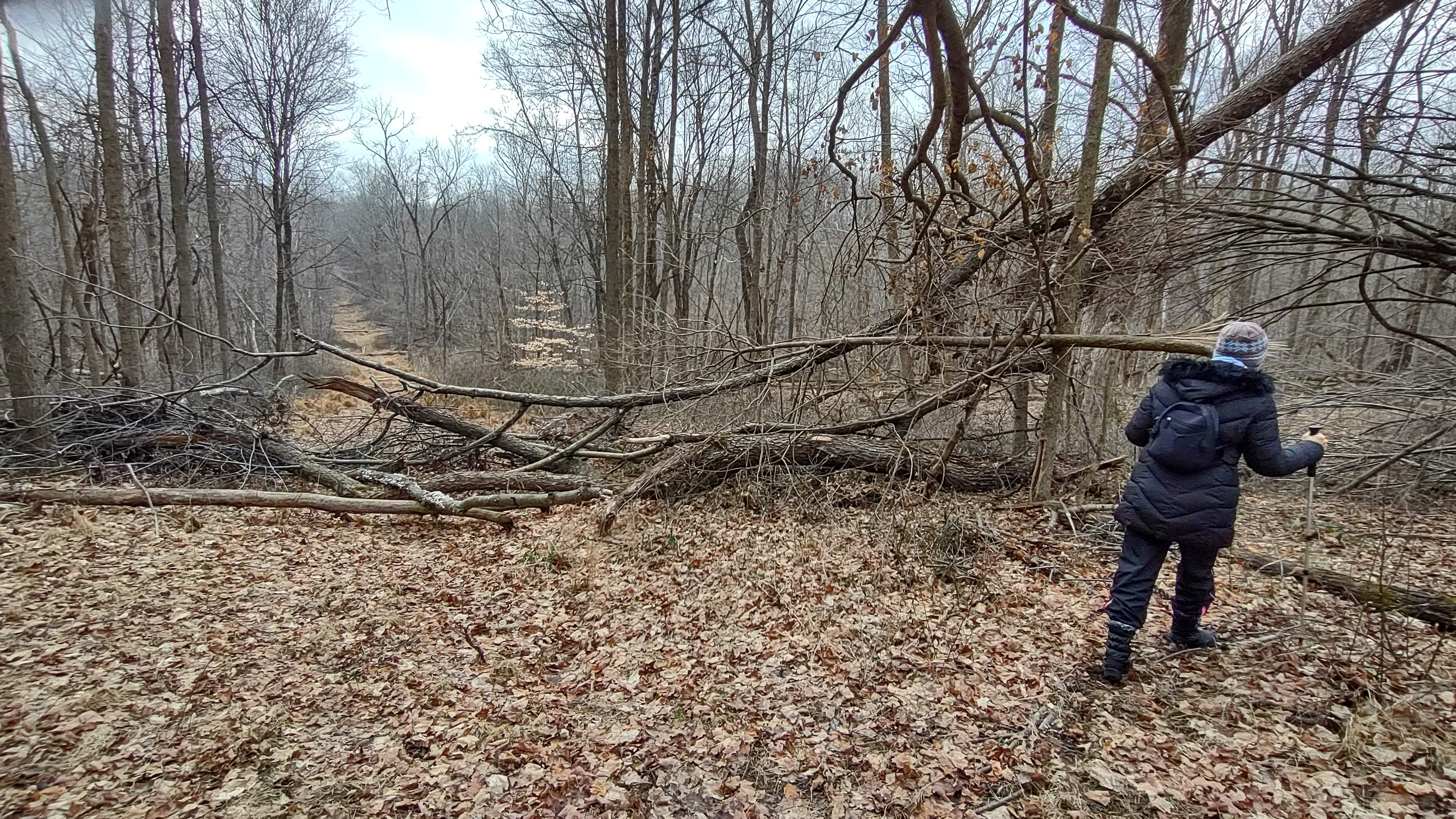
Tornado tangles still cover the trail. We turn off just in time. Not every day feels like fighting a tree.

On the other hand, almost any day is good for finding some stair steps and a cache in the middle of a wood.

Inside the cache, the Fergusons appear, with a sided house, glass windows, and the very steps now set before us. From 1819 to 1939, generations of Fergusons lived in the house, as bears, wolves and Wyandots left the land, a road to Newville passed by the house, Newville disappeared, and the house succumbed to fire.
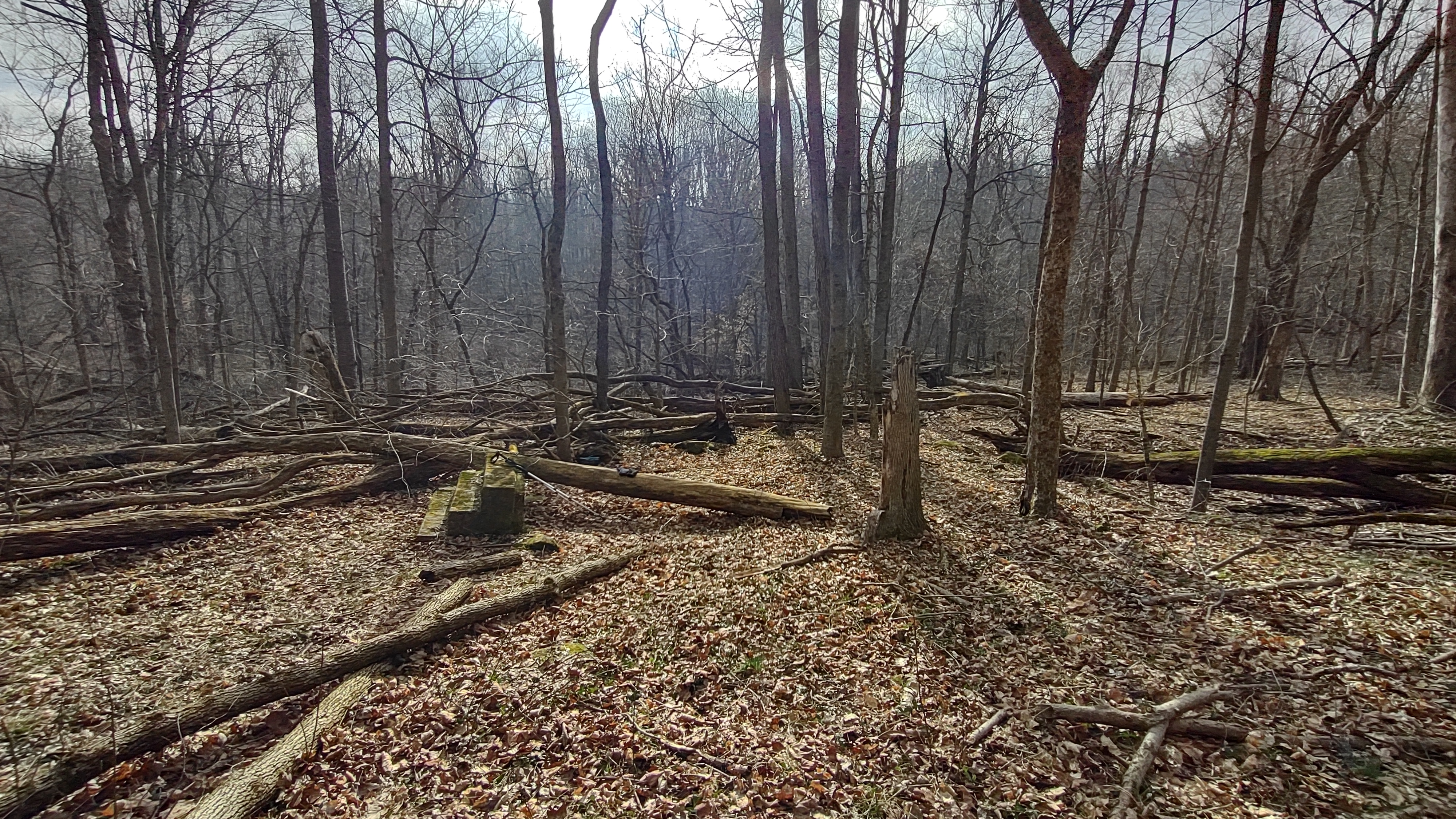
When Louis bought his land, Up Ferguson Way was already a landmark. He wrote a short work of fiction with that title, and readers came from all over the world to see where the story happened. Up Ferguson Way. Now we are here.

Twenty years of cache logging creates its own history. In 2002, a very early logger found it necessary, due to brilliant sunshine, to pull his sweatshirt over his head in order to get enough shade to get his GPS reset. Upon finishing, he found he was the object of a car full of older folks taking in the scenery. In 2003, a cacher apologetically records that they felt it best to take down all the red ribbons tied to trees by a previous finder, leading straight to the cache.
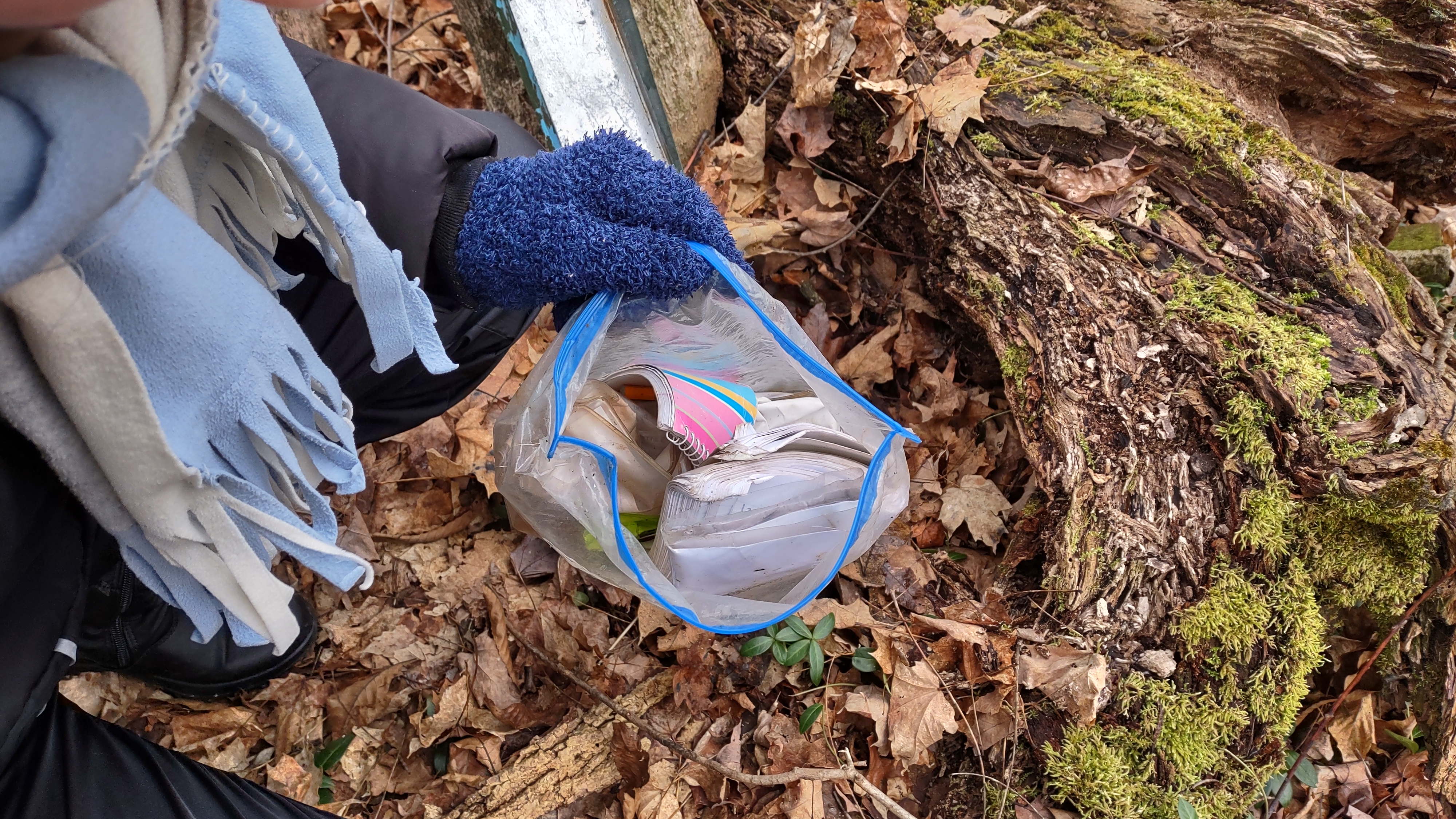
In 2008, the Cache Owner leads a tour of new cachers to find his cache . . . and gets lost. In 2009, all caching parents reverberate with the record: It is funny how little boys love tromping through the woods looking for treasure! In 2011, the guided tour of the farm comes up the hill to the Ferguson site. An entire tour group raises their hand and asks, “Hey, what’s that metal box over there?” Answer given. In 2017, with a cache now almost old enough to drive, the CO returns from somewhere, checks, and all is well.


Louis felt this small spot held a secret air of healing, rest, restoration, and peace, where his rambunctious mind was quieted. He is echoed by Cache Nation.
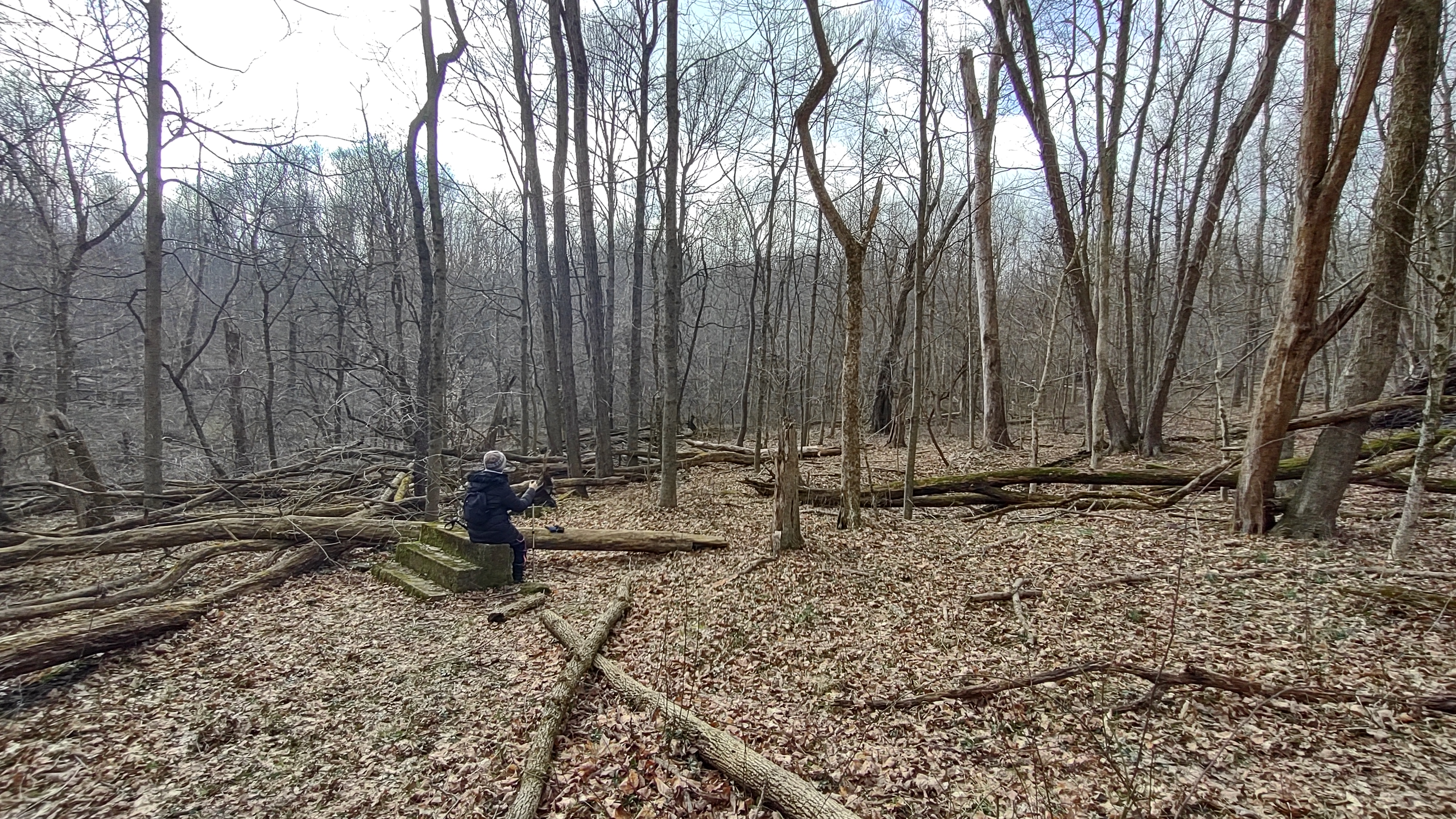
Wind whispers, moo of cows from far field echoes, flash of whitetail deer leaps through brush, mulch and mustiness and leaf mold mix in a forest cocktail. Green is a distant, September memory. Brown soothes, settles, and satisfies.
-
Sleepy Hollow
Placed by Cache Owner goose2553 in 2008, the Legend of Sleepy Hollow beckons.
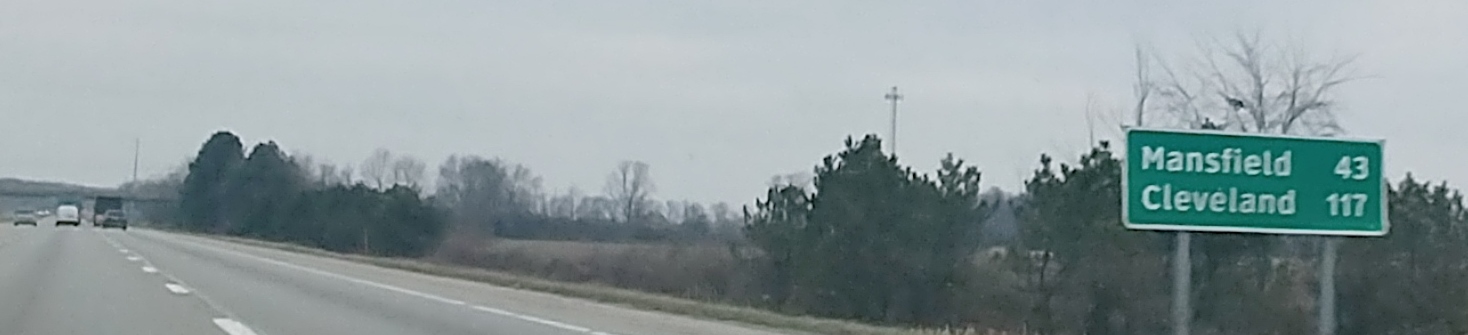
As we step into the Arctic freezer, coordinates pull us north, turning east at Mansfield.
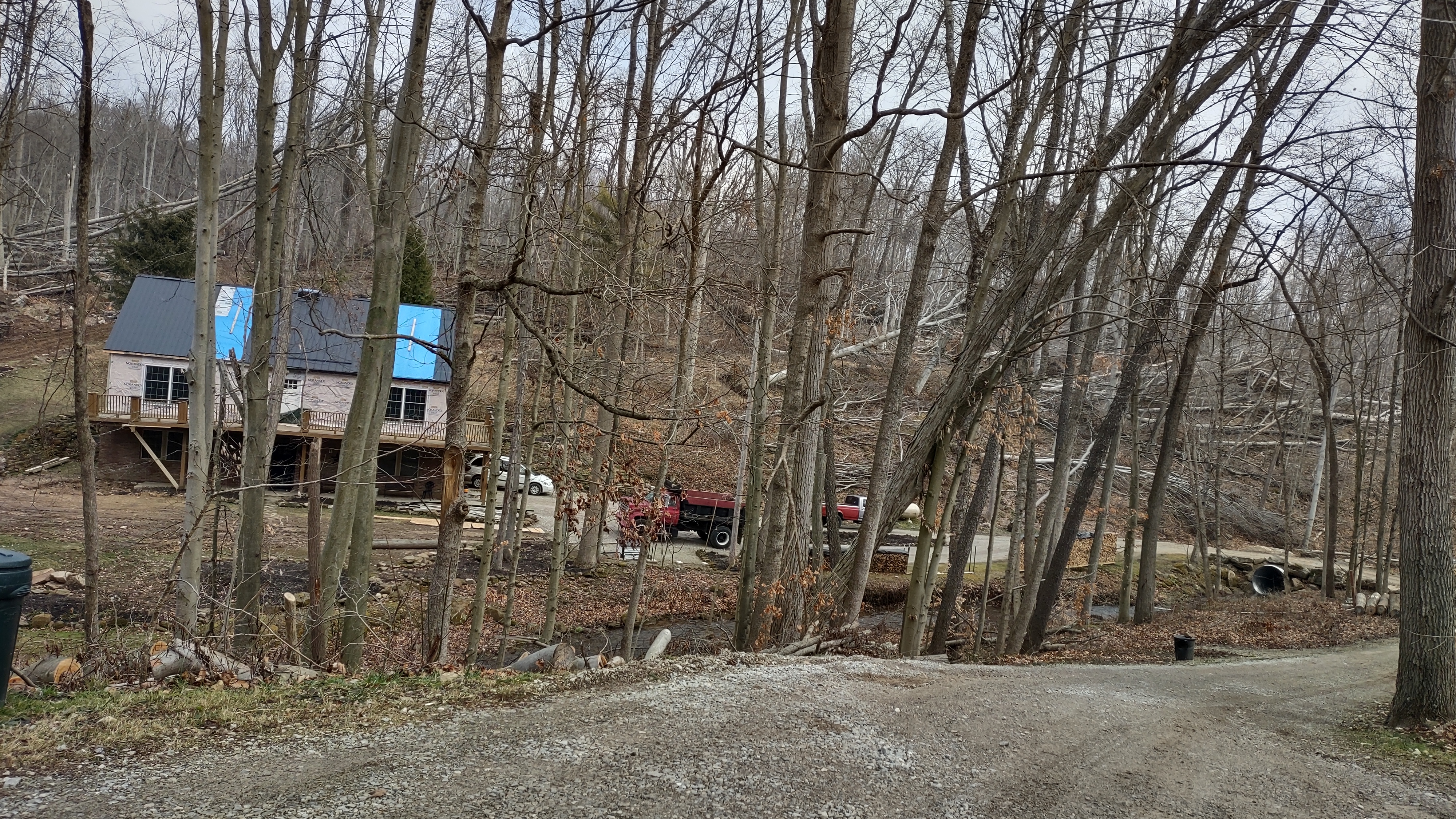
Deep in the woods, wind-bowed trees lurch, while homeowners replace siding lost in the June tornado.
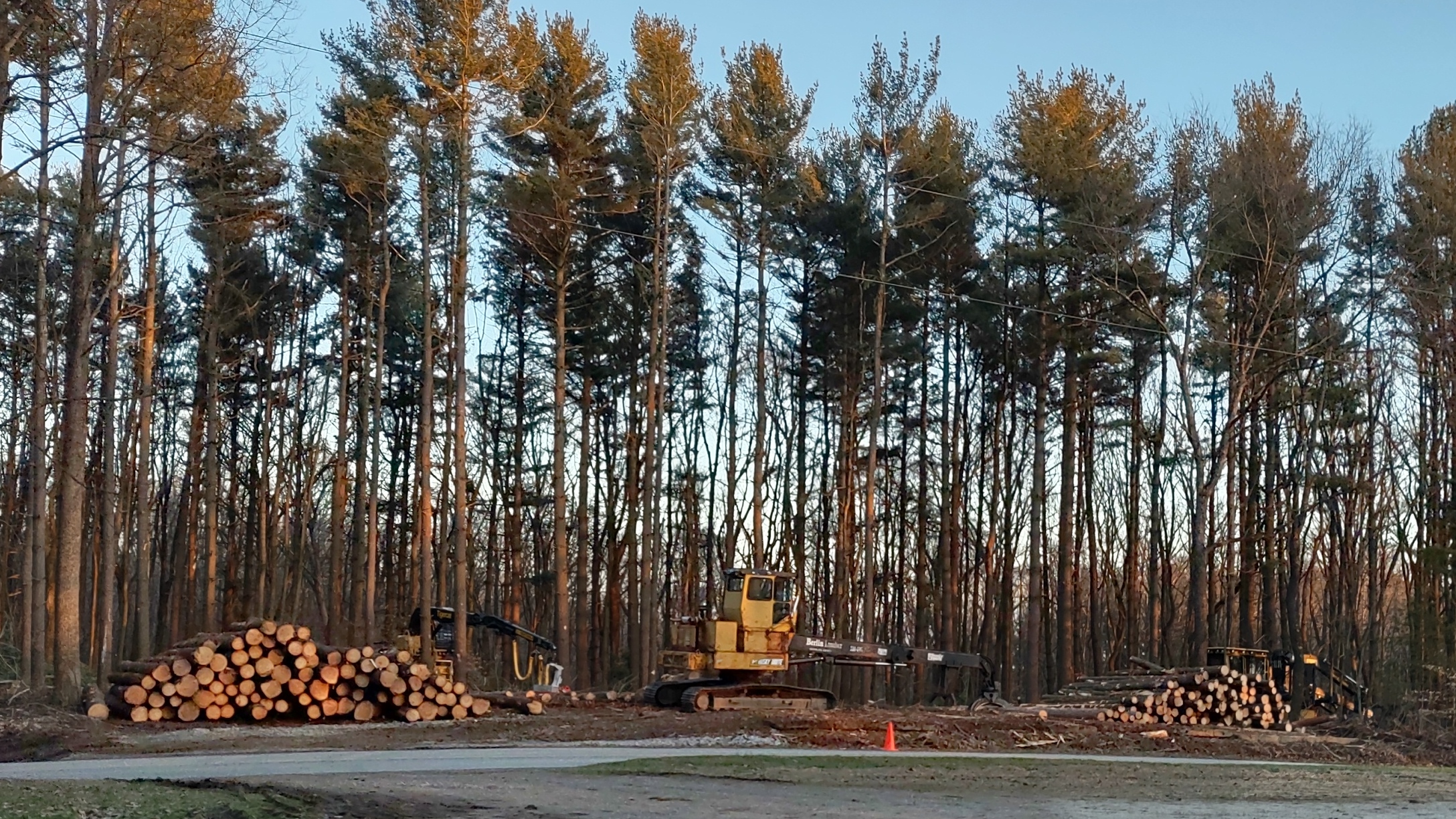
Down the road, forest staggers and falls, not to tornadoes, but to logging operations, spy-glassing the coming wave of hungry home-buyers.
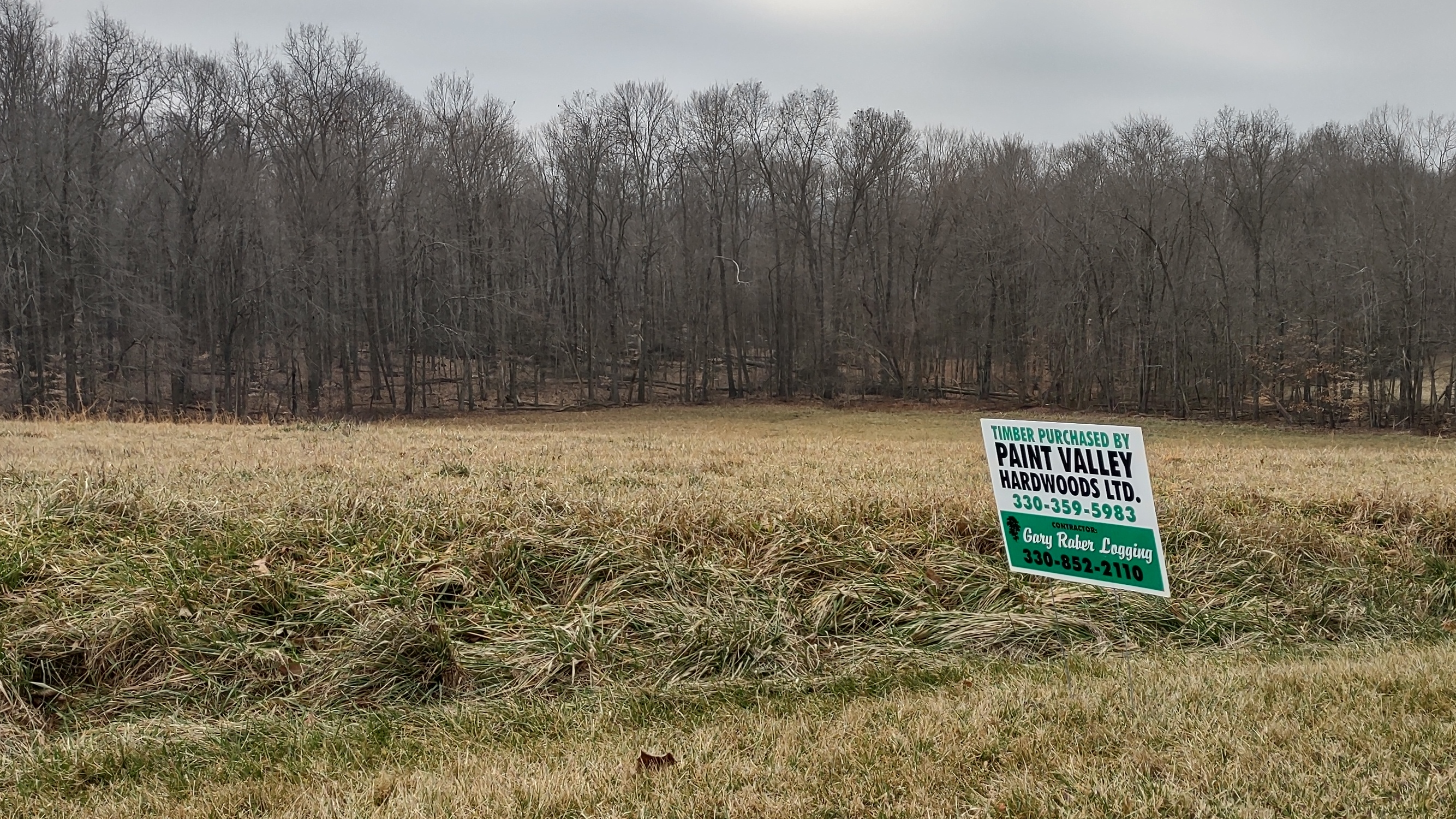
The appeal to self-interest, founded on rise of personal income, mutely but fiercely struggles with self-interest dependent on nature, beauty, stewardship of land, plants, tiny creatures, and fresh air.
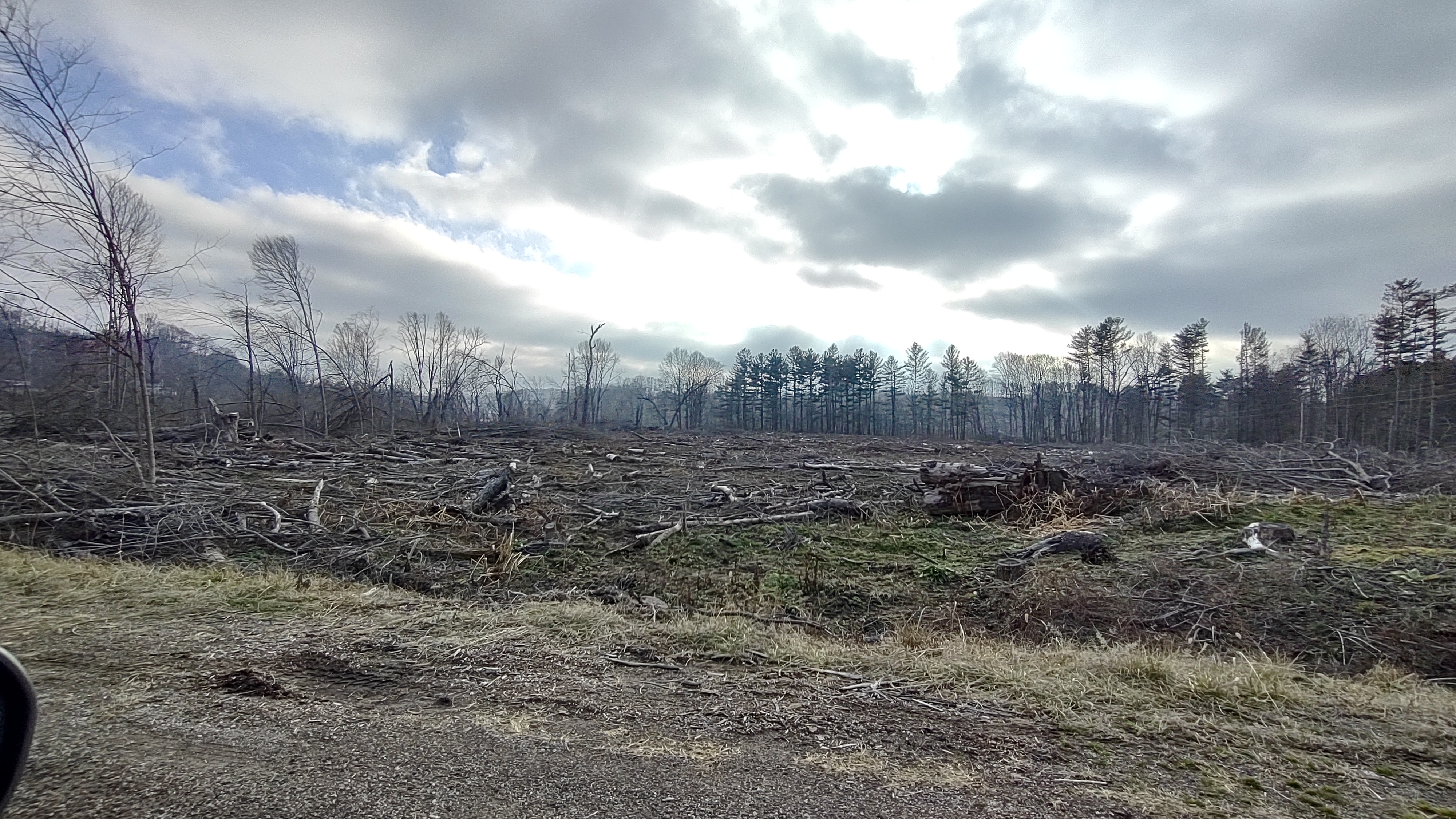
With the aging of generational owners, eyes are suddenly opened to the forest disappearing around them, melting into infrastructure for inflatable Santas and remote offices. In a county-sized reenactment, timber is scythed by 1700s pioneers, now reincarnated as 2020s developers.
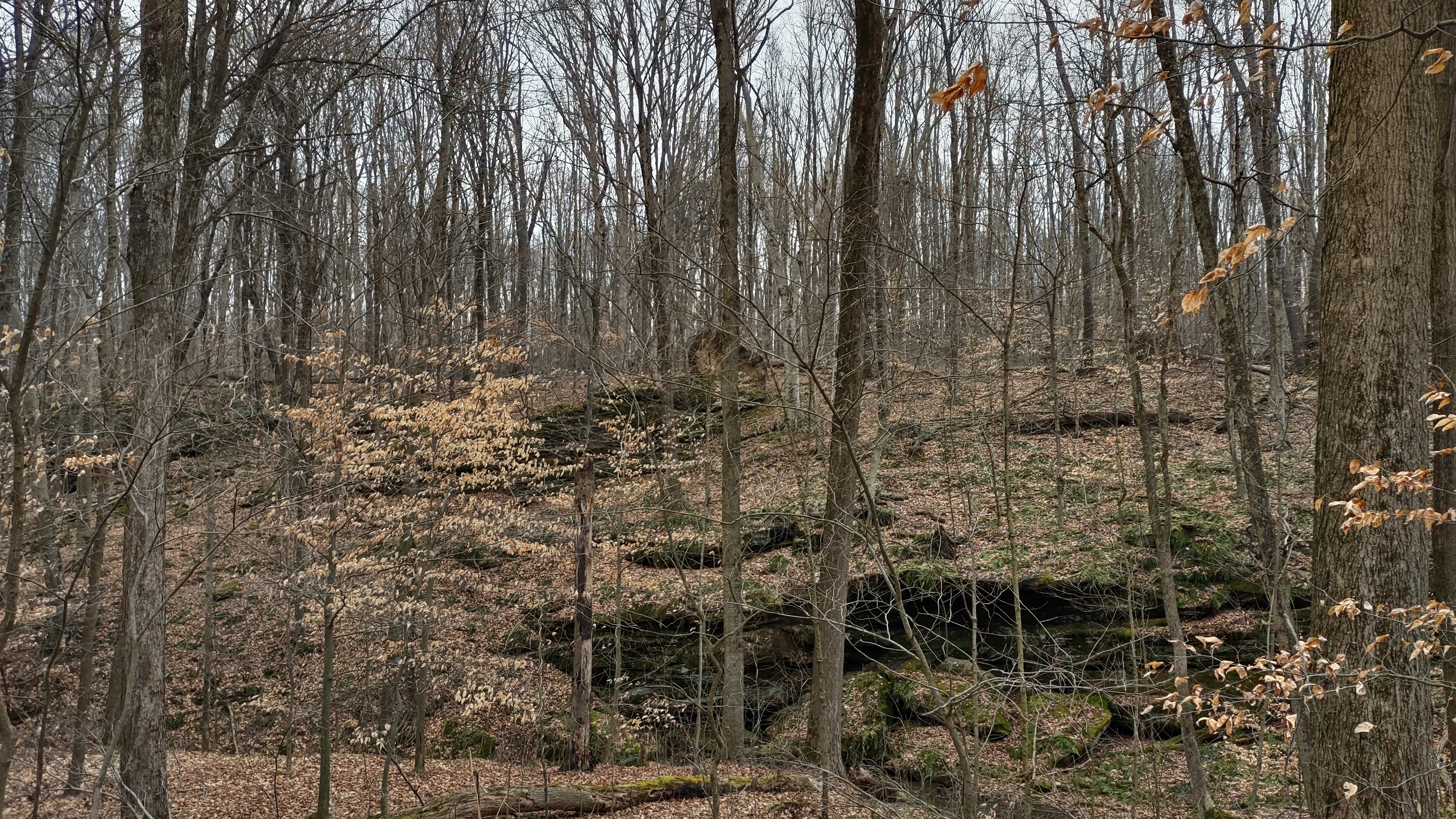
As ravenous real estate agents offer land owners undreamed-of wealth, love for their homesteads climbs to the top of the pyramid. Vast acreages are released, not into the market, but to existing preserves for protection and public use.
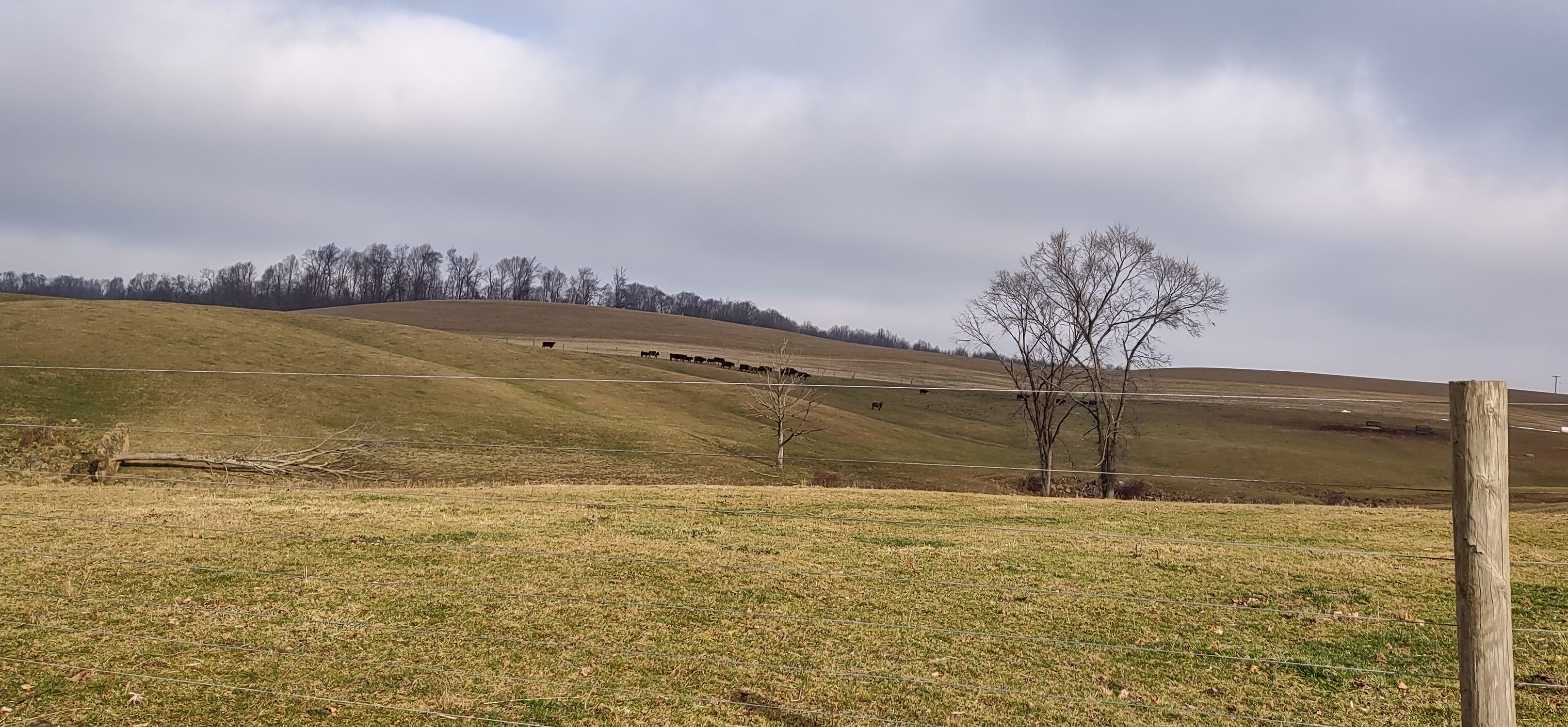
Around the corner, sun-washed fields are restored by grazing cattle, enriching the soil, bringing contentment to the heart, and adding new meaning to “grass-fed”. Restorative grazing moves cattle among designated areas, maximizing absorption of cow products back down into soil starved from overfarming. Deep-rooted perennial grasses return, turning the landscape into a sponge for water retention.
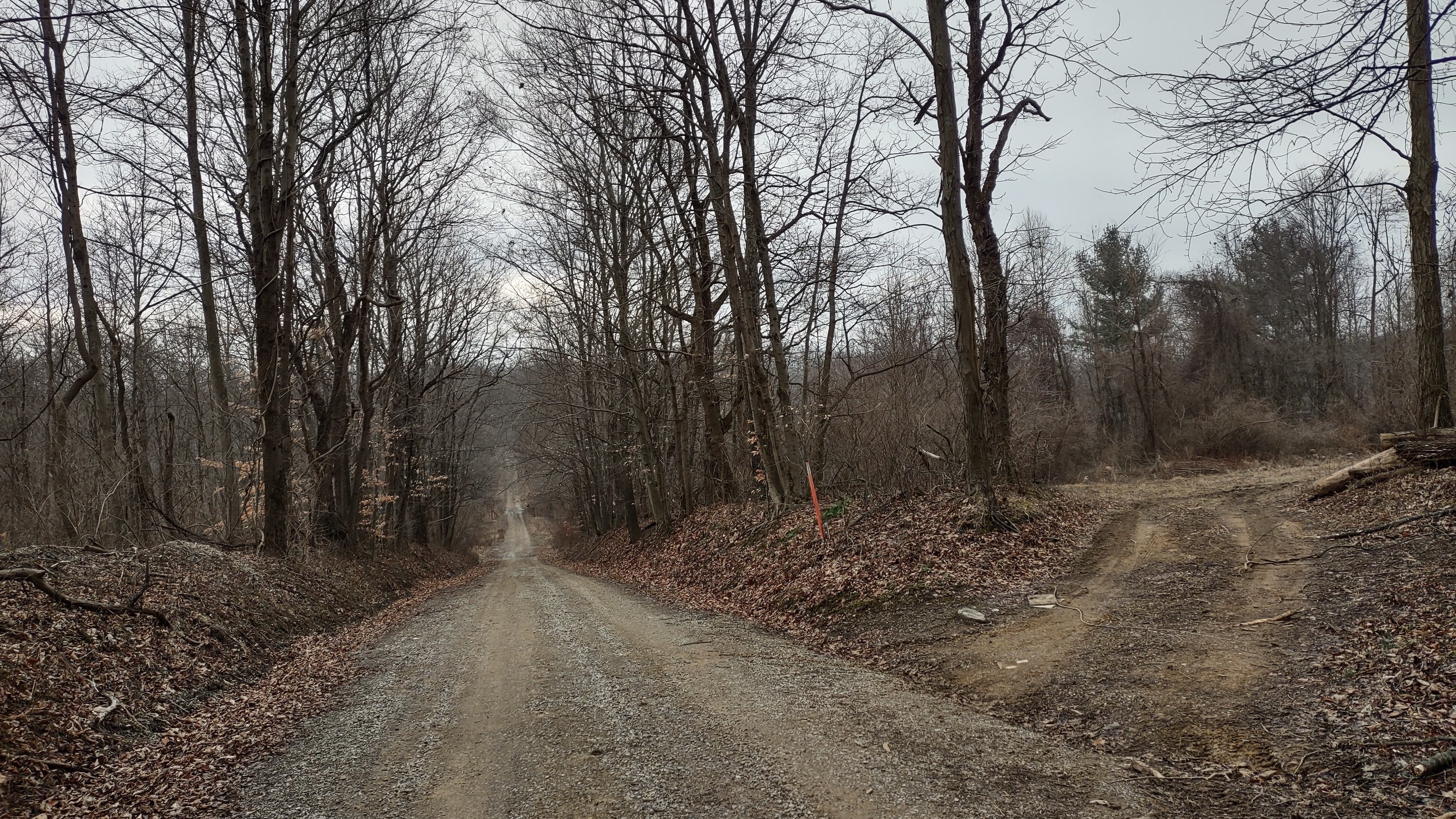
Coordinates drive down a gravel road, where off-road tracks tell us new home building is underway. Gated lanes and influx of nonlocals slowly tame rural ruckusing.
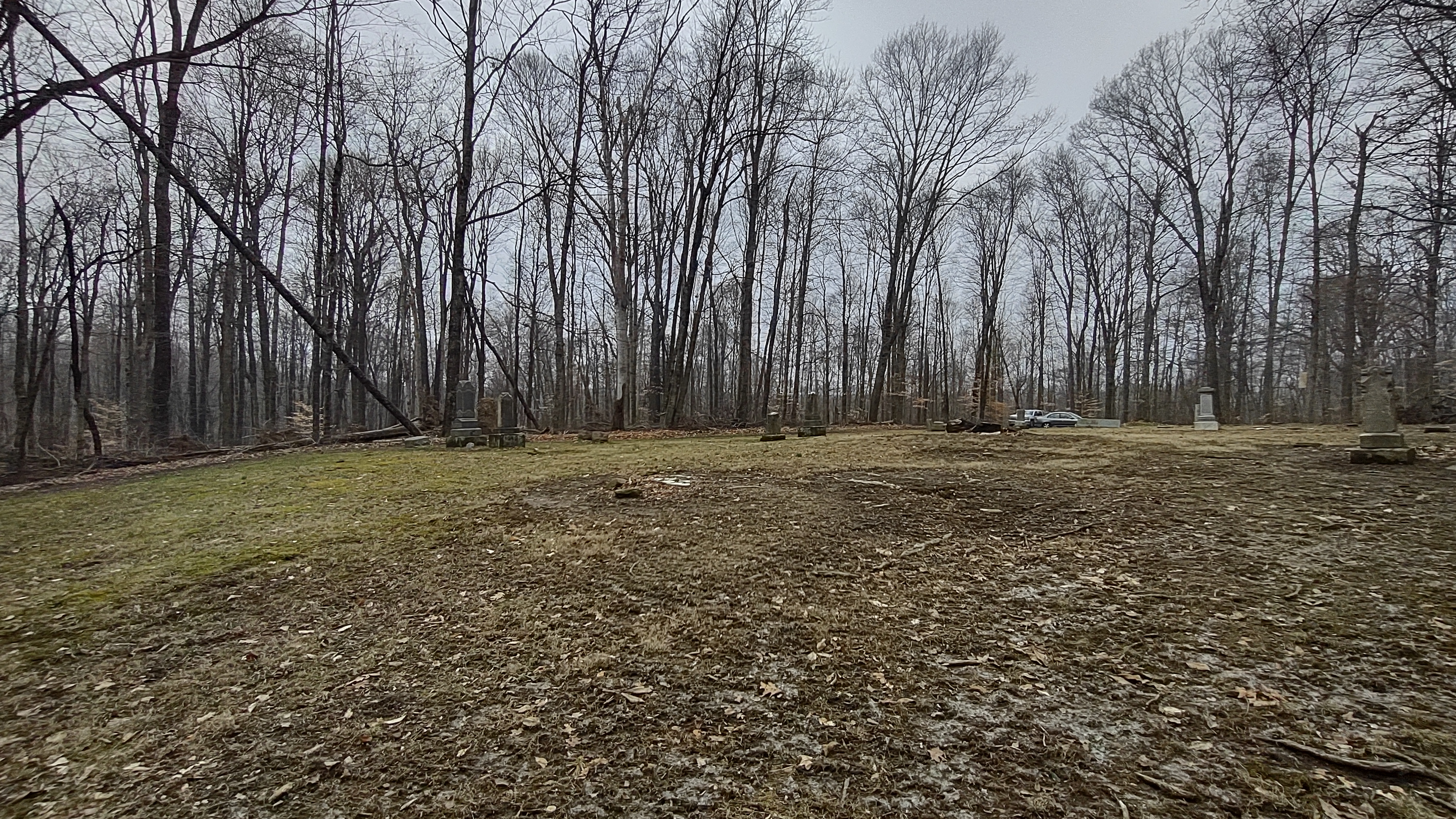
In 1960, Hidden Hollow Camp moved in next door, purchasing land with our cemetery thrown in. Zealous counselors brought with them the celebration of Walpurgis Night, an ethnic holiday marked by skeletons and skulls in the camp dining room, grave stones in the ball fields, and games of sawbones rally and witch torture at the swimming hole. In the perfect marriage of opportunity and intention, a real live graveyard, now owned by the camp, provided a spectacular Spook Hike to end this summer camp Halloween.
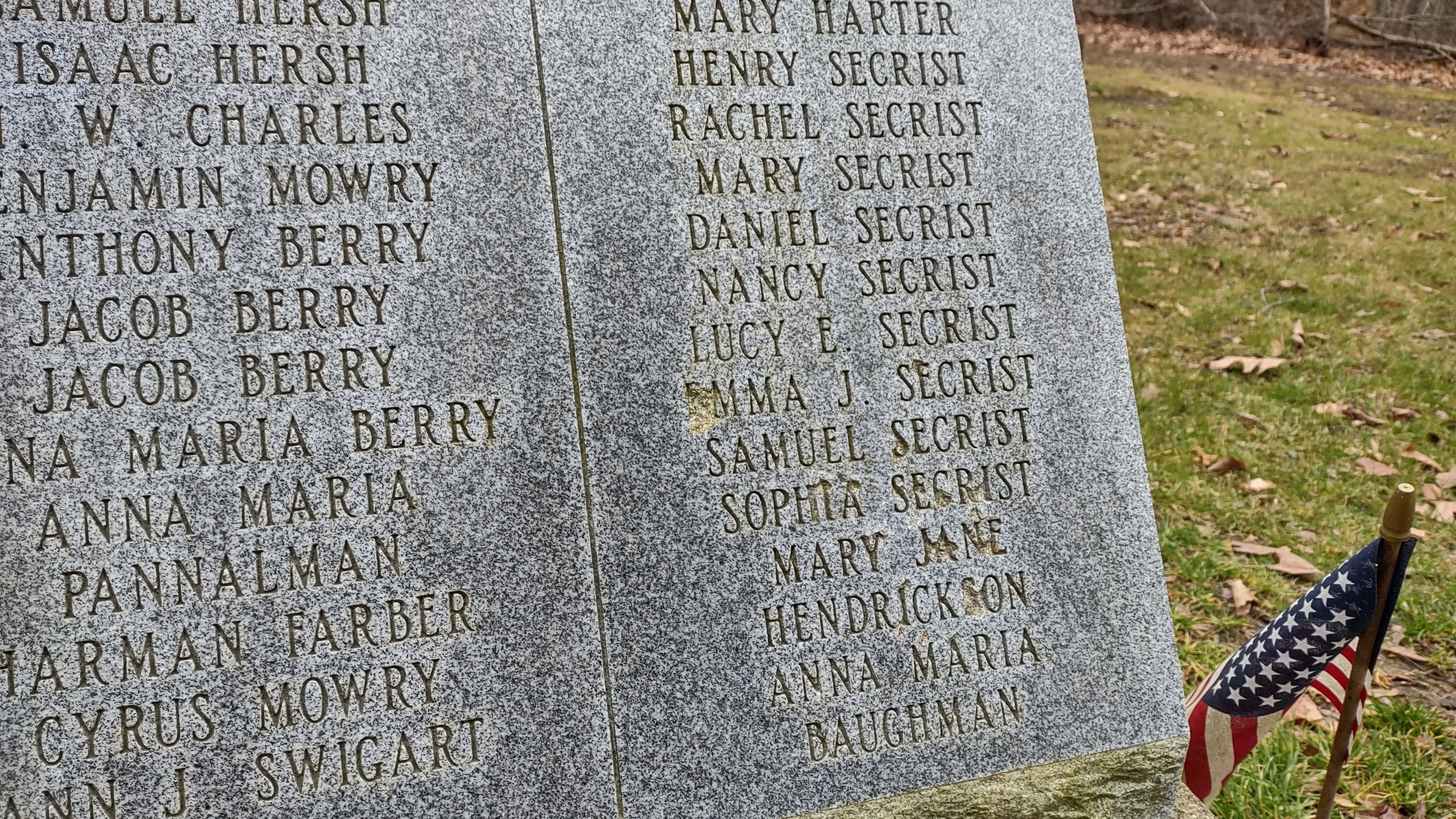
Mary Jane Hendrickson died in 1898 from cancer, aged 72. Her tombstone, lovingly placed under a towering spruce, set the stage for the 1960s ghost tale, leaving Mary swinging from a limb of the spruce as a convicted witch, and a curse on any who dared touch a stone in the graveyard.
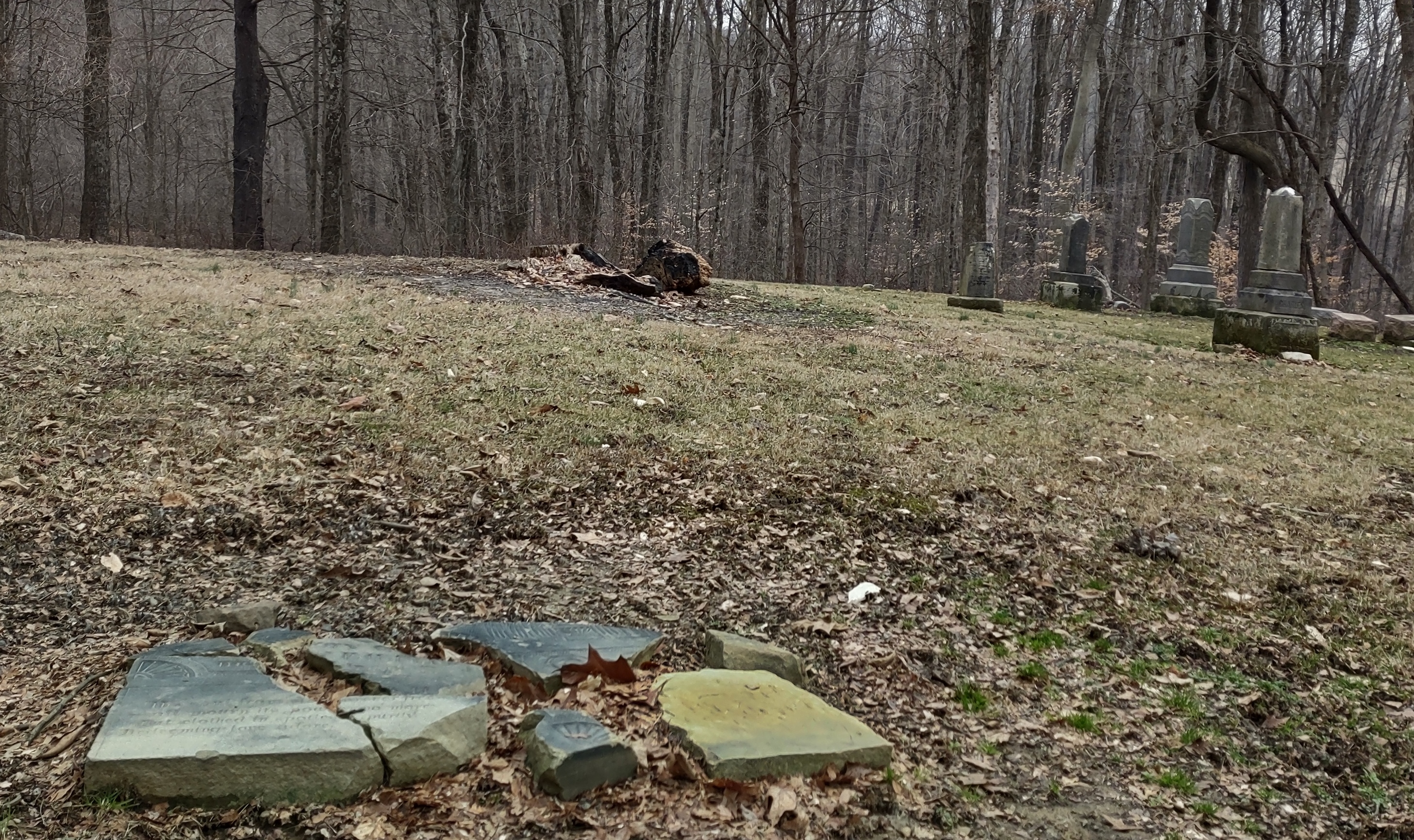
Over the next 50 years, the tale grew to MJ screeching at the stake, cursing the righteous as she died. The ancient spruce became the blank slate for blackened graffiti and good luck charms. Finally set on fire, the scorched bark rose above graves now smashed and broken. Teens parked at the dead end lane, drank, smoked, and drove, ending in a tragic car crash down the road.
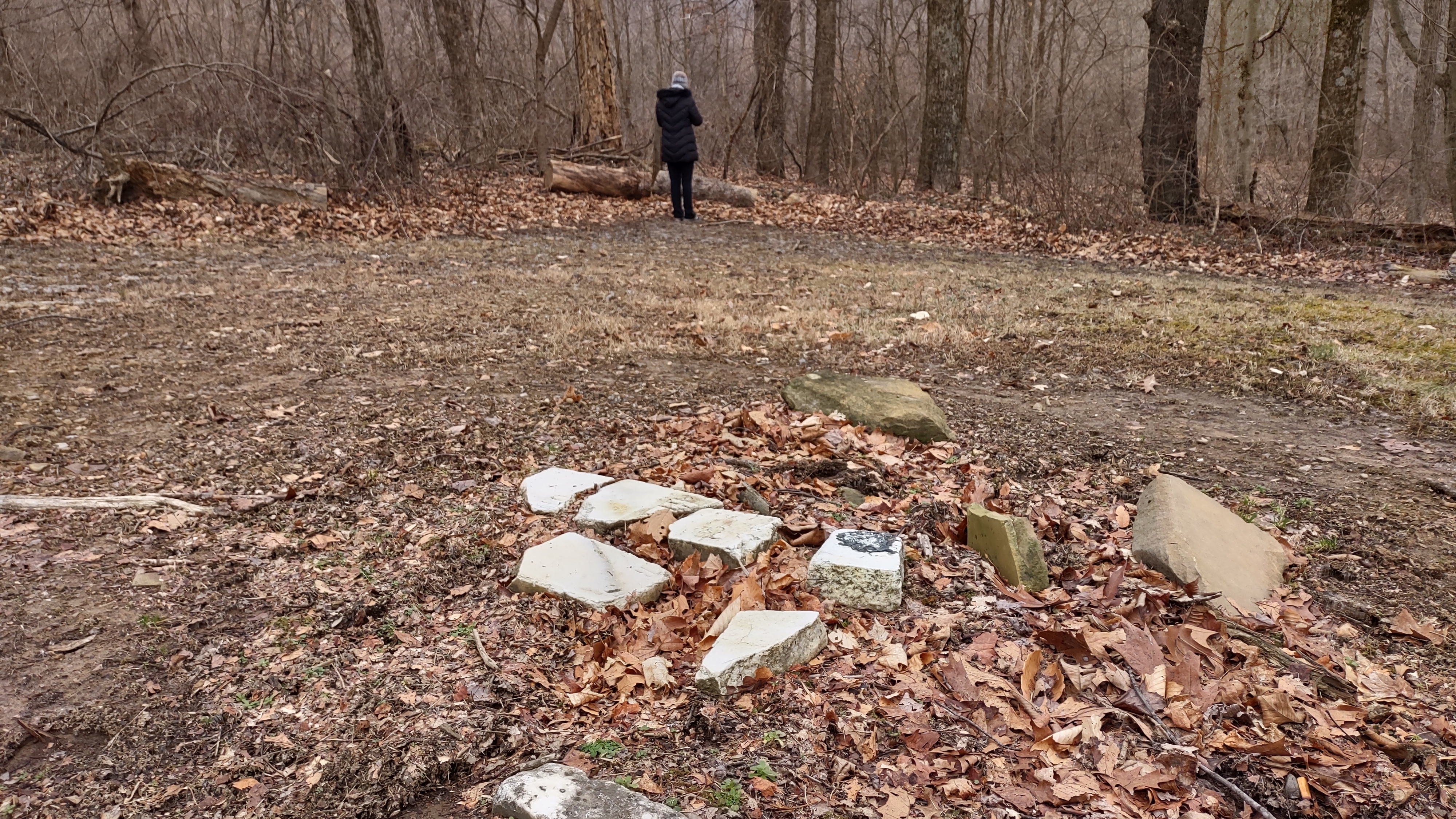
In 2008, a cache is placed, and Cache Nation begins to sort it out. Local cachers retell their own fears of the cemetery, growing up as campers at Hidden Hollow. Their fear walks them to the cache, and they walk away free, with a smiley. Others clean up trash and hallow the stones with their own anger and sadness.

In 2014 the crippled spruce is finally cut down. Mary Jane’s grave has long ago disappeared. A lone cacher encounters teens in a car as she angles her way to the back of the cemetery. I’m going to college, one tells her, and means, Please don’t think that we’re all like this. Or maybe we’ve grown out of it. And have better camp counselors now.
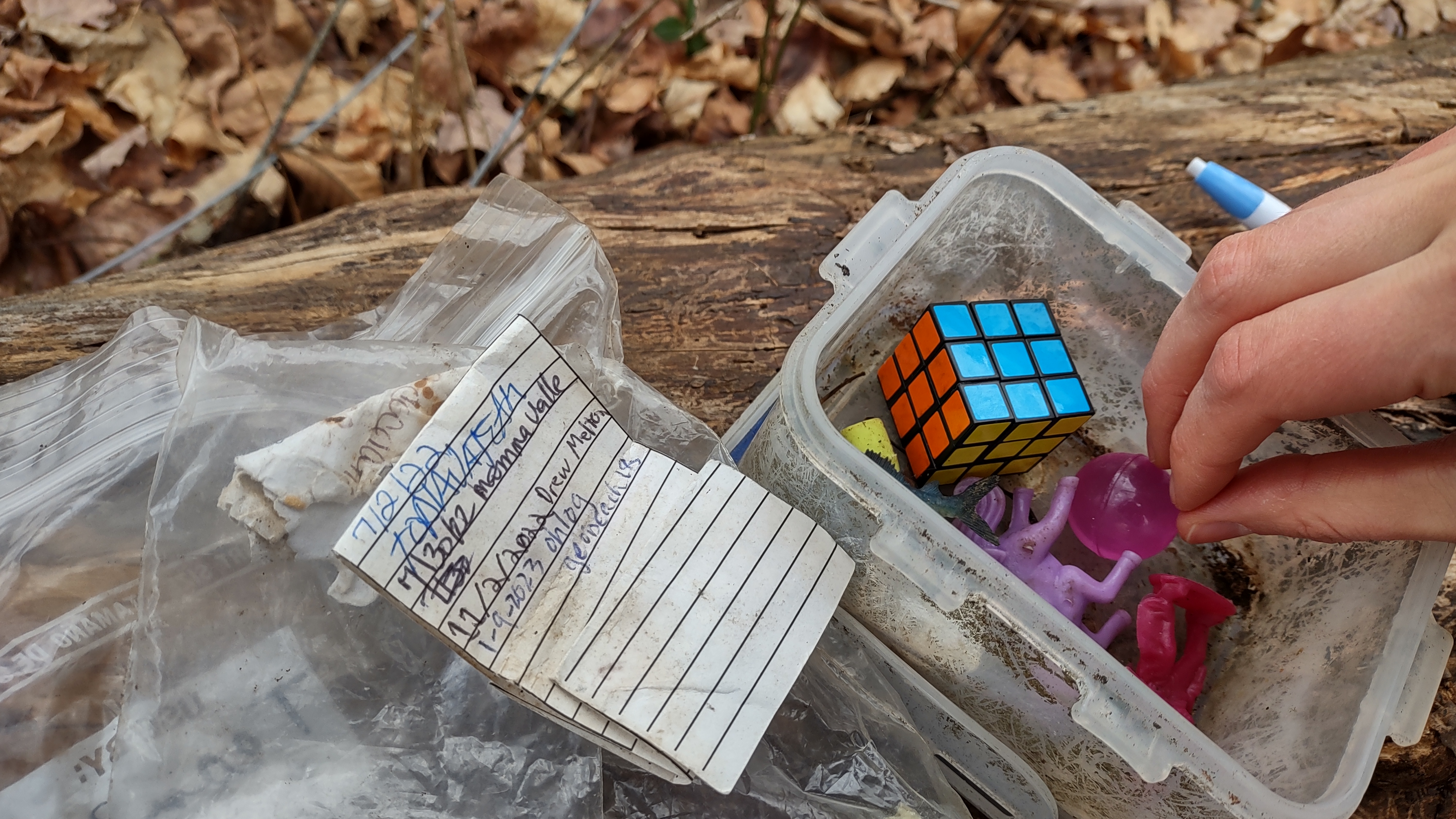
The bond between cemeteries and cachers resonates. Respect for the past, for those lives lived, for the time each has, for the CO who brought others to a quiet and peaceful place, together weave a knotted network of strength. Without malice, a log asks where those who did this will find their final rest.
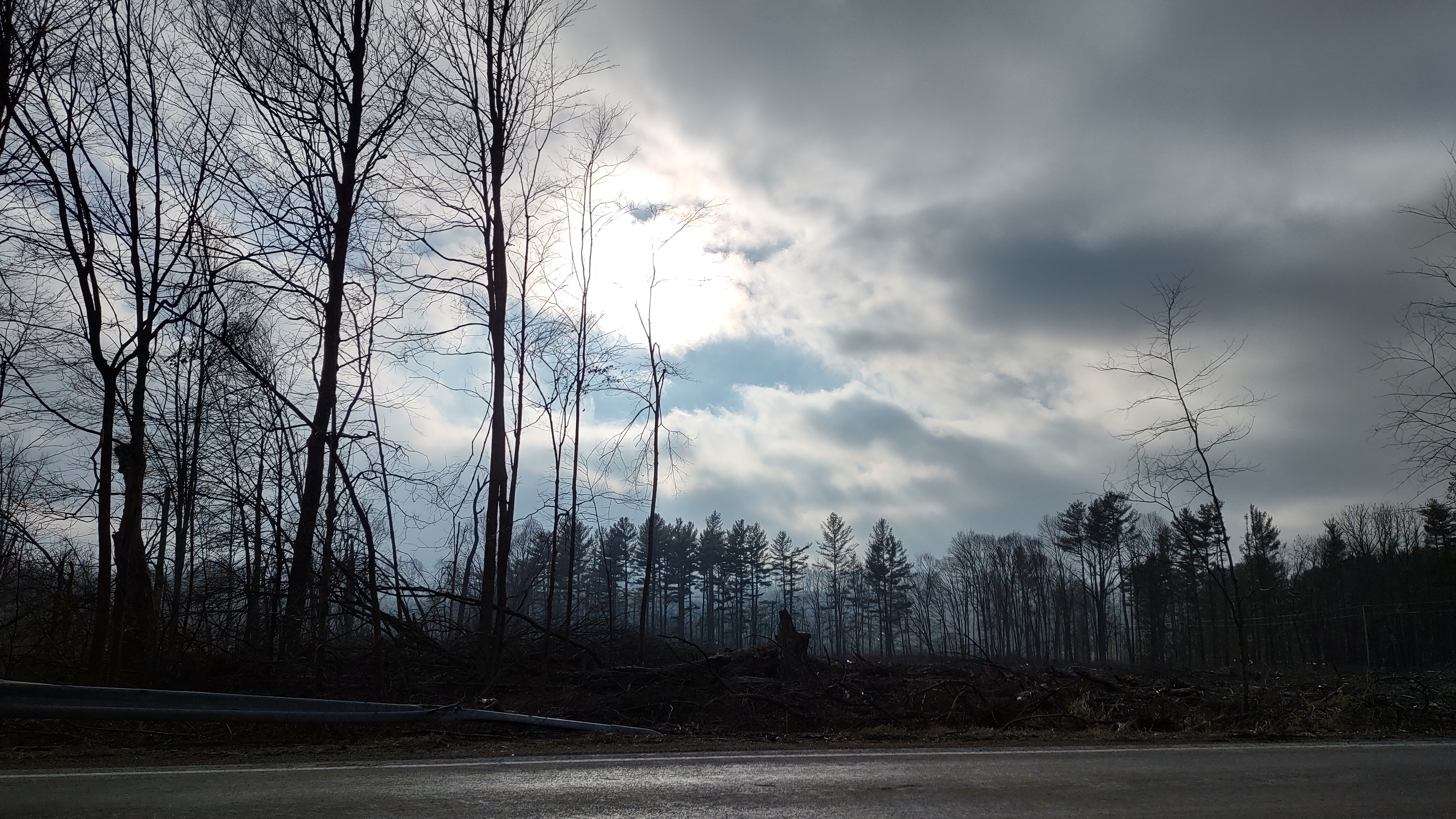
Quietly we leave Mary Jane Hendrickson in peace, and all who come, and all who remember.
-
Cache a Fish Again – Charlie’s Memorial
A six-month-old baby cache honors the memory of Grandpa with a fishing expedition, set by Cache Owner LukasKC13.
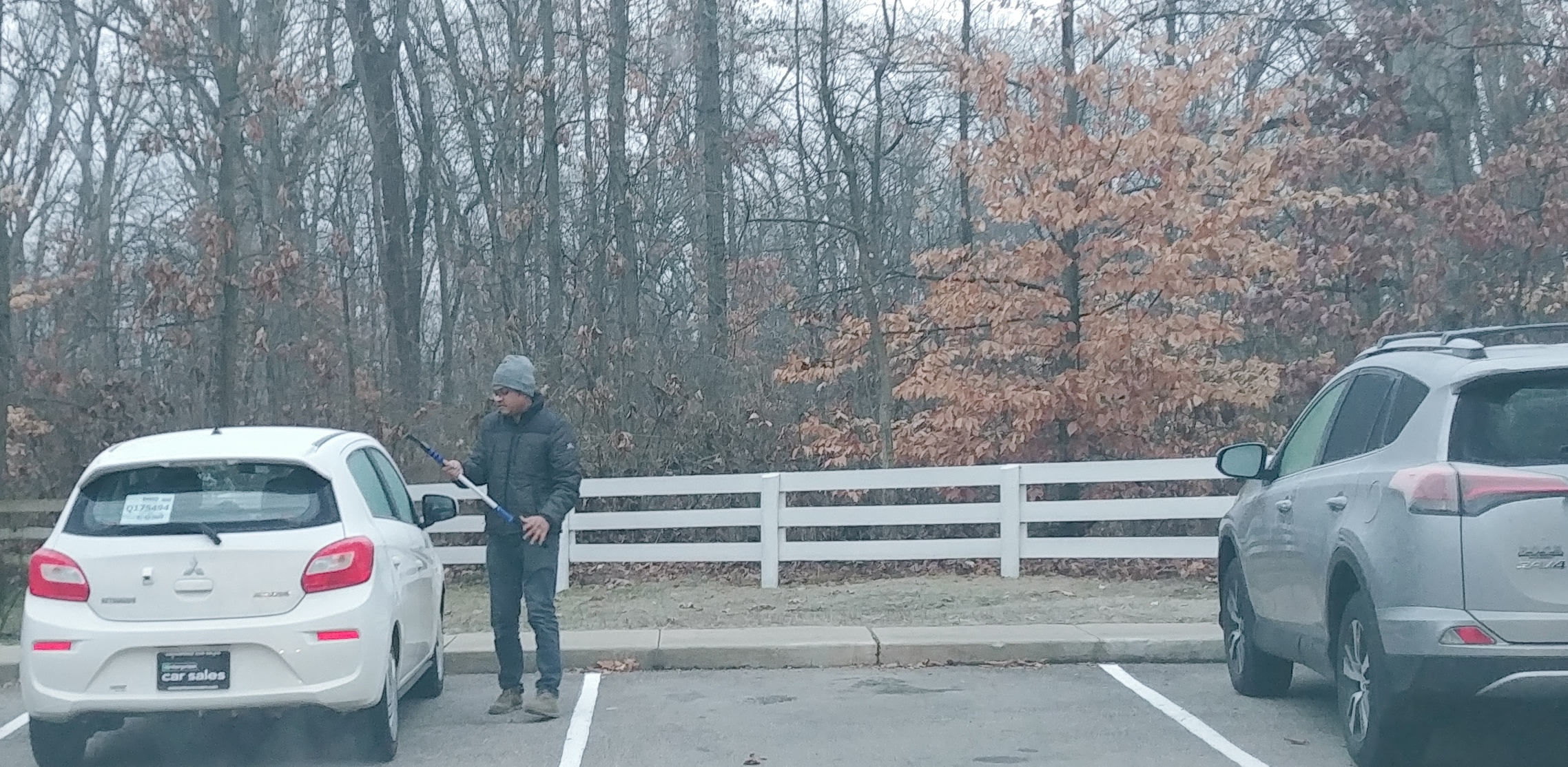
Wintry air greets us, with communal windshield scraping in progress. Stoically adapting to precipitation turned white, deep, and frozen, new Americans discover that, for conversation starters, Ohio weather always wins.
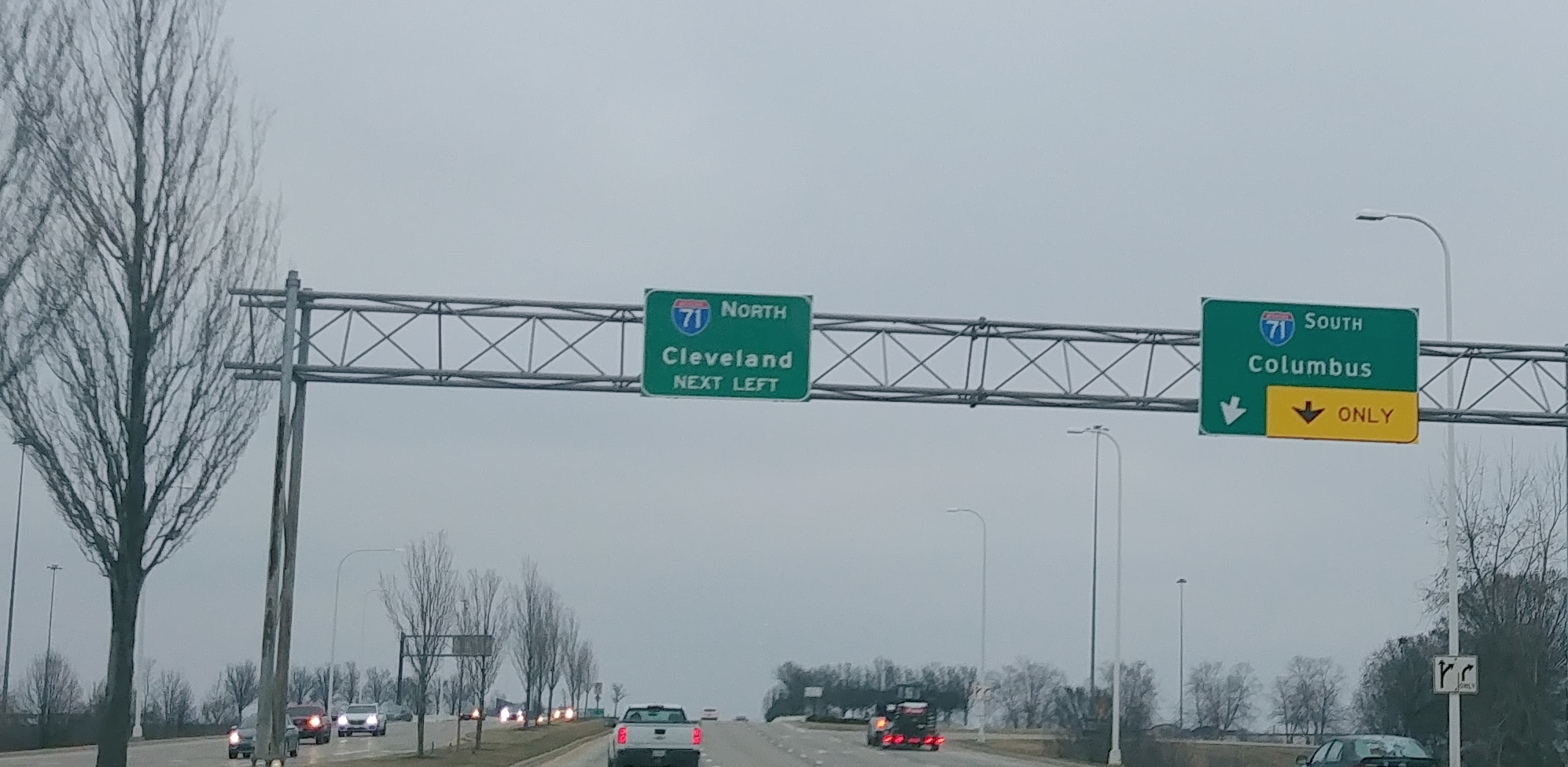
The geotrail speeds north then east, toward Mohican country. Water vapor cocoons, as our spinning planet pilots the hemisphere back toward summer, somewhere far, far ahead.

With the flick of a finger, the freeway rolls our puny pinball off the exit ramp. Turning here and there, we land on the toenails of the Appalachians. Homesteads climb up the hill, opting for space that is wide and open, though somewhat horizontally-challenged.
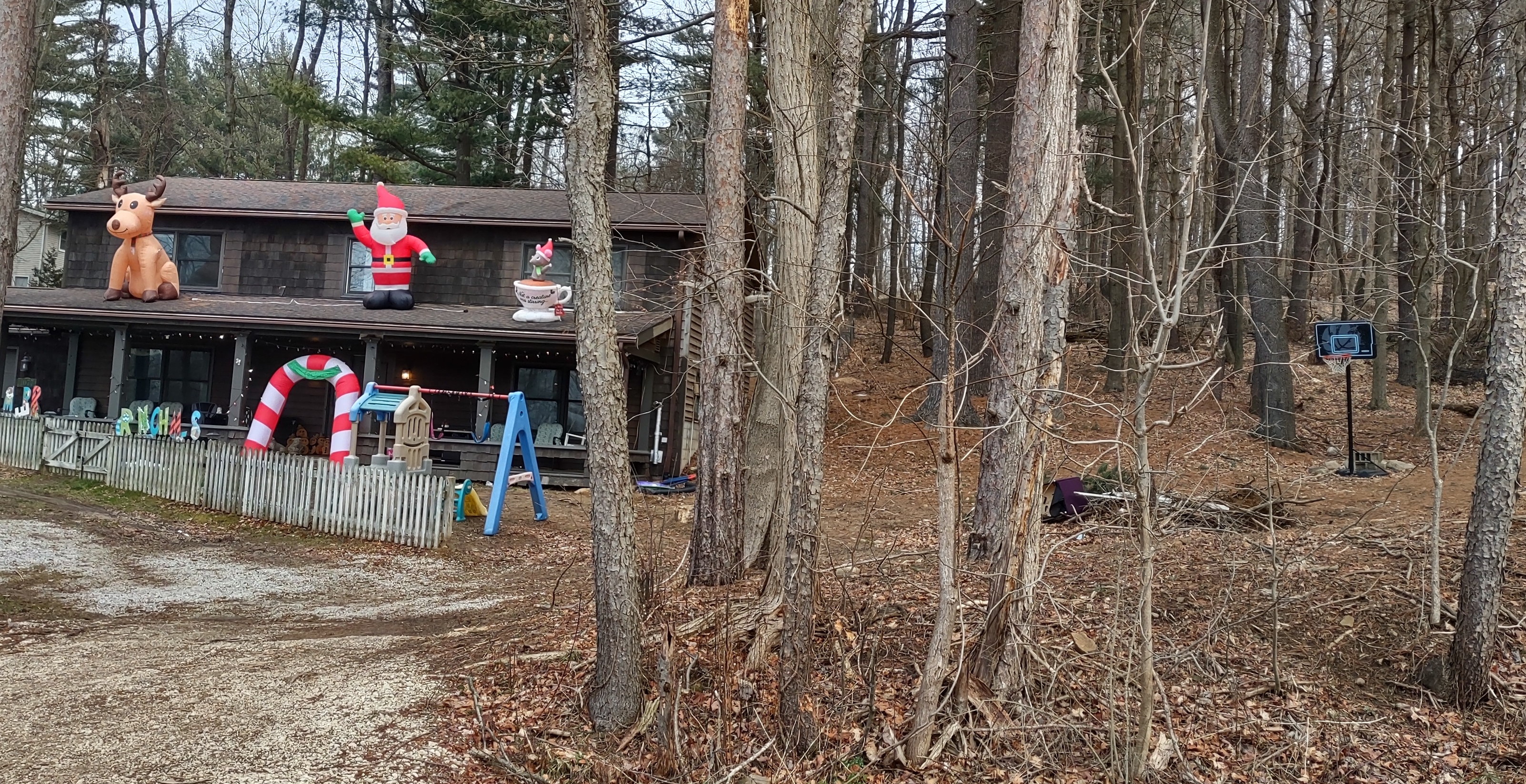
City transplants blend in. Or not. Restaurants, stores, and admiring neighbors are far away. Images which reflect self back to self are lost in immense, empty landscapes, with an infuriating absence of likes or thumbs up.
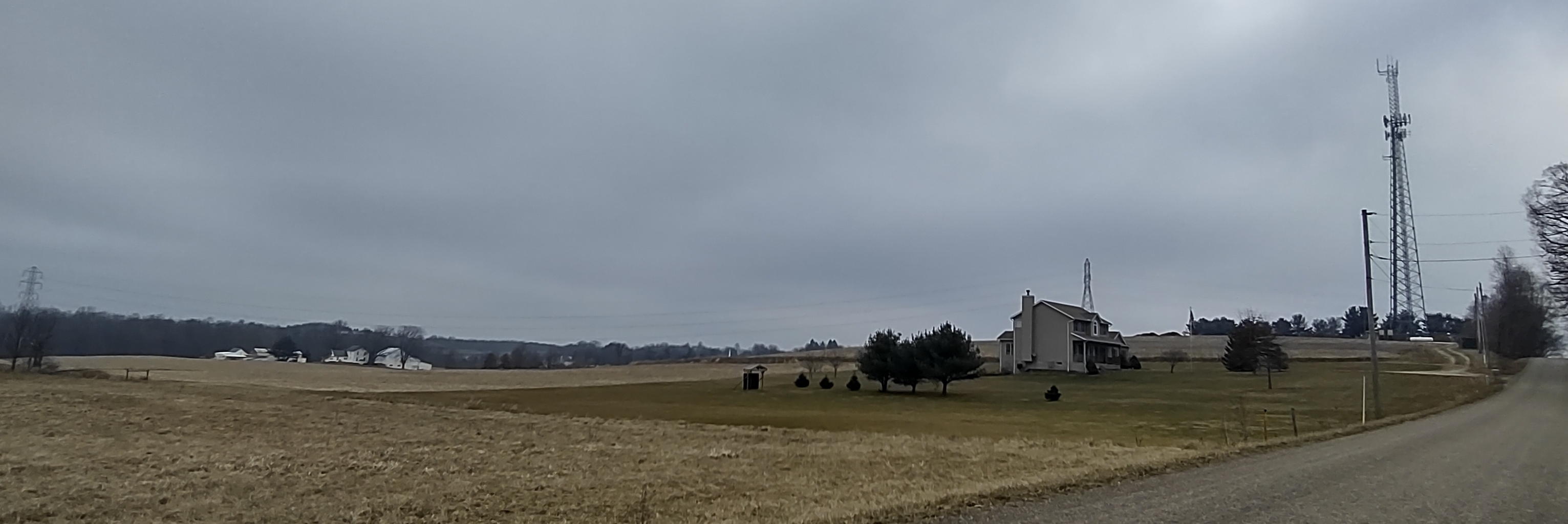
Cell towers follow remote workers into the countryside, tentacles probing the phones in every household. Conscience, empathy, codes-of-conduct, imagination, heritage, and individual determination clash cosmically with data-collection and manipulation.
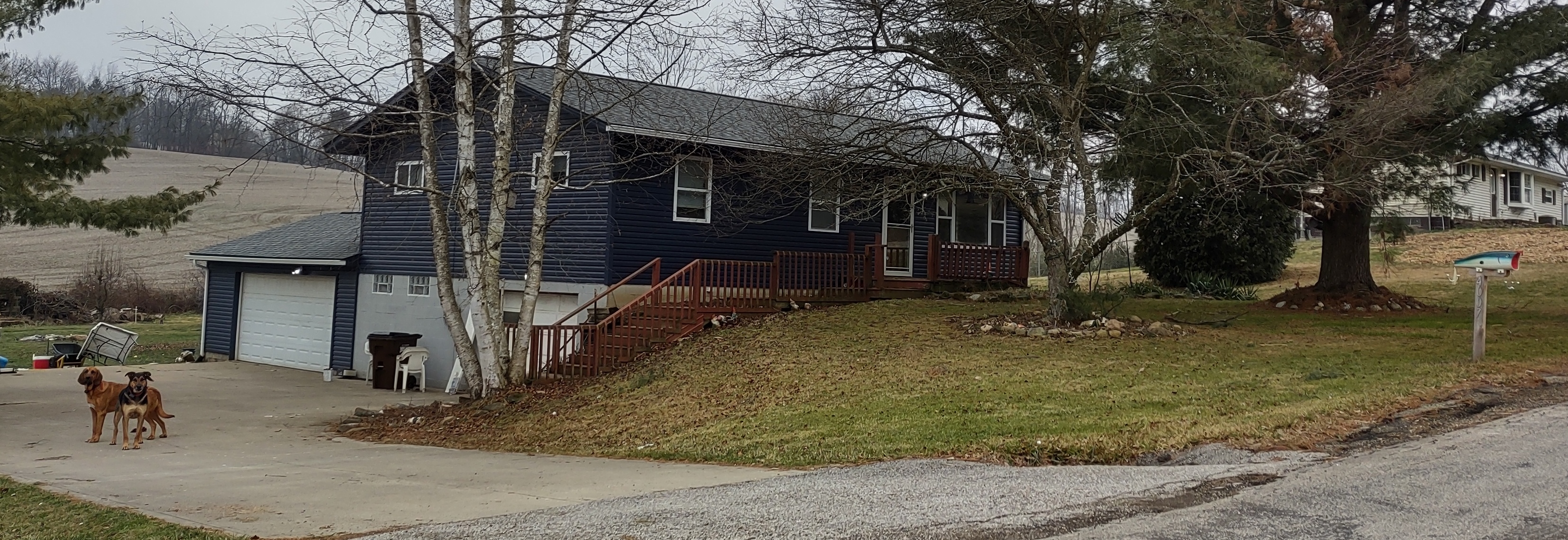
Our coordinates suddenly land squarely, on a road where dogs run free, and mailboxes can be fish. We have to be close, right, Lukas?
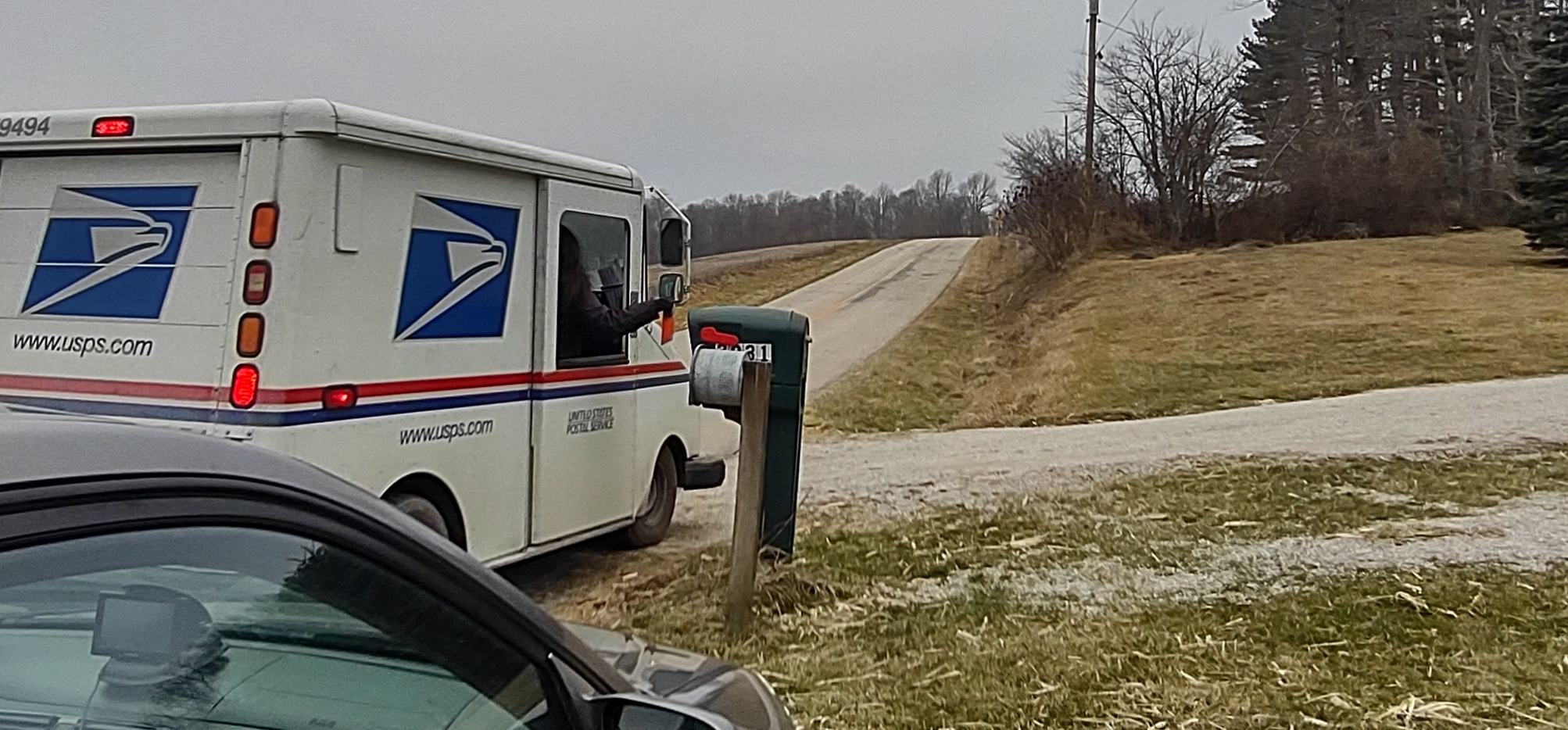
The mail truck pulls up.
You girls okay?
At that second, the bait can beside the mailbox catches our attention.
Yes, yes, we are. Just getting a geocache out of that can. (You really should be honest with the US Mail, shouldn’t you?)
Well, I always wondered what that thang was for. Is that like a Pokemon thang?
Not really, but okay.
Conversation over. Yes.
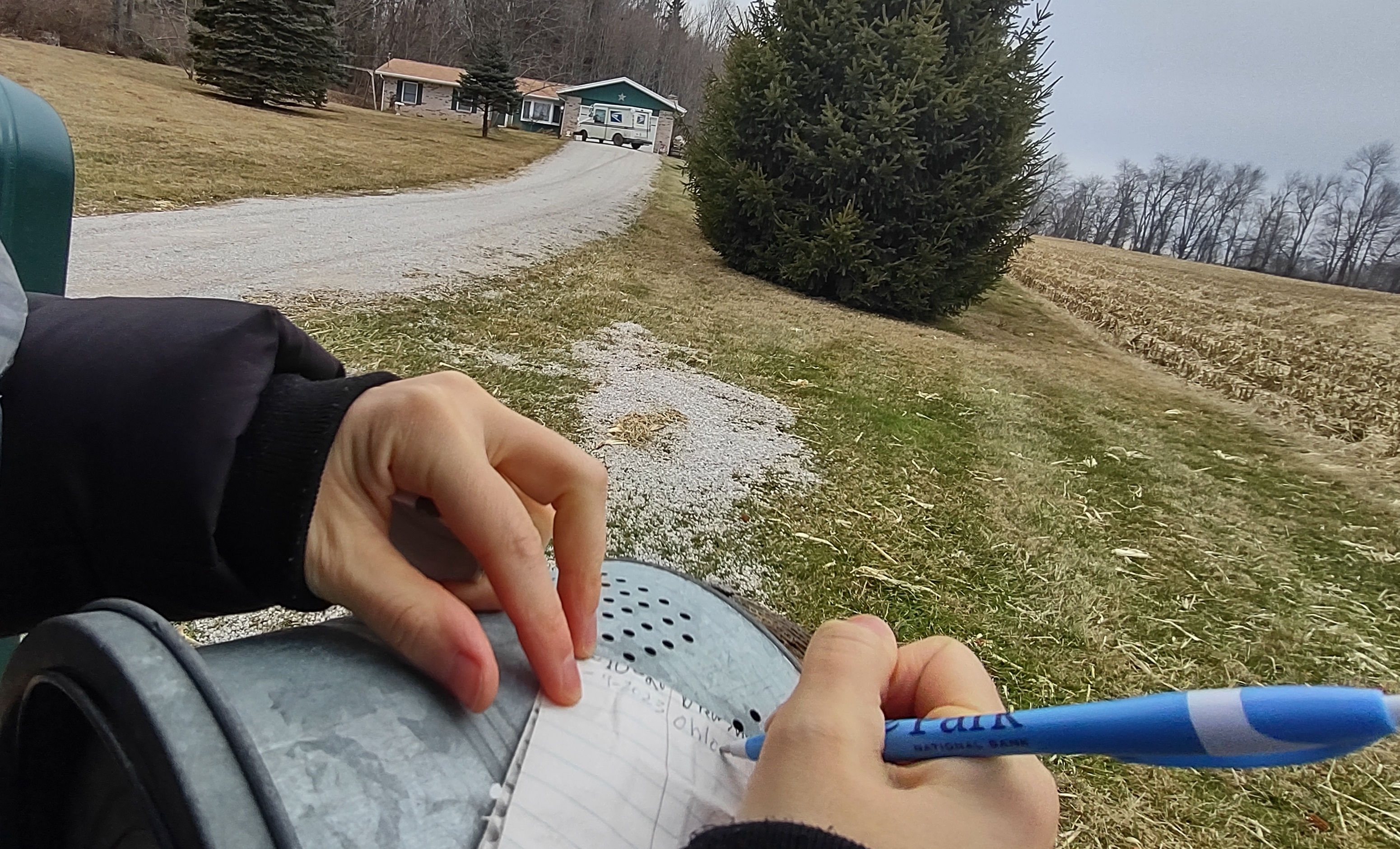
The cache is hooked. Previous finders gently cherish the story of Grandpa and grandson, fishing and caching together. In a great circle of connection with us, the mail lady, the watching house, the log signatures, and the sharing of a beloved bait can, happiness settles, with plenty for all.
-
Alder’s Stash
Cache Owner creekstompers has watched loggers come and go for 14 years. We will be next.
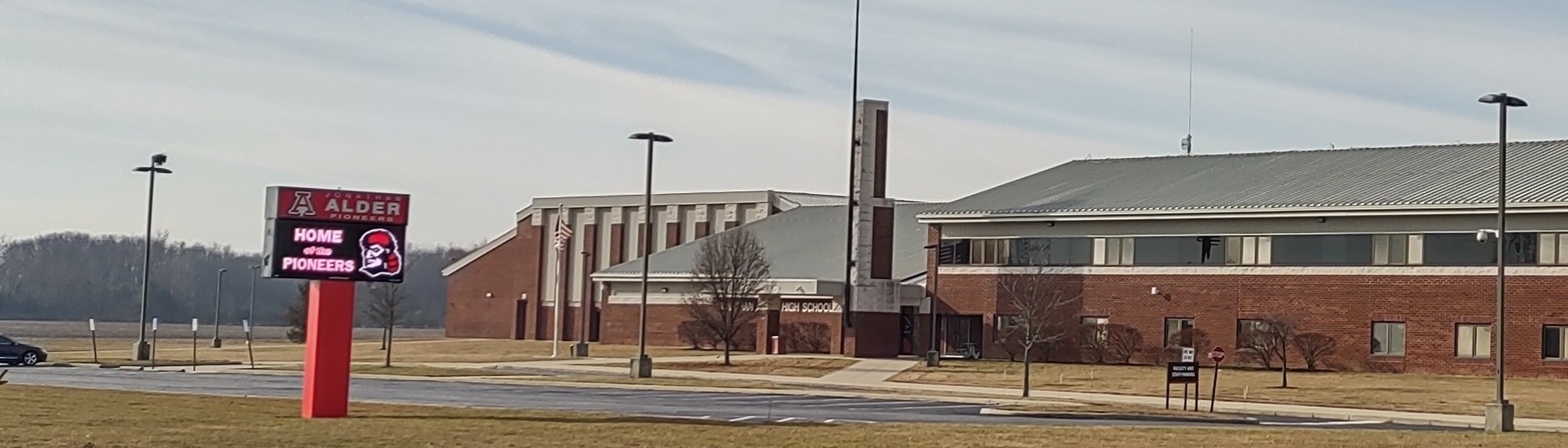
Our last geotour in Madison County spirals through pioneer history. With an entire school district chanting his name in gyms and stadiums, the legend of Jonathan Alder still beats a drum.
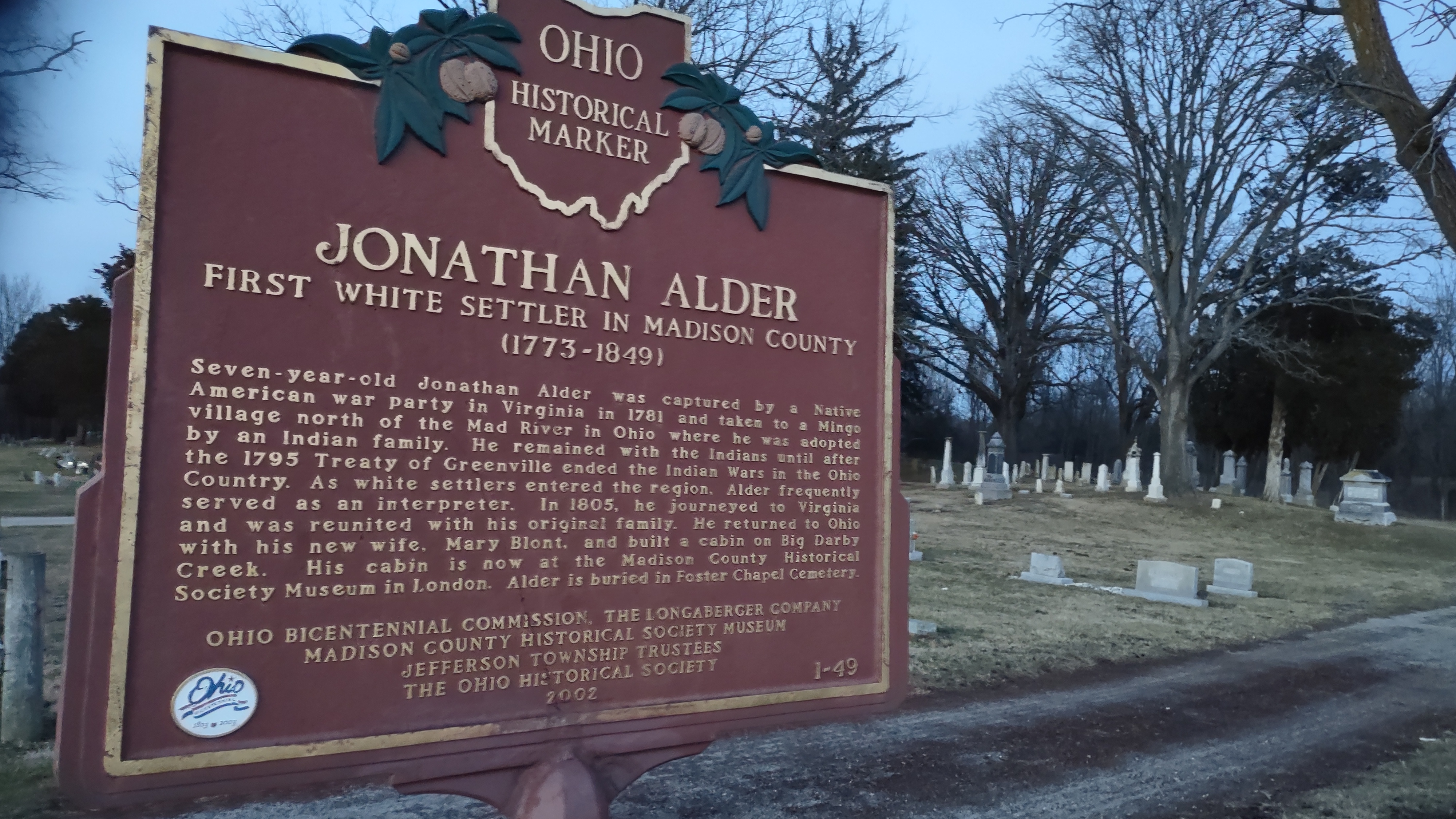
Coordinates lead to Foster Chapel Cemetery, where Jonathan’s grave still stands. Kidnapped by tribal warriors, he lived and hunted as a Mingo brave, fighting with Blue Jacket against Anthony Wayne and the American army.
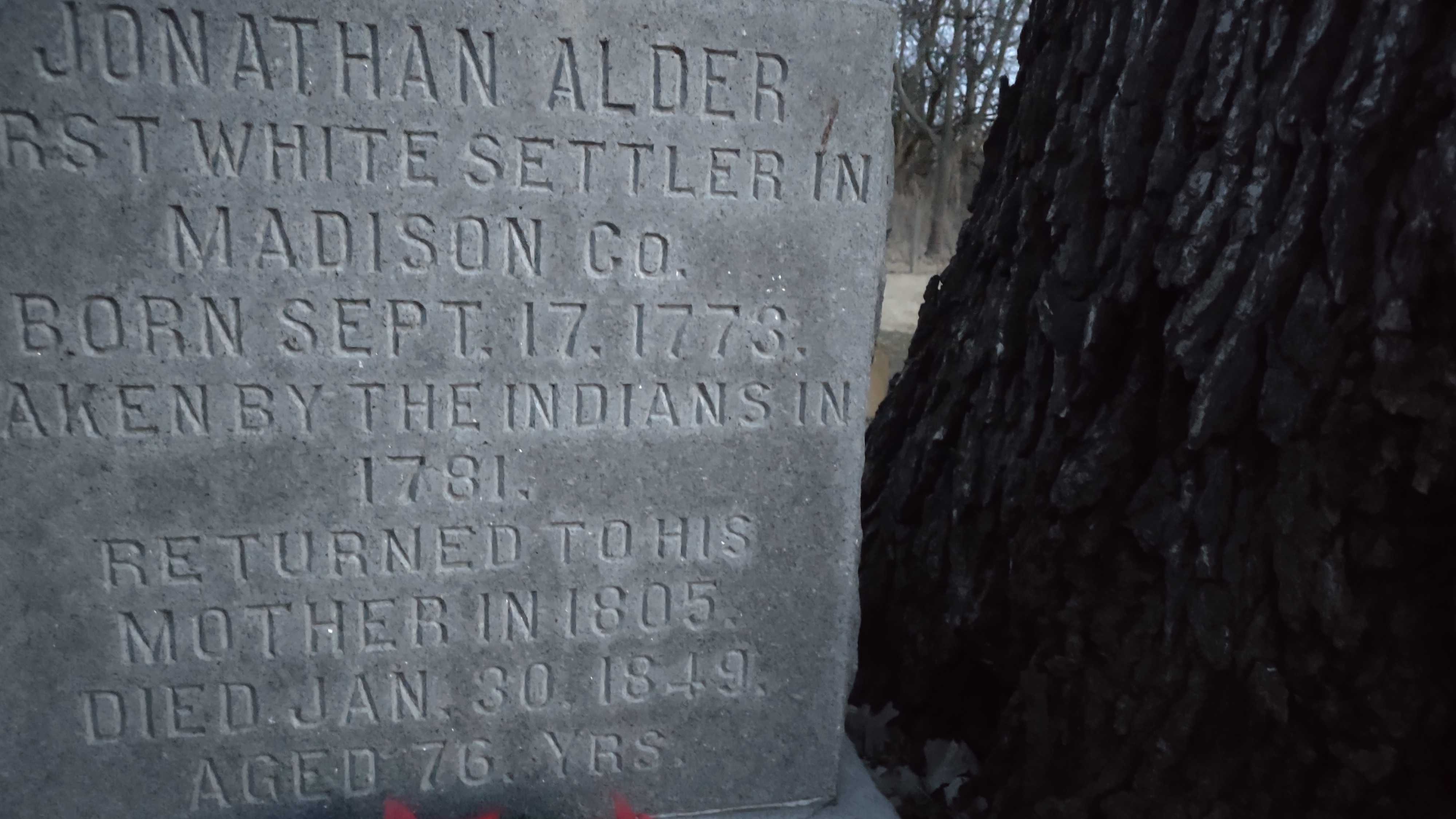
When the Treaty of Greenville pushed tribes further north, Jonathan settled near Plain City, managing a thriving business, selling milk, butter, pork and horses, and relearning English. He built a cabin along the Big Darby, fathered 12 children with a wife from Virginia, and joined the American side in the War of 1812. In that early conundrum of identity and ethnicity, Jonathan worked it out.
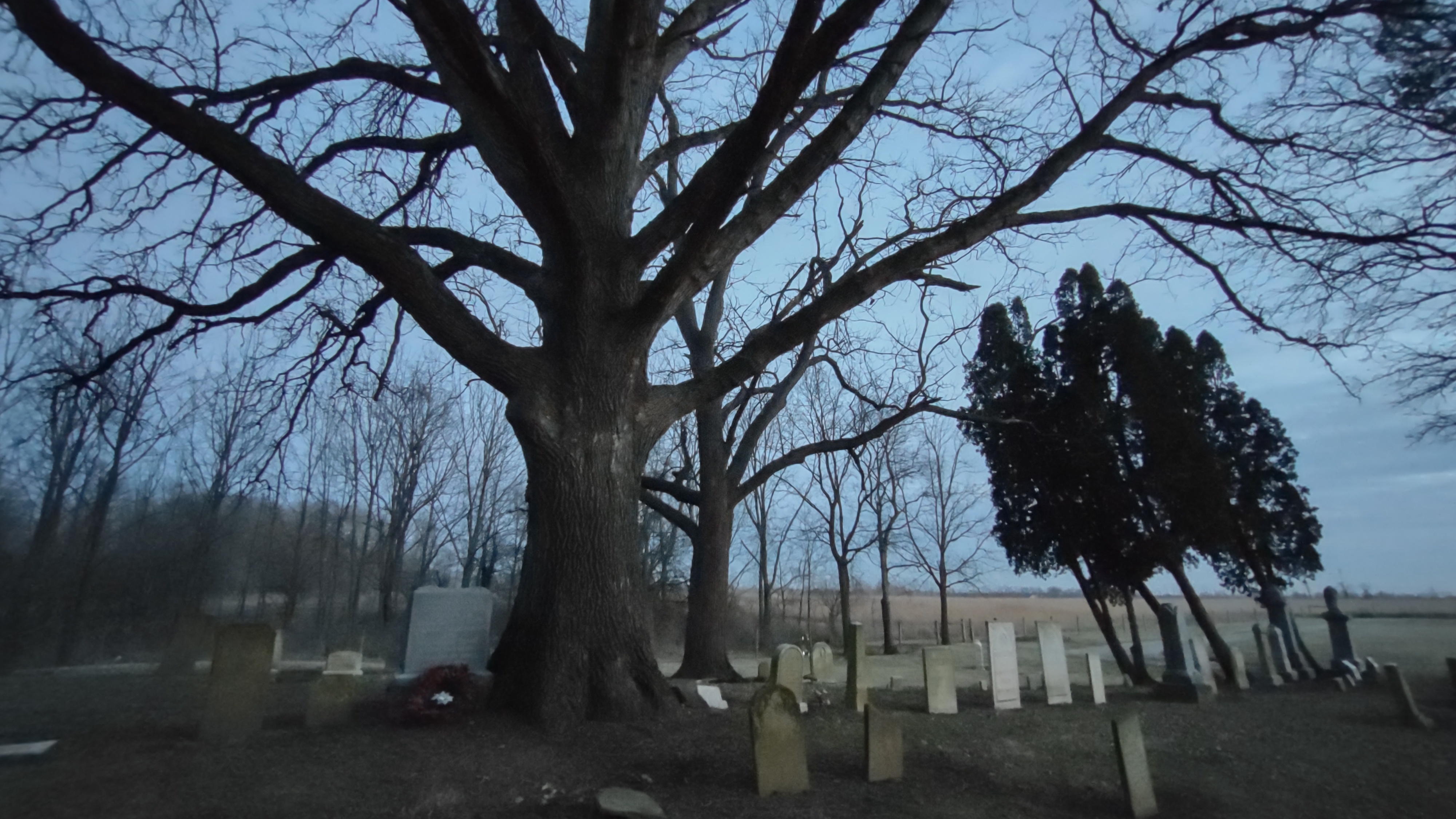
The monarch now sheltering his grave lifts arms high and wide, strength of trunk and bark and leaf beseeching all pilgrims to tread tenderly over this wounded land.

Cache loggers respond in kind. A logger on his own journey to his father’s funeral finds solace in this place. A daughter who lost her father to a senseless killing now visits his grave here, with her mother, and logs the cache.
The story of a teenage girl, assaulted and murdered along the back fence of this cemetery 21 years ago, is logged and held gently, with compassion and sorrow.
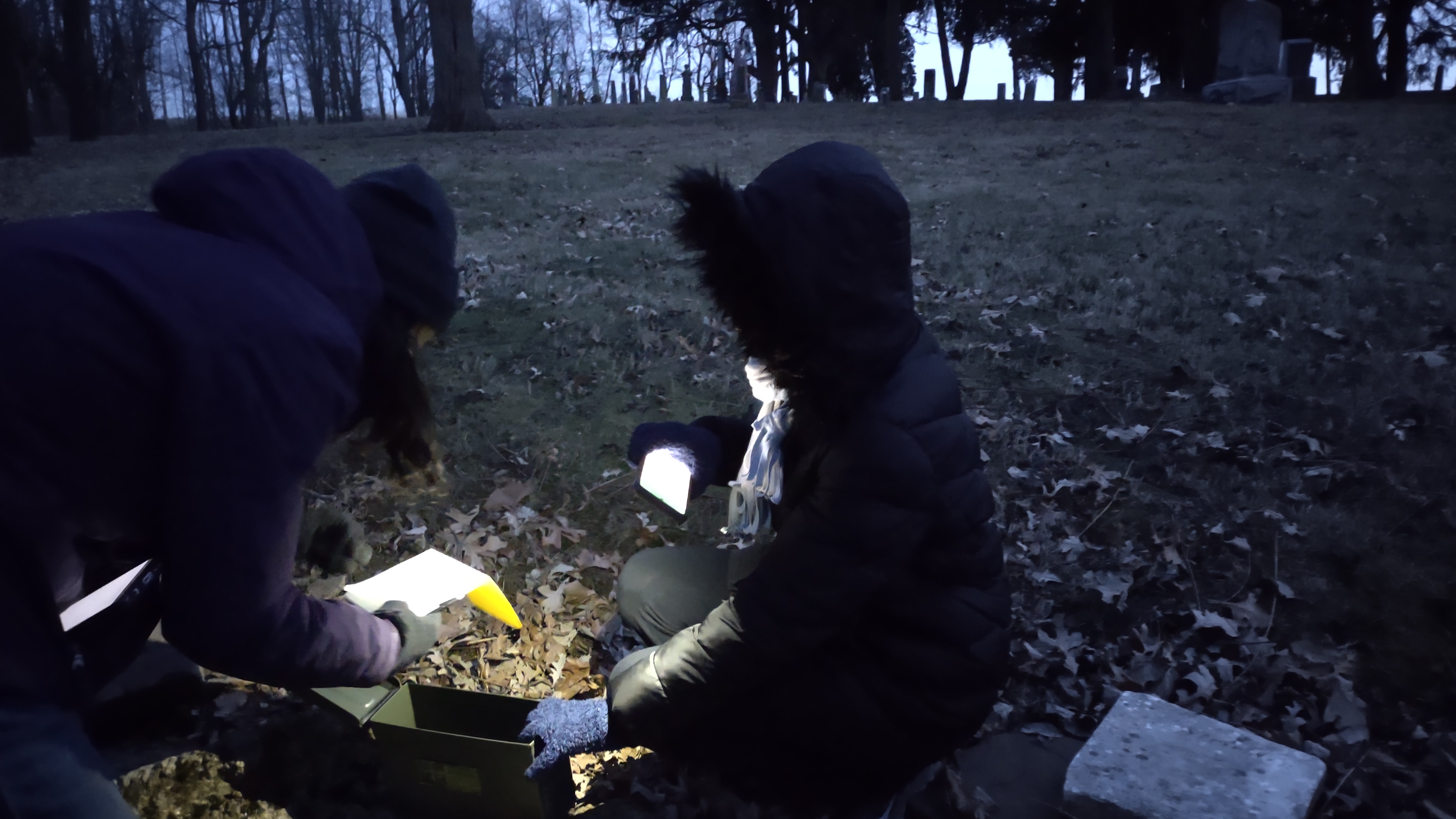
On this short day of daylight, peering shadows sneak and slink.
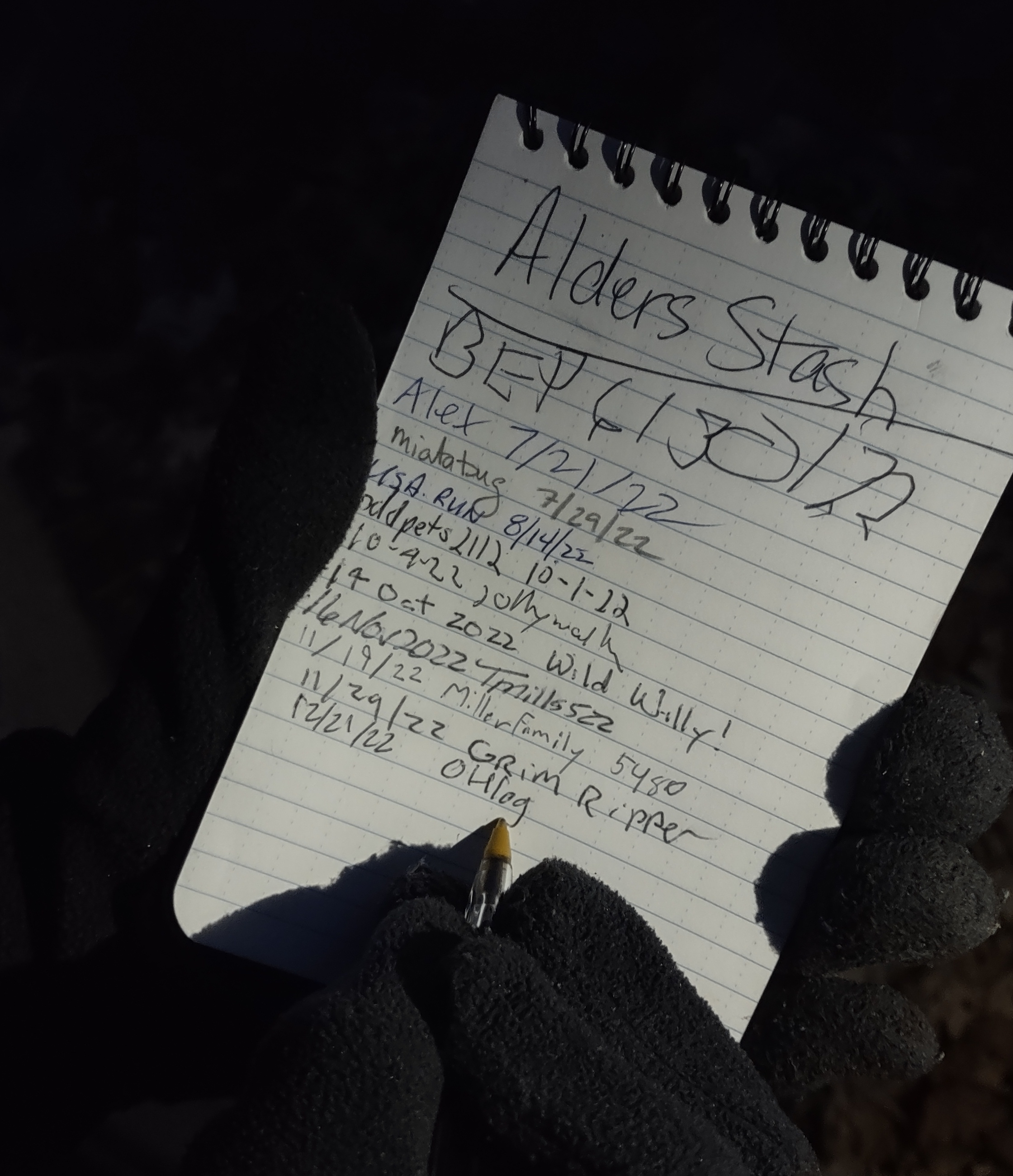
The previous signer does not show up in the online log. With macabre humor, the darkness deepens around us.
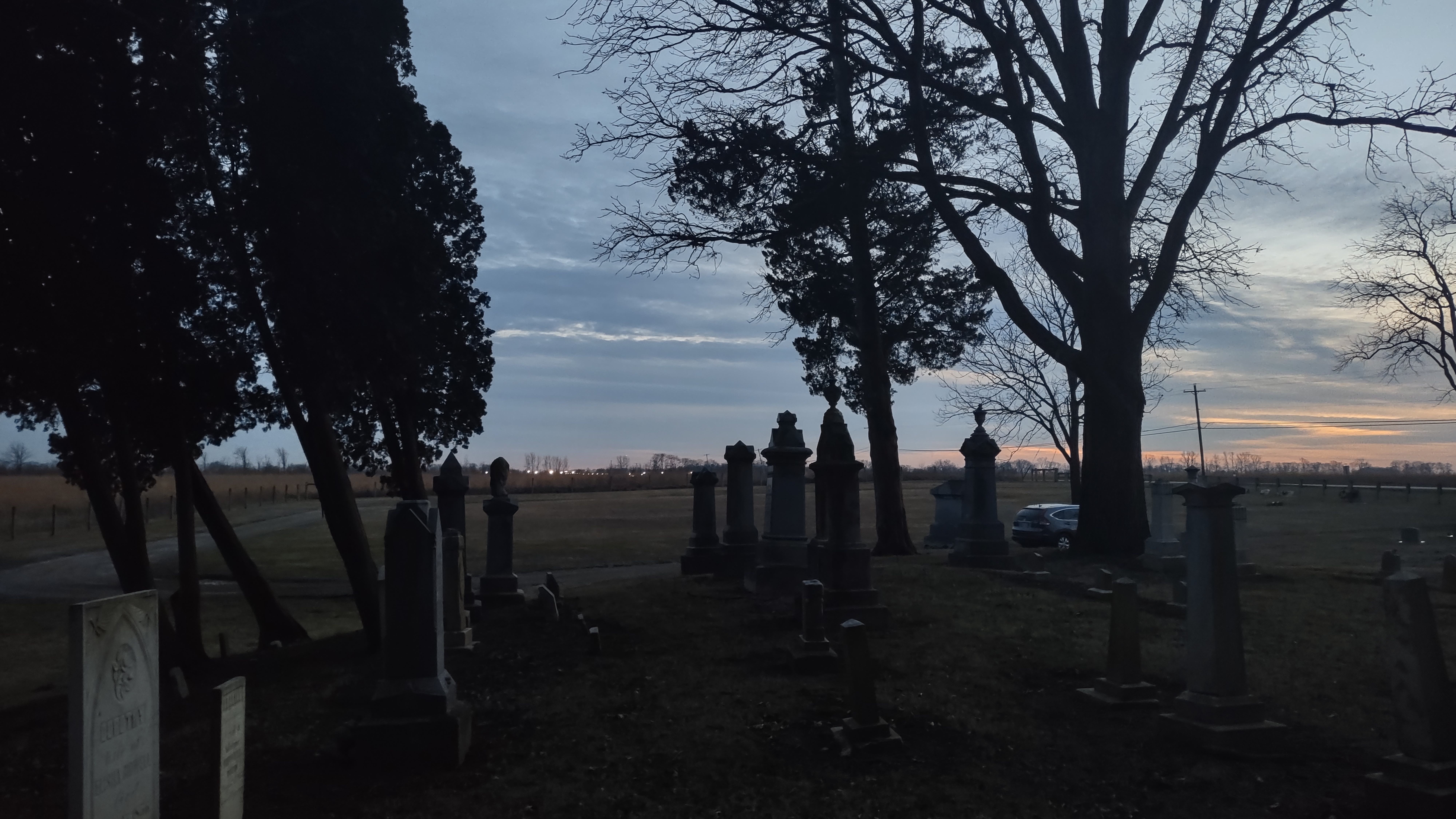
We walk quickly, turning our faces toward those who have walked before us, in a circle of belonging, meaning, achievement, fellowship, and strength.
-
Simply Snyder Lane
A 12-year-old cache placed by Cache Owner raiderdad drops us north of London, home of raiderkids.
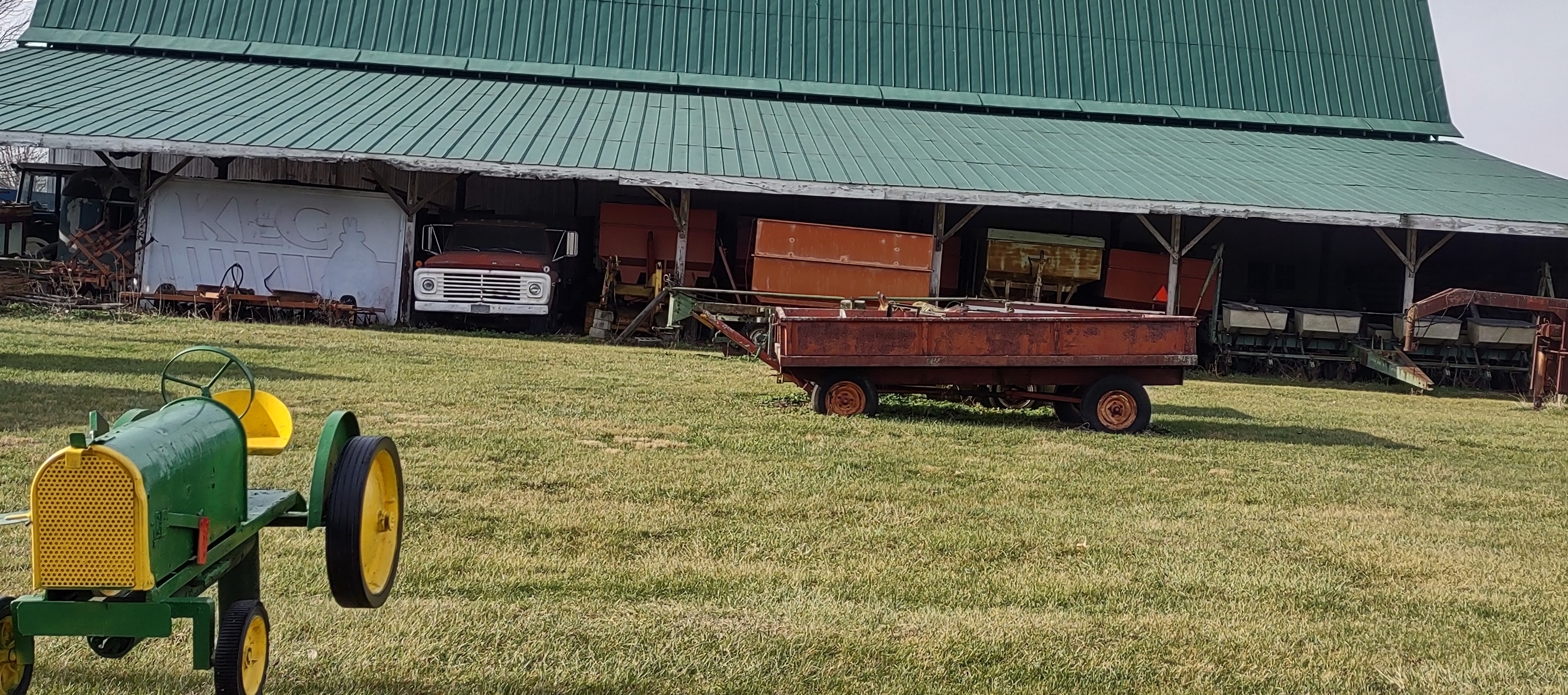
Old farm machinery nods sleepily from the retirement home, waiting for time to take its toll.
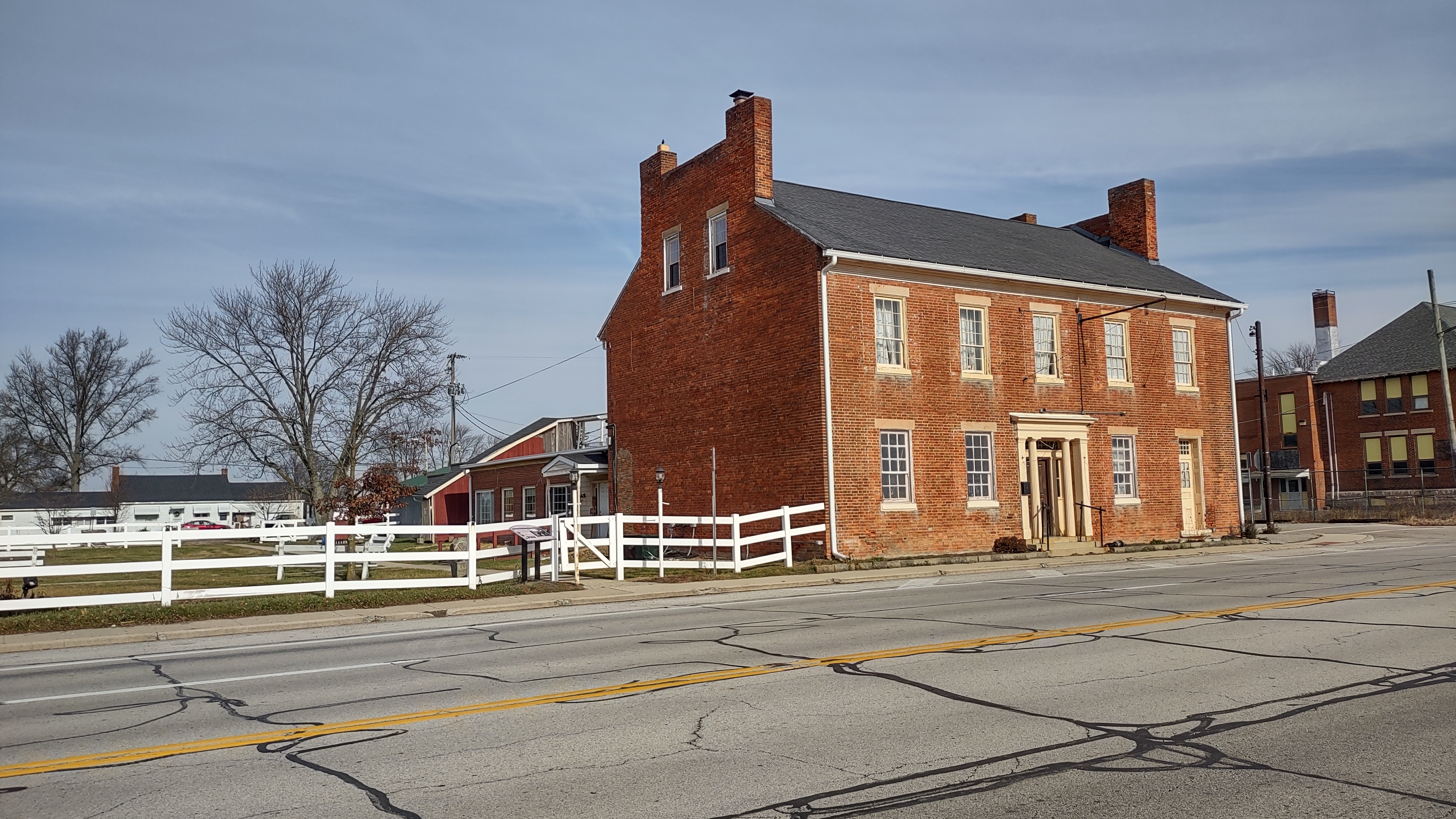
Down the road in Lafayette, history rules, in a brick building so solid two centuries could not move it. As practical and sturdy as its own name, the Red Brick Tavern stays mute on other names it might drop, from Adams, Harrison, and Tyler, to Taylor, and Harding. Here those who aimed for the seat at the top lay down to rest on their bumpy, National Road journey across Ohio.
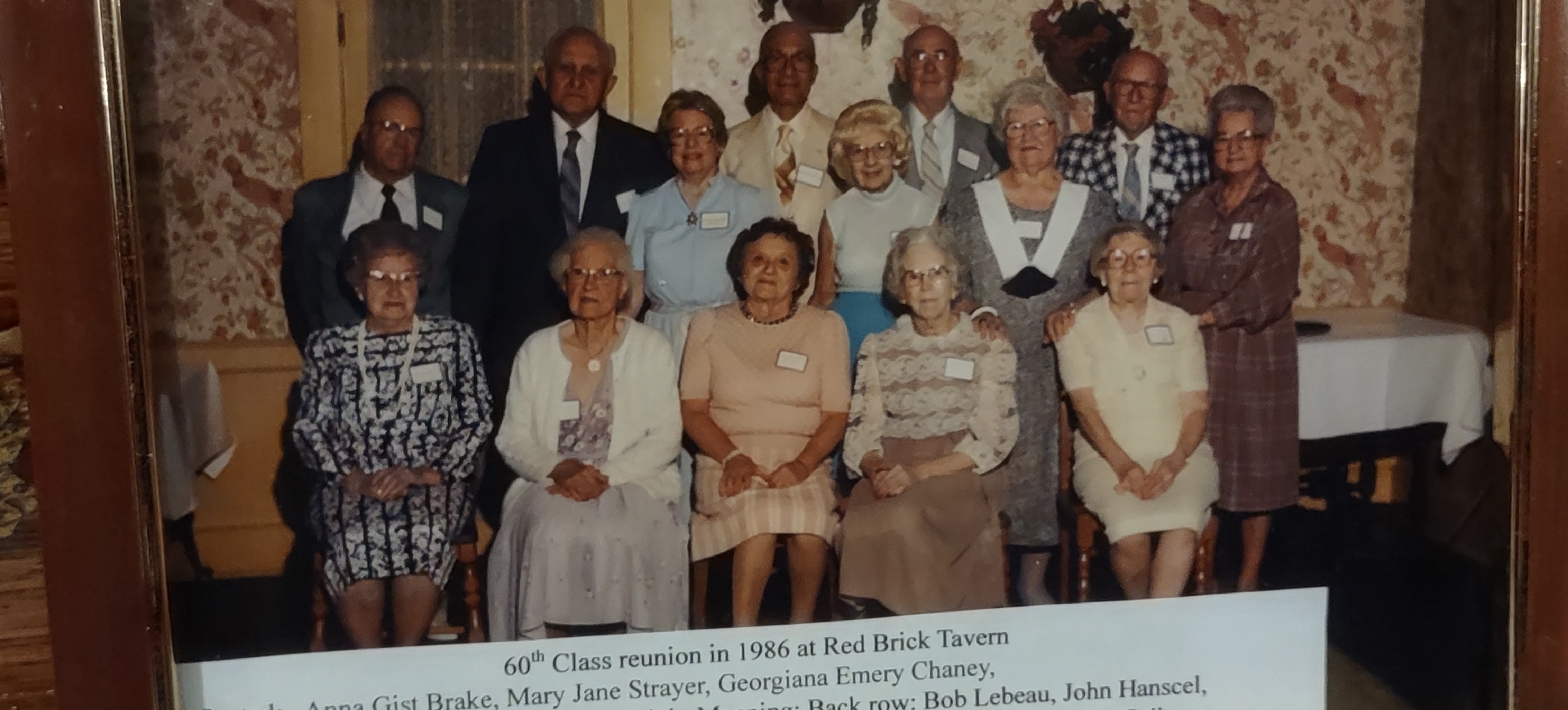
While shooting stars rose and fell in the political galaxy, people of Ohio came to the Tavern for birthdays, reunions, anniversaries, and every celebration of life. When the Tavern was purchased and remodeled last year, joy rebounded across social media, with 795 shares.
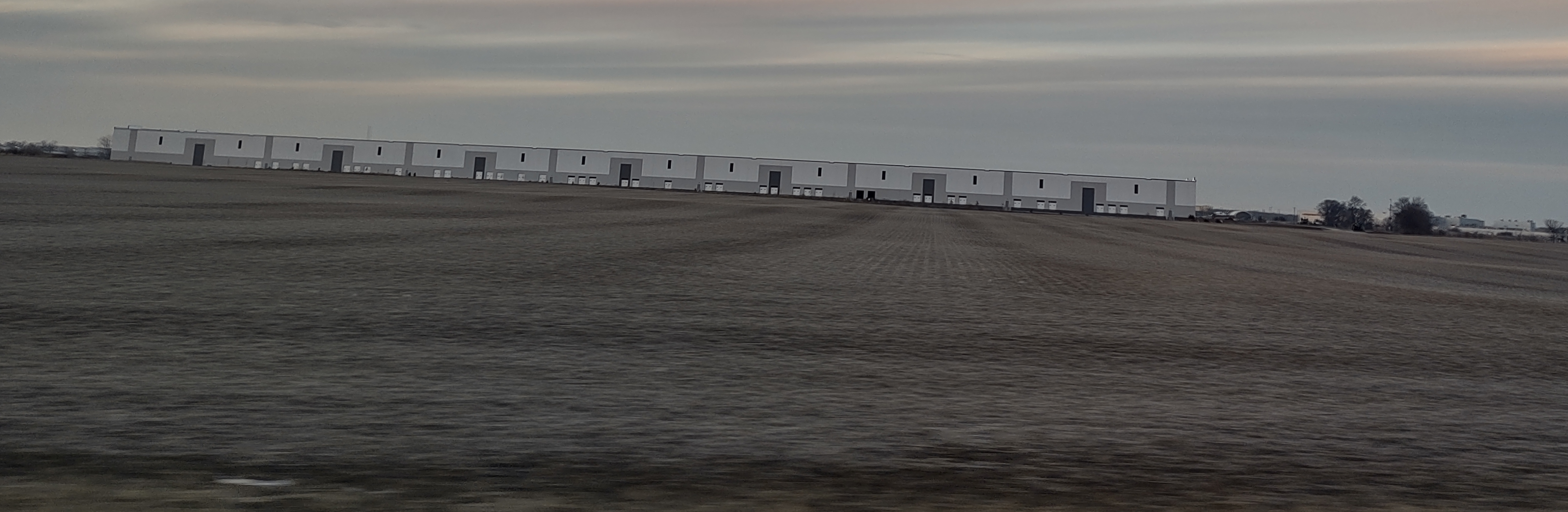
In the other direction, Presidents who worked to stretch roads, then canals, then railroads, and then airports across this land might admire the slowly creeping warehouses feasting on the soil.

Arterial networks pulse with the beat of goods flowing at warp speed from eyes to screen to mouse to click to credit card to warehouse to truck to driver and back to eyes. Township trustees rezone land, already tired from corn and soybean overfarming, into warehousing.
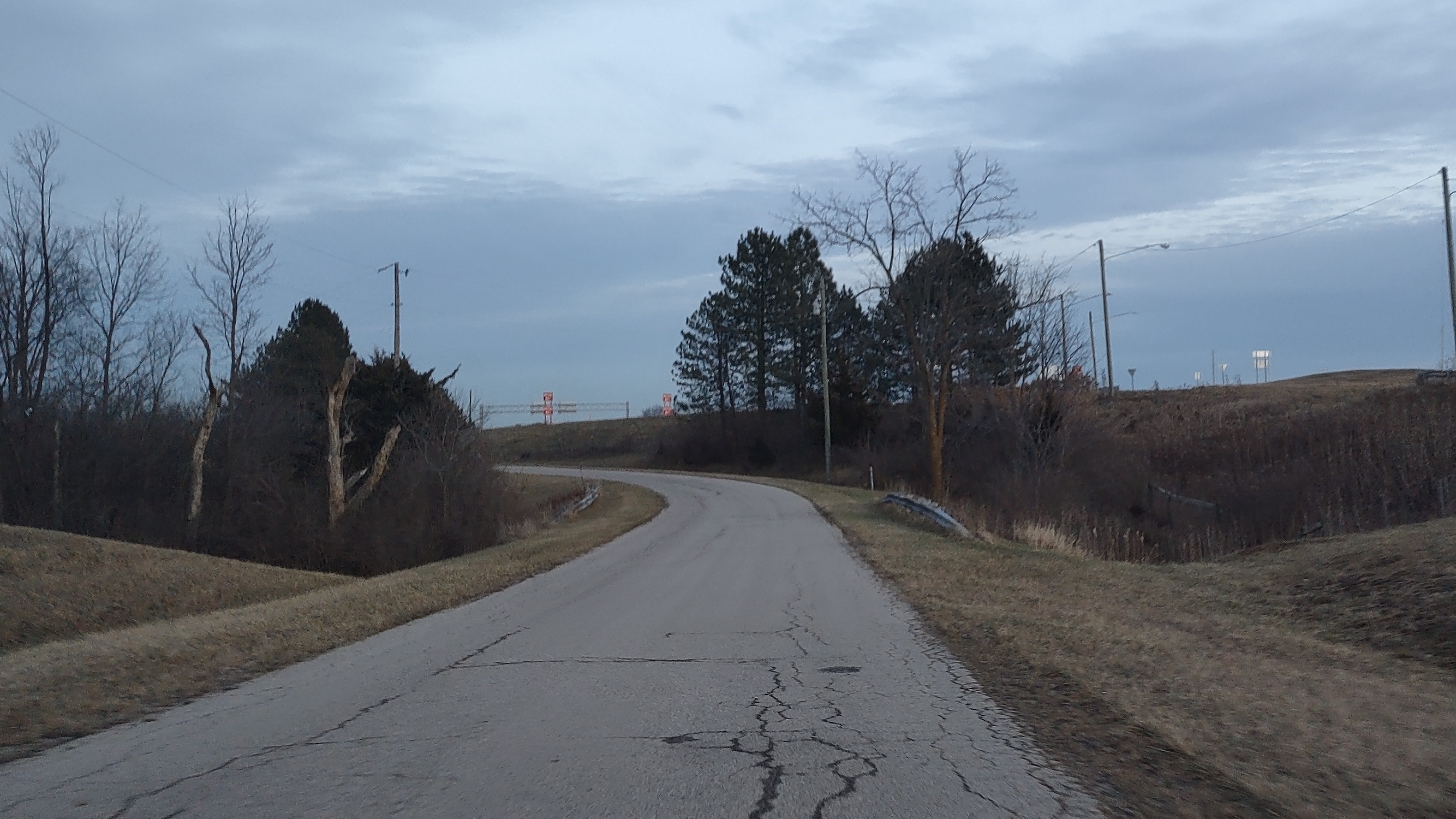
Coordinates circle to a GR, soundlessly being itself. Previous cachers answer to a roll call worthy of a Disneyland parking lot: MO, KS, IN, CA, WA, IL, FL, IA, PA, OK!
Wildlife also come calling to greet the Two-leggeds, insisting on shared partnership when the log is signed. Logs record a lazy squirrel multi-tasking between sunbathing and guard duty. Turkey buzzards watch cachers hungrily. And five deer enlist, all signing the log as Bambi.
On our way home, aliens pulse from the darkness, newly landed to meet our every need and want, at a click.

We drink a last long breath of sunset spilled across fields still free.
-
Sugar Maple Trail
A fifteen-year-old gift from Cache Owner Doing Time beckons bashfully from the boondocks.
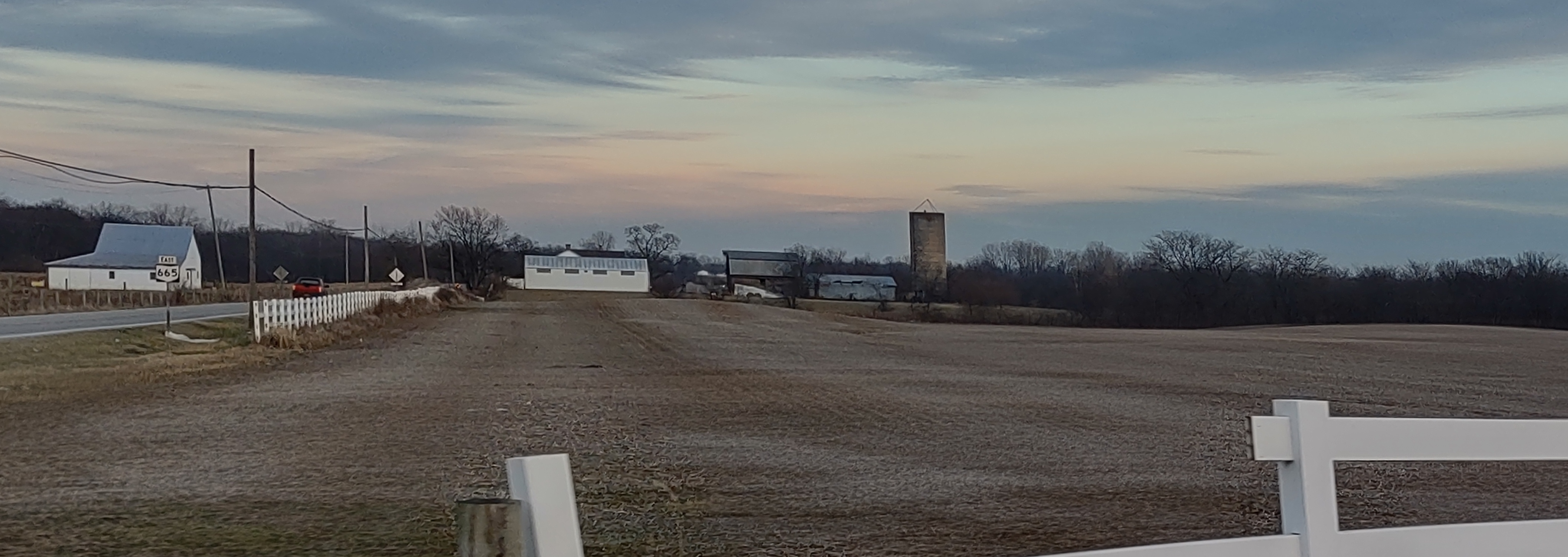
Winding through the spaghetti bowl of Columbus freeways, we exit I-70 to Route 42, turning onto Spring Valley Road. With the silent softness of a sleeping Siamese, the land ripples, dependent on yet master of the farmer who claims it.
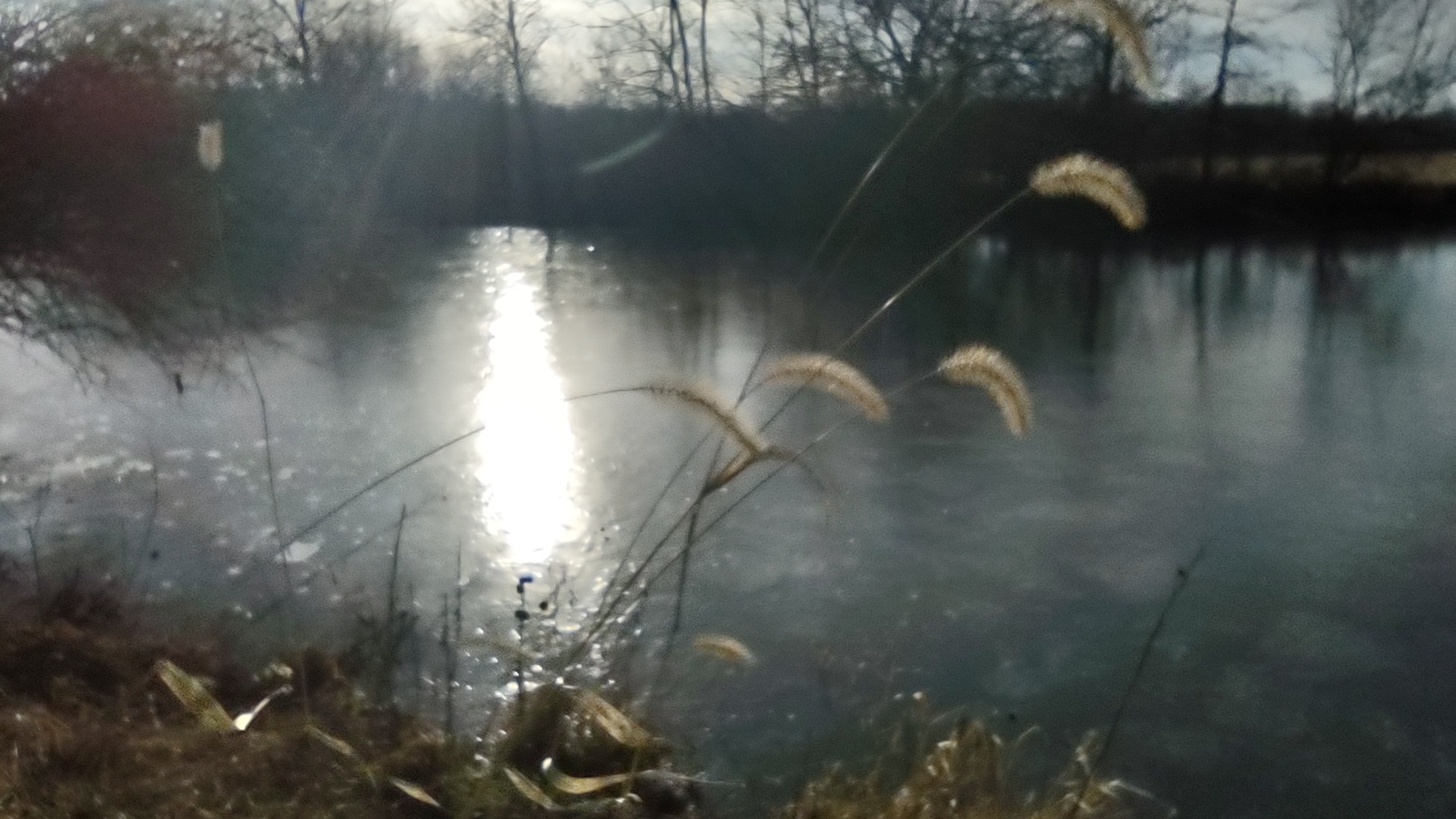
Ice flashes across a frozen Deer Creek, quivering in serendipitous sunlight. Among these broad fields linger long-ago litheness of Shawnee, Wyandotte, Mingo, and all tribes sharing this public hunting ground. Immigrants cultivating today’s sod farms harvest armories of arrowheads, once clasped in tribal palms, then held by two centuries of soil, now handed to the future.
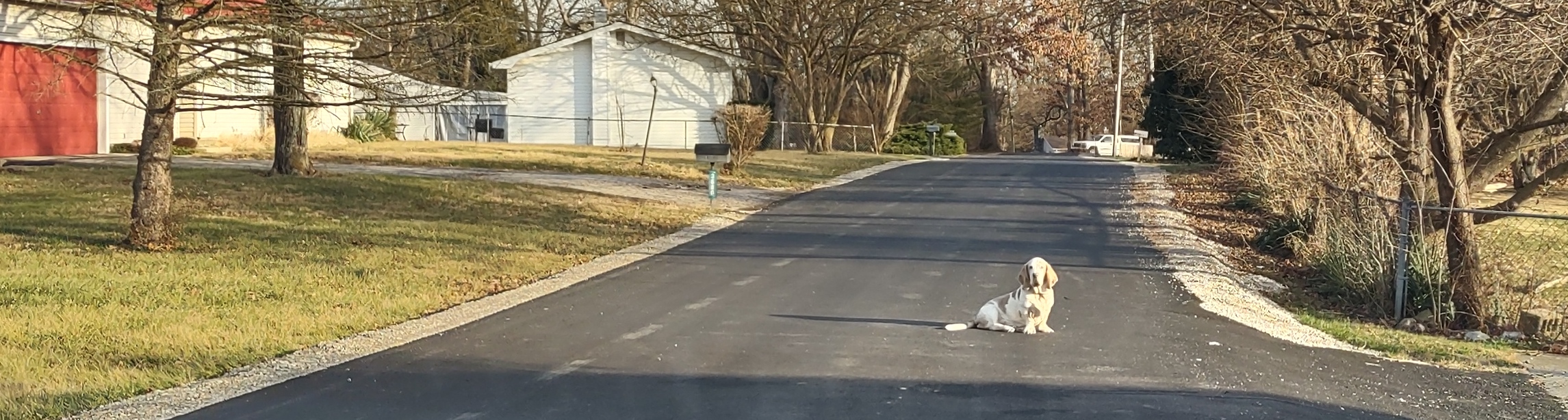
The damming of Deer Creek forms the jewel of Madison Lake State Park, now blocked by a politely dogged obstacle. Shamed for not being the loved and long-awaited master, we creep by.

Gnarled cloud fingers unfurl across a darkening sky, warning of the coming storm. Still, we will prevail.
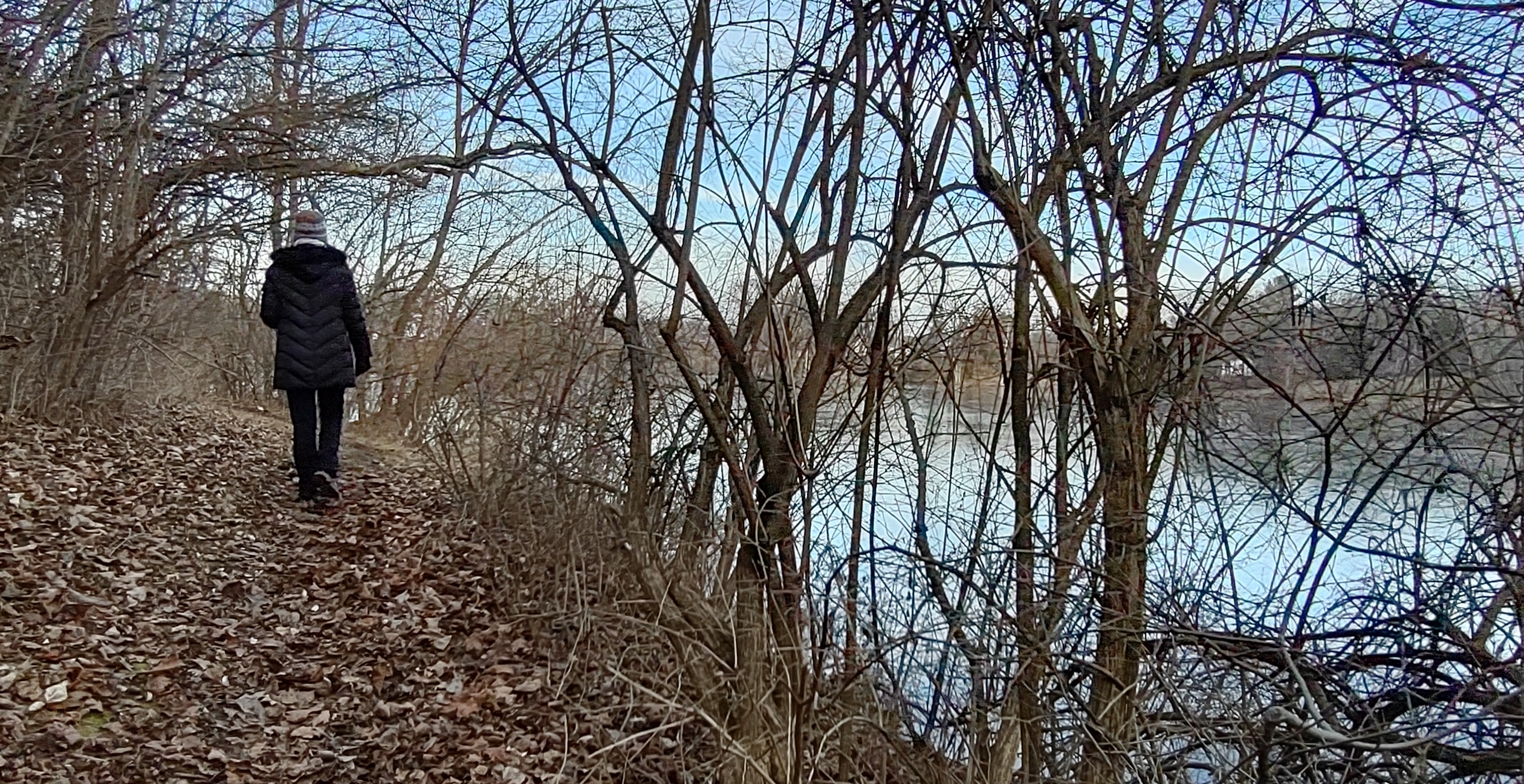
Coordinates lead us to the Sugar Maple Trail. In 2016, Cacher Tripple Shot began checking on this decade-old cache. In 2021, Tripple Shot replaced the container and the log. Two more cachers followed, describing the container as broken and soggy.

Two months ago, Tripple Shot ruminated on the meaning of the Cache Owner Doing Time, and accepted de facto adoption of the cache. Like all cache owners, Tripple Shot will make an investment which repays no dividends, no interest, no promotion, no political capital, no engineering of plant or human, only careful guarding of a tiny vessel in a distant place, and the gratitude and goodwill of nameless strangers.
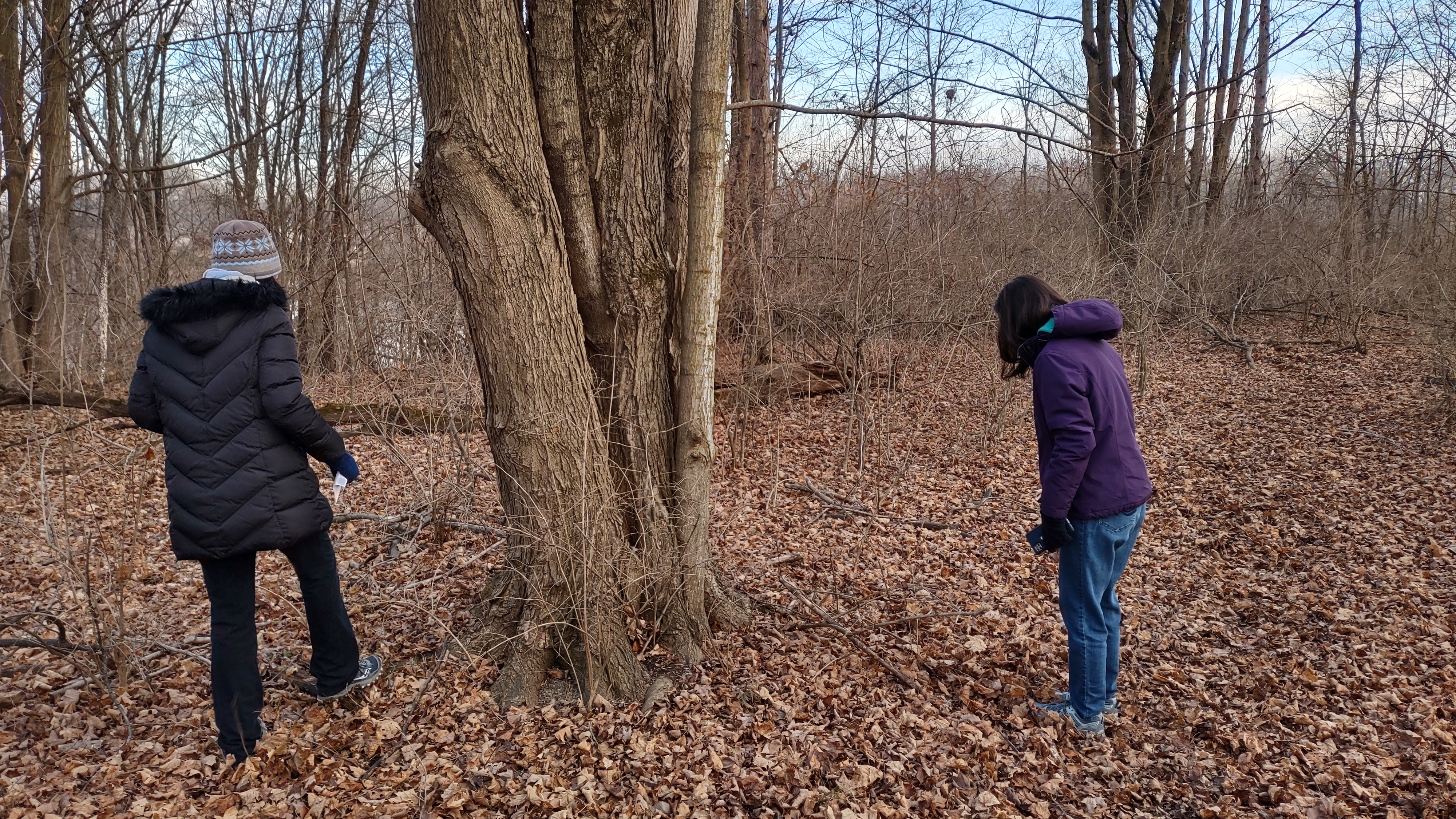
Tucked into a tree trunk, the abandoned adolescent is given a cool new geocaching pouch, dry drawers, and another 15 years of life.
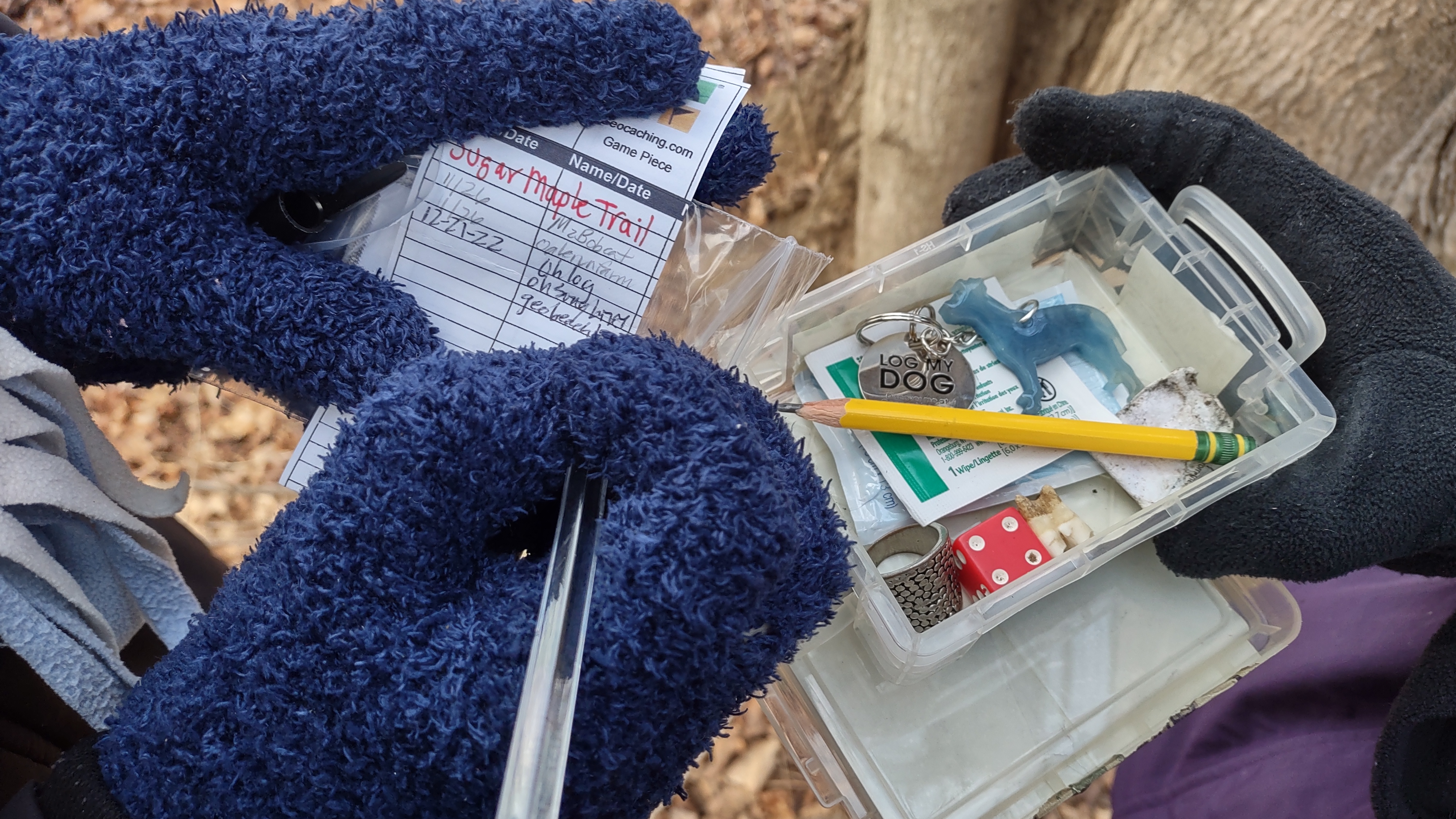
Past logs tell us that, for this year’s Thanksgiving walk, Grandma brings her grandson caching, and they leave a trackable. When she goes to log, she sees she found this cache 12 years ago.
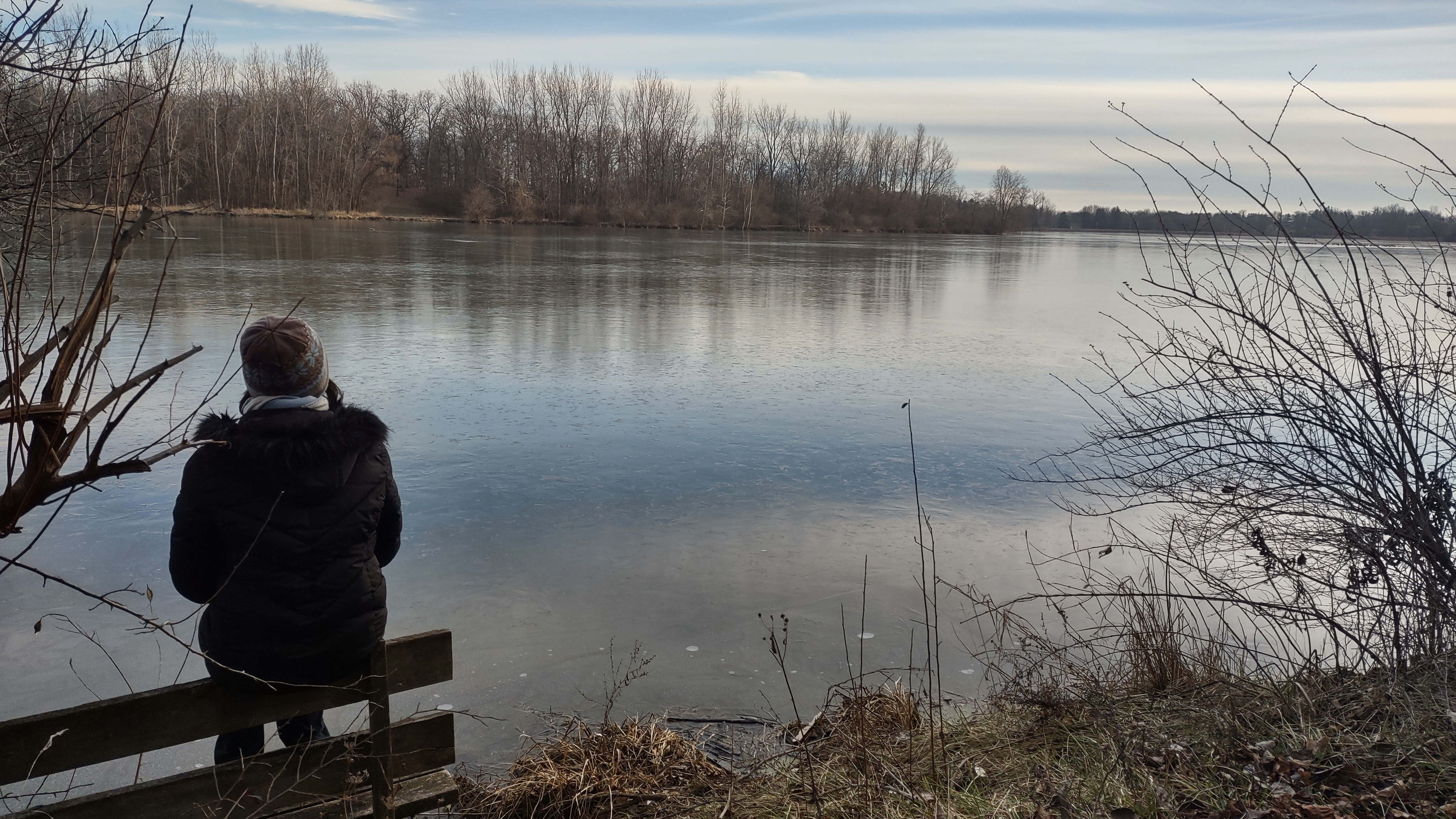
Anchoring our hearts to the places we love, the gentle graces of this and all cache owners walk with us back down the trail.
-
Company K
With her 2014 hide, Cache Owner msmandi circles us through the arc of history.
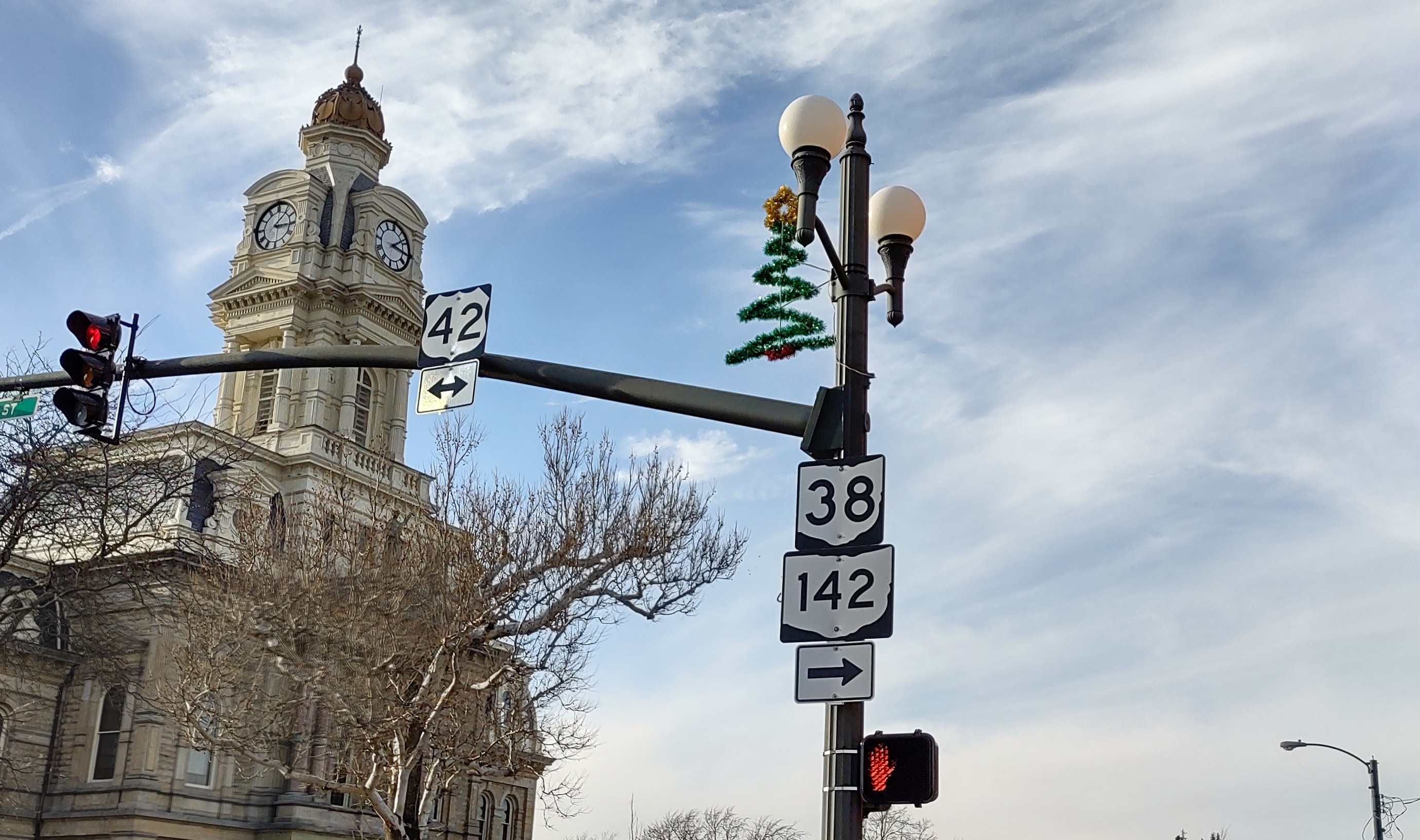
We trace the curve of south-bound 270, and then westward on I-70, crossing the Madison County line, slowing to fresh-air-speed on Route 42, and finally landing on a spider web of roads, converging at the mothership in downtown London.
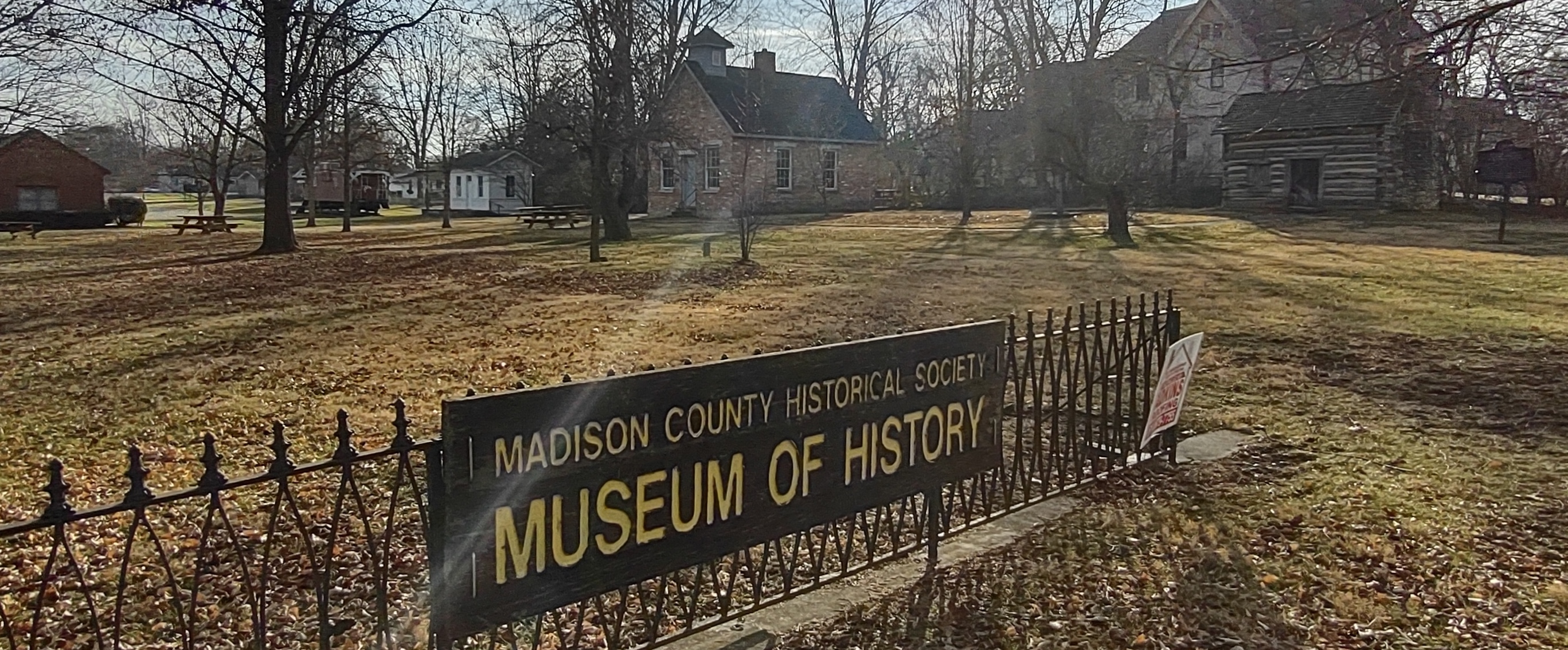
Our geosense tells us that the history center of this rural county seat has some mysteries to unlock.

Our guide, descended from lawyers and optometrists who set up shop in London, narrates the tales of this land on a virtual real reality PowerPoint slideshow walk-through.
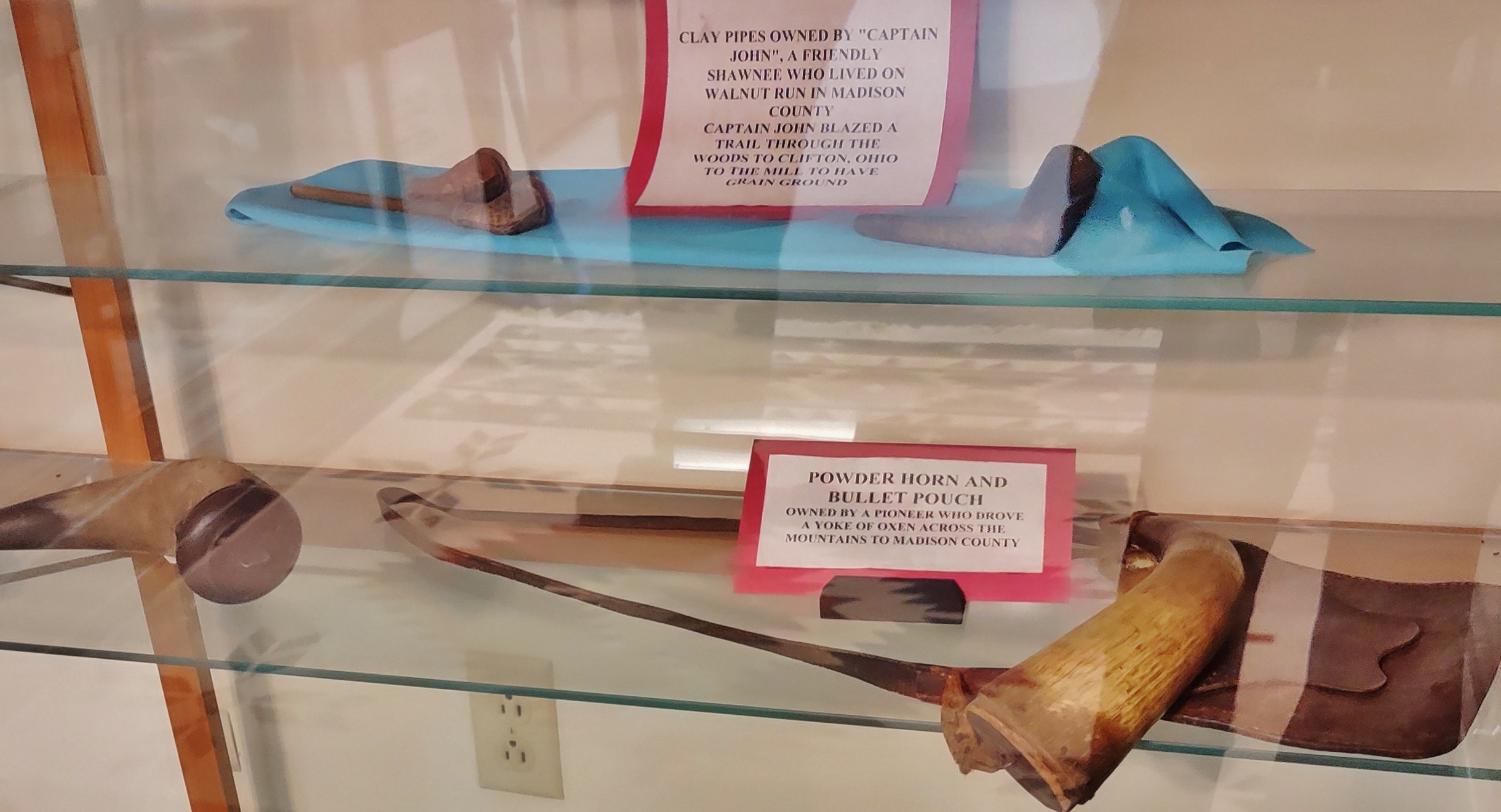
Our first slide opens. A pioneer powder horn shares the screen with clay pipes owned by a local Shawnee man. Captain John, living on Walnut Run south of London, slowly melts into the changes sweeping over his hunting grounds.
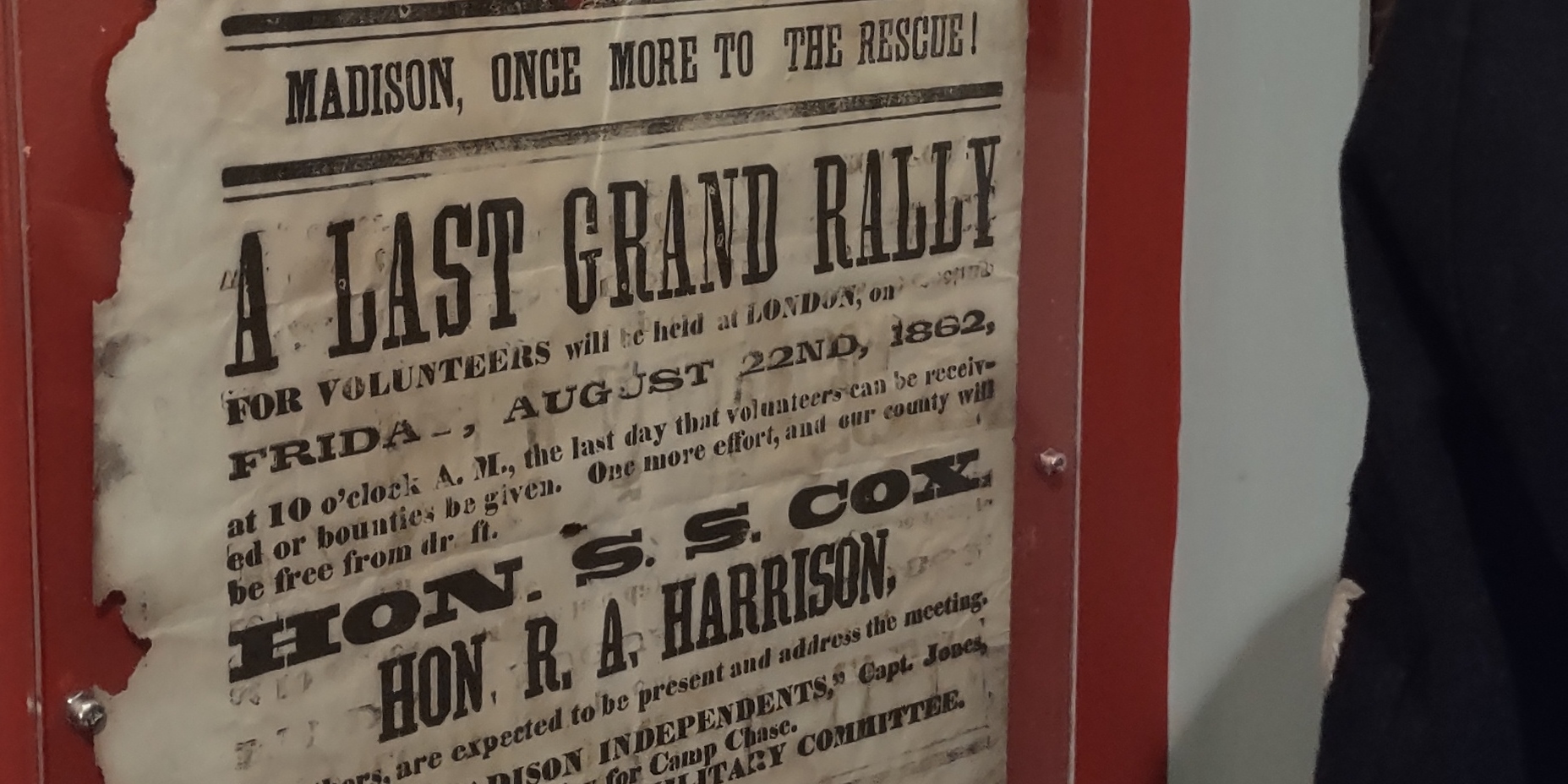
As dads and grands retell tales of heroism in the Revolutionary and 1812 Wars, sons enlist for the Union.
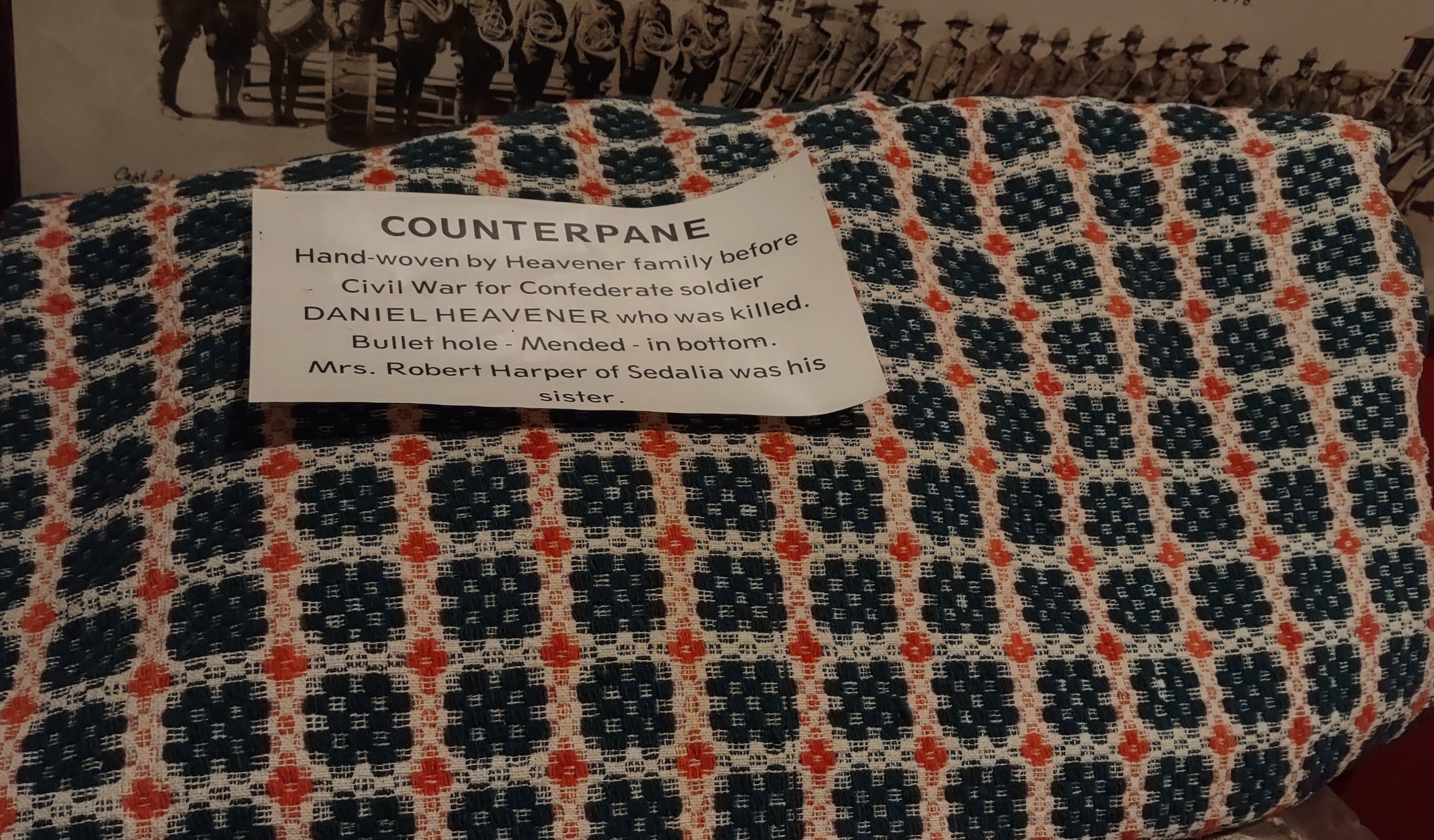
In a repeat of the 1770s, when families were torn between King George loyalists and rebel siblings, families of the 1860s look across the Ohio River to see relatives shooting back.
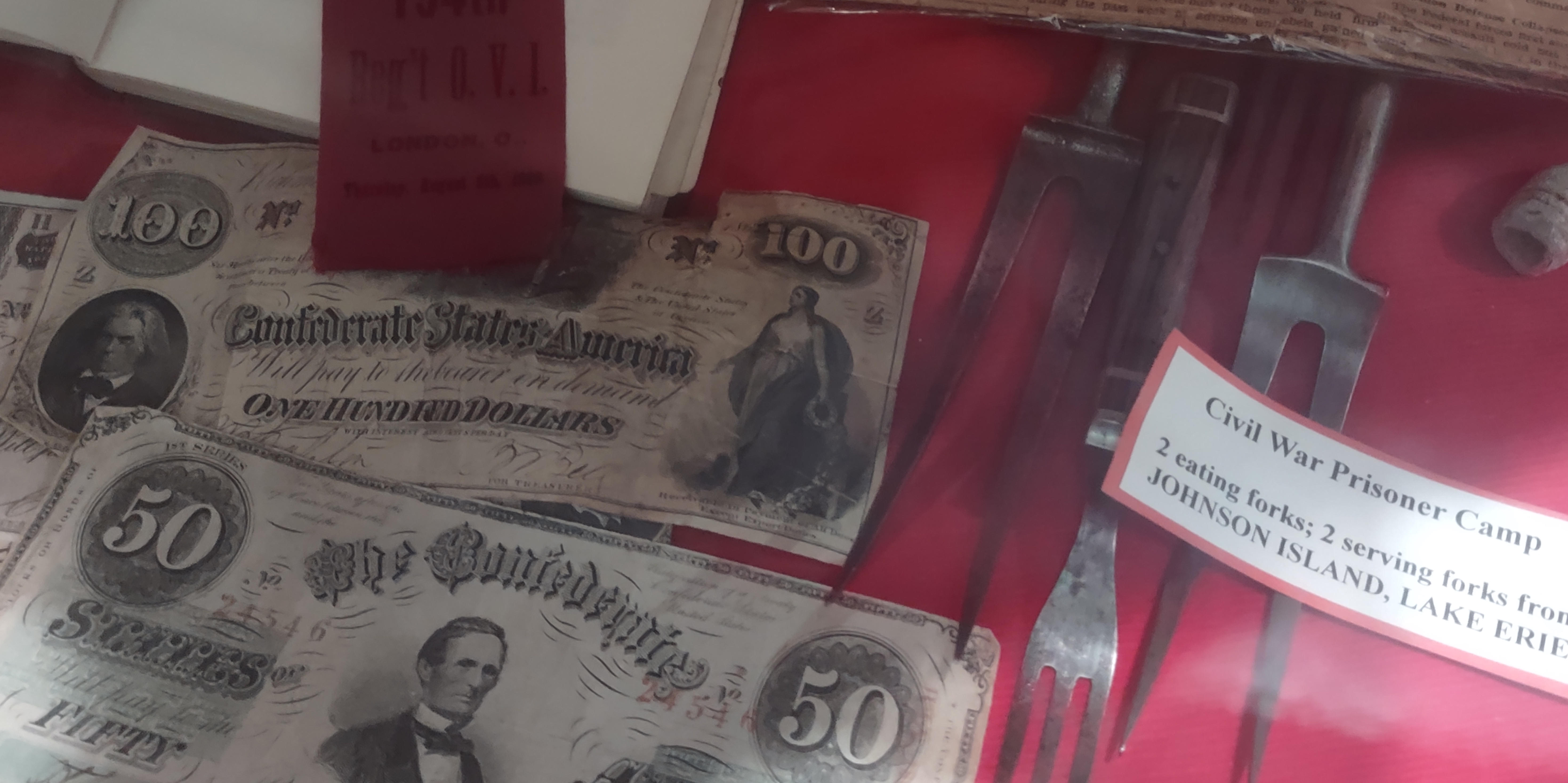
On the south side of the river, Confederates cut their teeth on granddad’s tales of revolution, and ask why not? A baby country spins into action, printing money, and sending men to die in battle. The Union holds.

On the next slide, an 1880s general store, where you can one-click ask the clerk for anything on the website on the shelves, pick up your email snail mail, hear the latest gossip from social media the horse’s mouth, play online games checkers, get a call on your cell phone the store phone, get a package delivered tied up and handed to you, and order again tomorrow wait for your next trip into town.
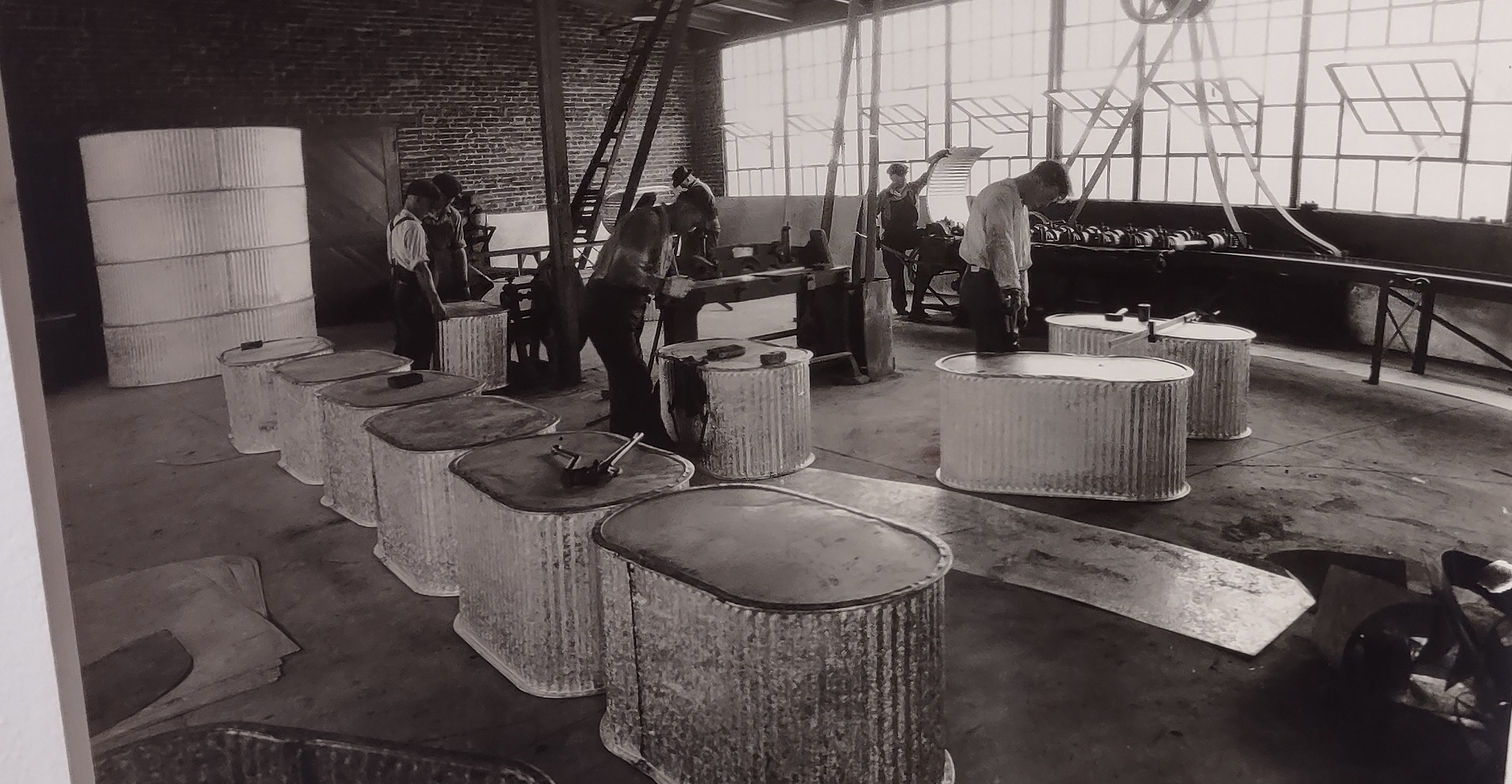
As Mahoning Valley steel blankets the state in the Roaring Twenties, the Thomas and Armstrong Company employs 36 men, making brooder houses, water tanks, hog troughs, corn cribs, and silos for increasingly larger livestock operations. As today’s economy shifts to underpaid, disenfranchised, and unrewarding labor, overworked minions increasingly opt out.

By the 1930s, America’s romance with steel boxes on rubber circles trickles down to chubby child hands, passing on a passion that has not faded.

On our last slide, eras mesh together to create today’s story of $30 trillion in national debt, which somehow makes sense to someone somewhere.
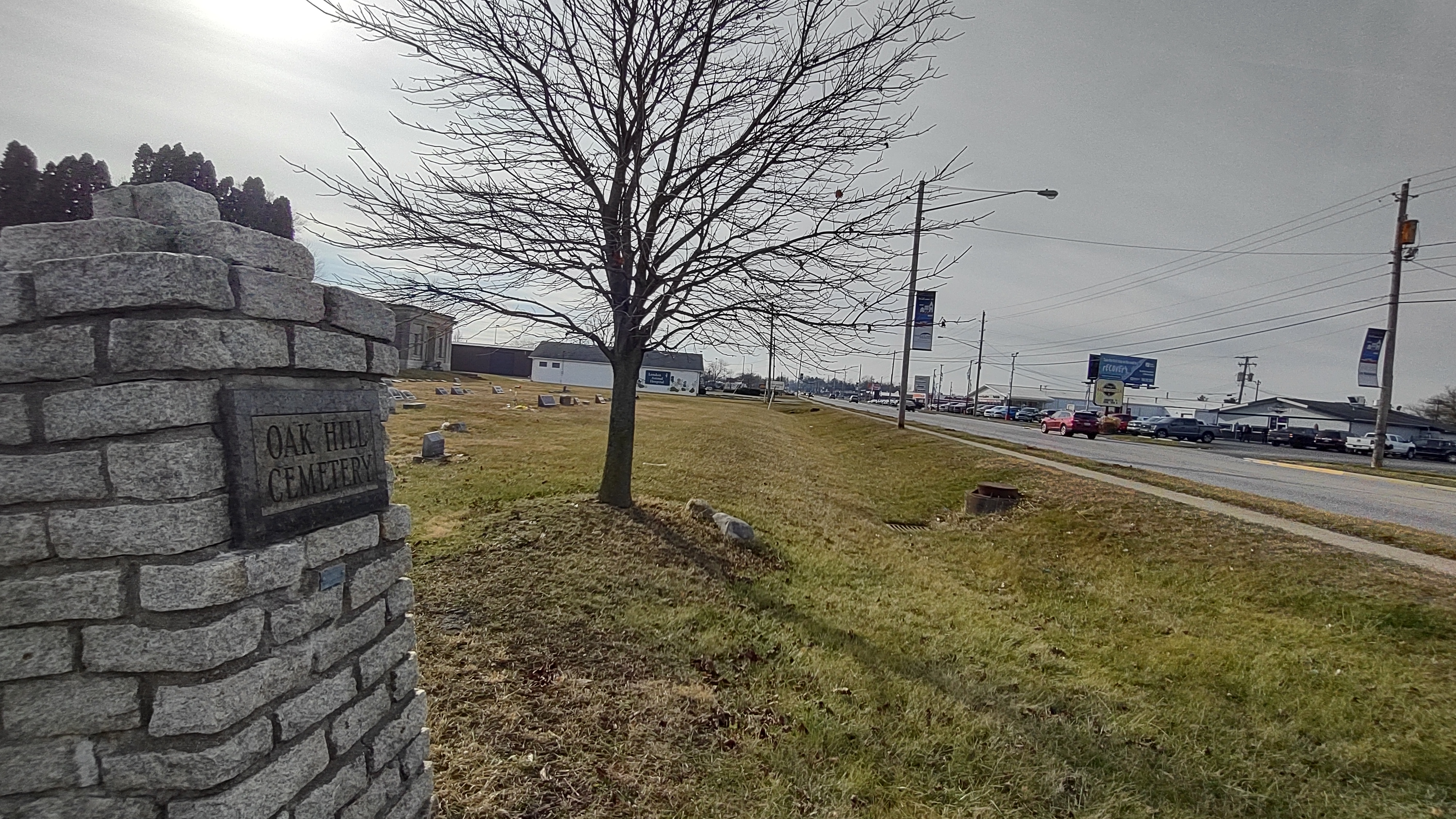
Our coordinates lead us back outside and down the street. Cemeteried land becomes a new guardian of the soil, holding houses, farms, and businesses at bay, preserving life in stone and also in undisturbed ecosystems.
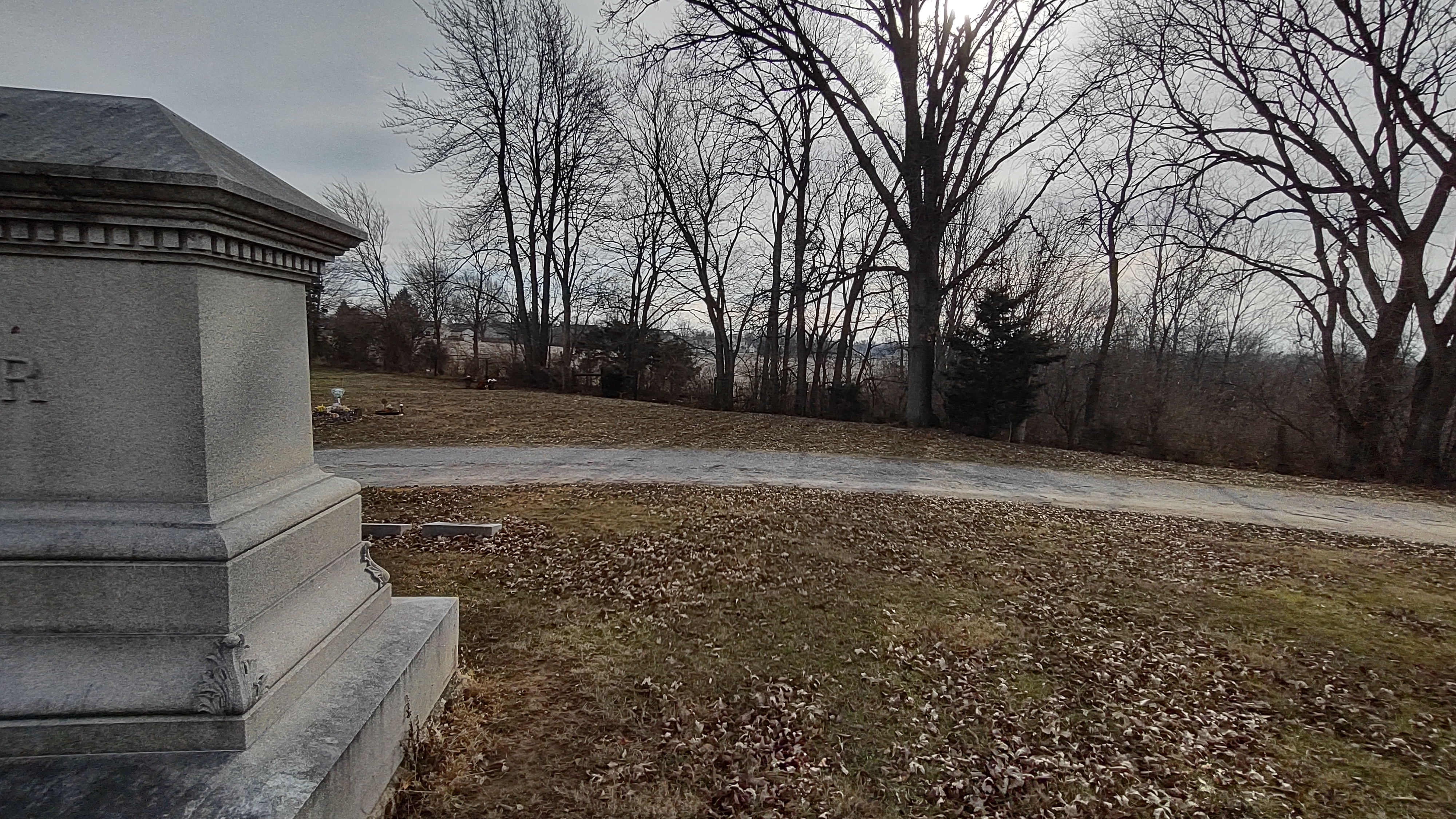
We move toward the back of the cemetery, where new ground holds the dust to which we will return, protected for another 200 years.

Crunch of brown and drying leaves echoes the invisible microbe universe, giving nutrients back to soil for another season of summer growth.
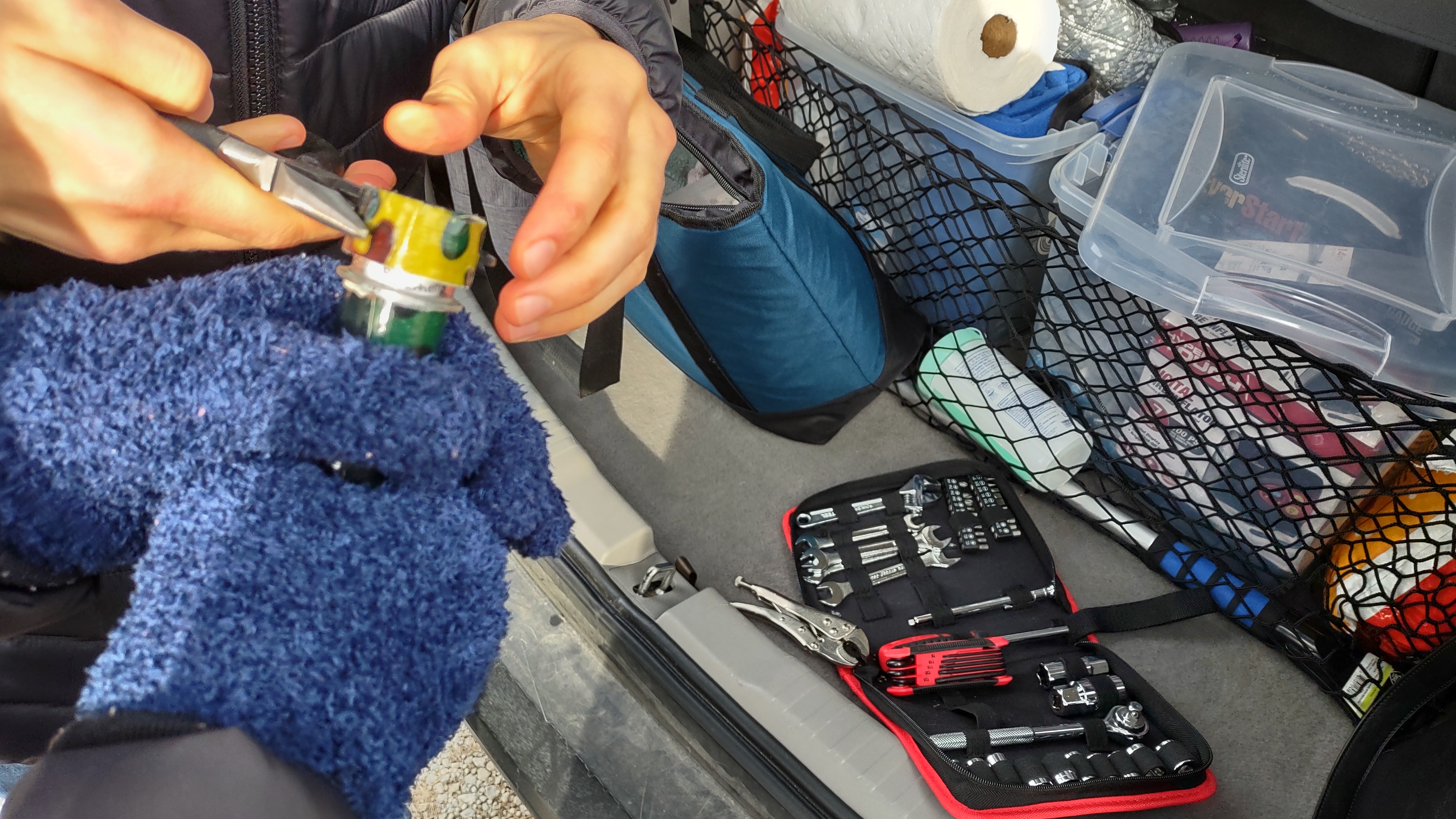
This one takes a little teamwork. And a good set of pliers.
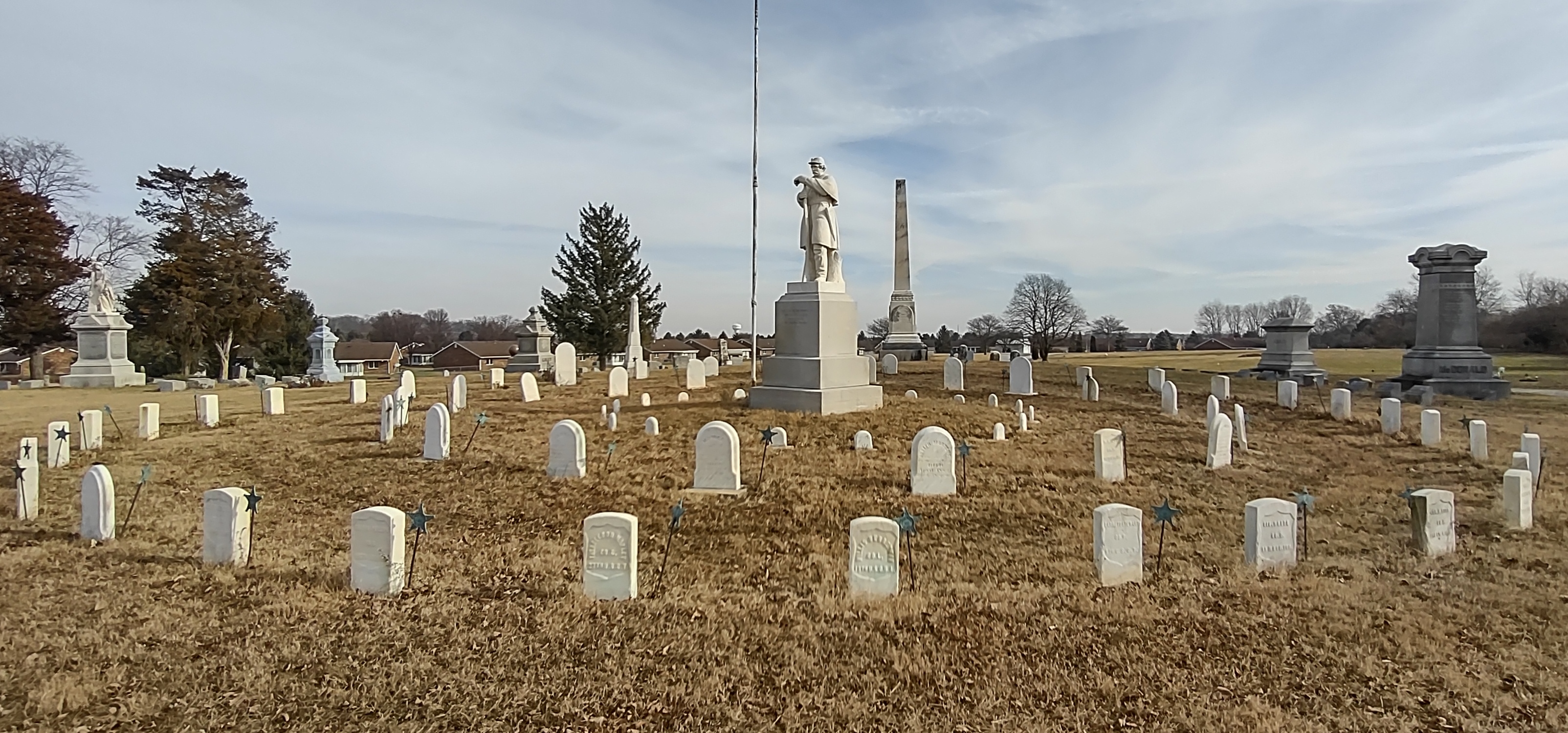
In her cache description, msmandi tells us of a transplant from England, Major Cowling, who seemed to feel right back home when he settled in Ohio in a town called London. He became a successful business man and, in 1861, roused the farmers and craftsmen of Madison County to join in defense of the Union. London’s Company K headed into western Virginia, where many of them died. Cowling and his family are buried in this cemetery, alongside 65 veterans of Company K, for whom he erected this honorary monument.
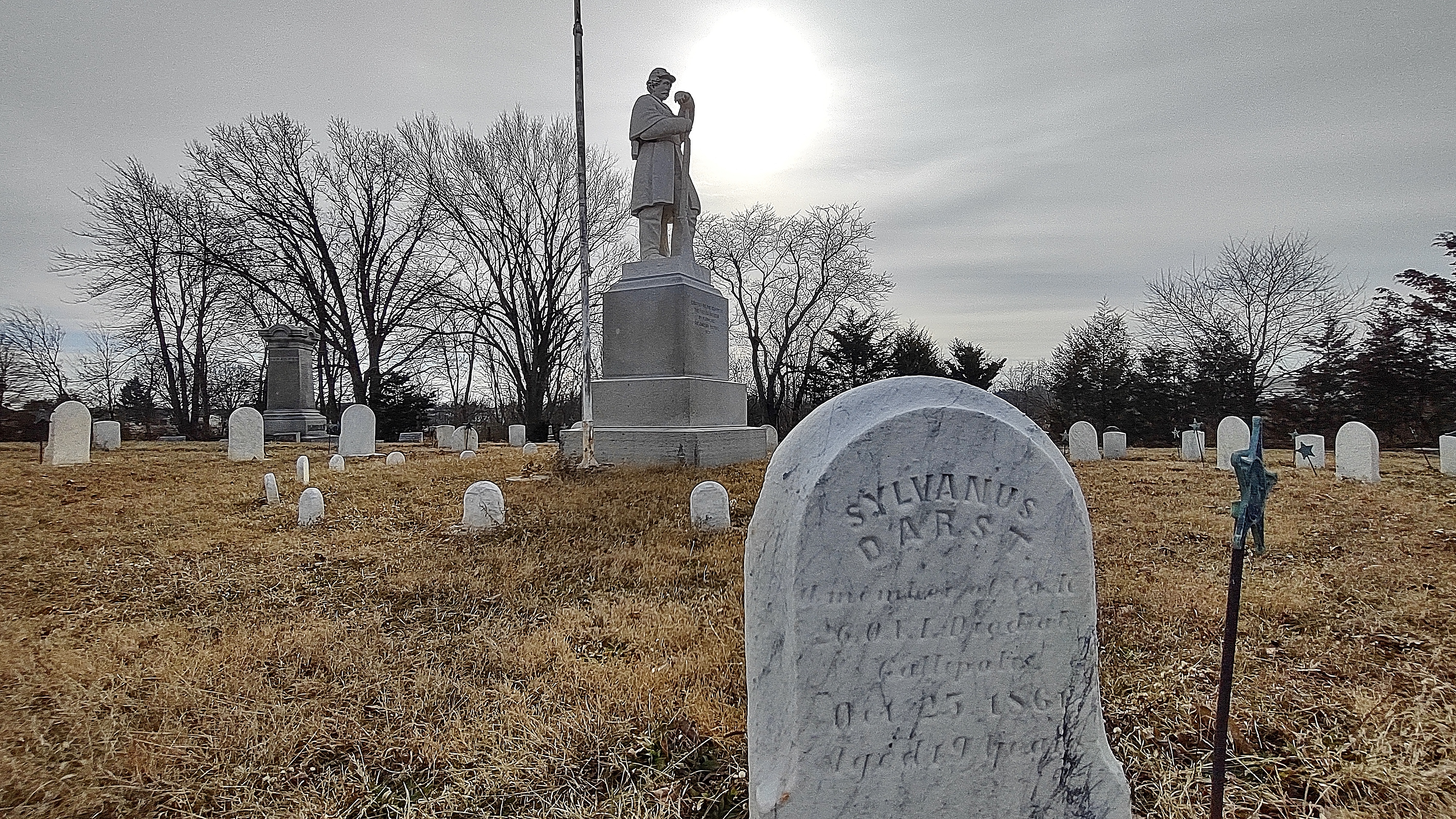
The dedication of the monument in 1871 still echoes.
When they left our midst in the bloom of youth and the pride of manhood, as they climbed the high hills or bivouacked on the open fields of the south, as they met danger on the fields of strife or languished in the camp and hospital; as they reposed at noontide beneath the orange and magnolia trees, or in the forest at the midnight hour, listening to the wind sighing through the boughs of the pine and cypress, perhaps no silent wish more often swelled up in their hearts, and no uttered prayer more frequently ascended into the presence of the Divinity in whom they trusted, than that their actions and efforts might be appreciated and they might be remembered by those at home.
-
Kitchen Cache
Placed by Cache Owner Pioneer Ts in 2010, we will be ransacking the kitchen drawers for this one.

Crossing one county line westward, our geotour routes through farm country, where agribusiness moves corn and soybeans toward ethanol plants and feedlots.
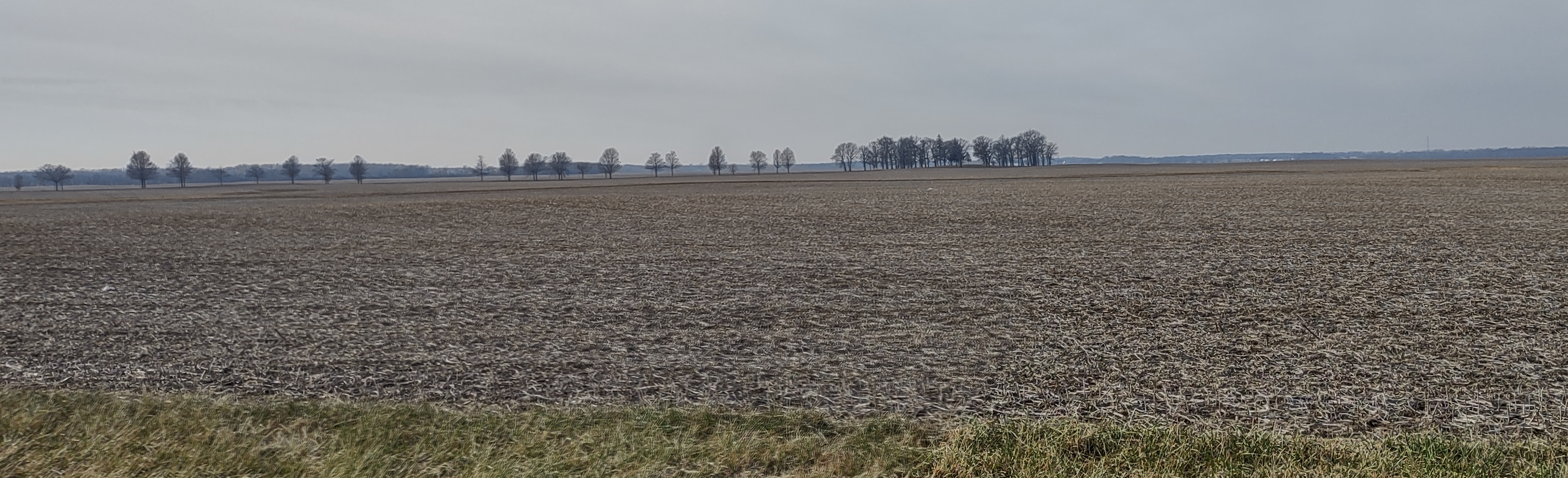
Aiming for Plumwood and Route 29, tires transport past land purchased by Business Manager Guy, aka Midwest Farms, for Mr. Gates. Dropped into Bill-ionaire’s shopping cart for $28 million, the 6,300 acres is now worth $53 million. Energy giant Savion holds a two-year option to purchase the land. Savion would like to lease or buy 10,000 acres, generating 1,500 megawatts, from four to five million solar panels.

As we pull up to Mr. Gates’ gate, the dirt around us glistens like gold. Biofuels harvested from corn, and genetically modified seeds, are some uses for dirt that Mr. Gates likes. Setting up solar farms is another one. More than 20 solar projects are underway in Madison County, half of which are Amazon’s. While Bill-ionaire grows fake meat in a lab, his land is over-and-done with lush forests, tribal hunting grounds, pioneer cabins, family-sized farms, and agri-business. It will now darken, buried not under the asphalt of neighboring suburbs, but beneath millions of black rectangles, slowly following the sun’s trajectory from east to west.
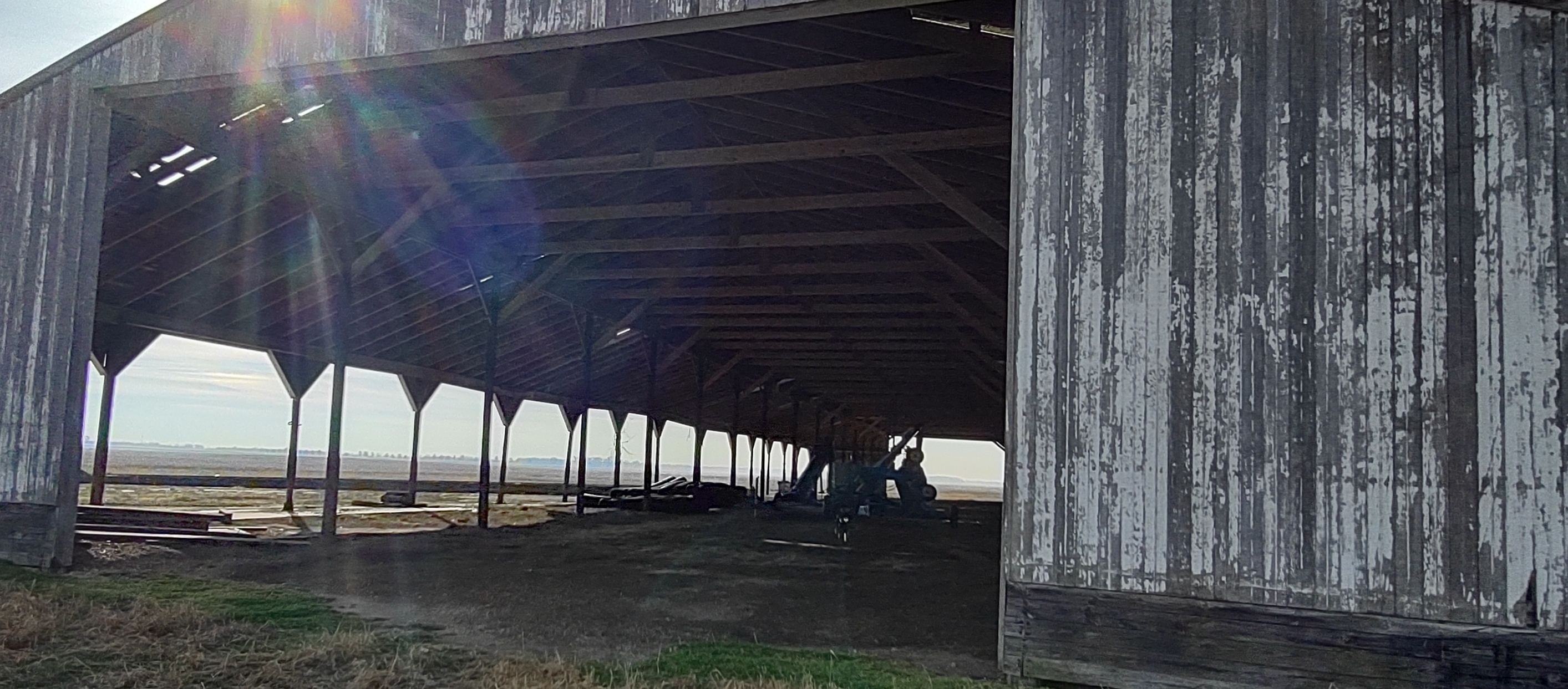
Down the road, Savion is about to flip the switch on the Madison Fields Solar Project, a thousand acres of land generating 180-megawatts. The land is purchased or leased, copying the model of cell tower construction across the rural landscape. Project applications describe the layer of topsoil which will be lost, soil compaction and erosion from construction vehicles, and a 30-year life limit, at which time toxic panels will assuredly be disposed of in the safest manner.

Like those removing coal from the earth, solar farm barons race to harvest the most the fastest. County administrators see the dollar sign bonanza, which promises to finally put them on the map.

Around the corner, a small farmer holds his own. Winter wheat sprouts in the nourishing sun, defying the corn-soybean monopoly. Mites living in dirt penthouses break down dead matter, cycling nutrients back into living soil.

Rural residents wrestle with waves of change. Electric lines delivered the age of the radio, iron, microwave, washing machine, sewing machine, fridge, furnace, well pump, and lights without which we cannot live. Tower-powered internet access now extends a hand and a new kind of fishnet, with the profiteers listed in the fine print. Facial surveillance software effectively manipulates moods toward real-world behavior choices. Individual updates and photos elicit Big Tech responses with below-the-radar political or monetary nudges. Like their 300-year-old German ancestors, who reluctantly swore loyalty to the British crown, today’s land dwellers immigrate into a strange, new digital space, navigating unknown dangers and opportunities.
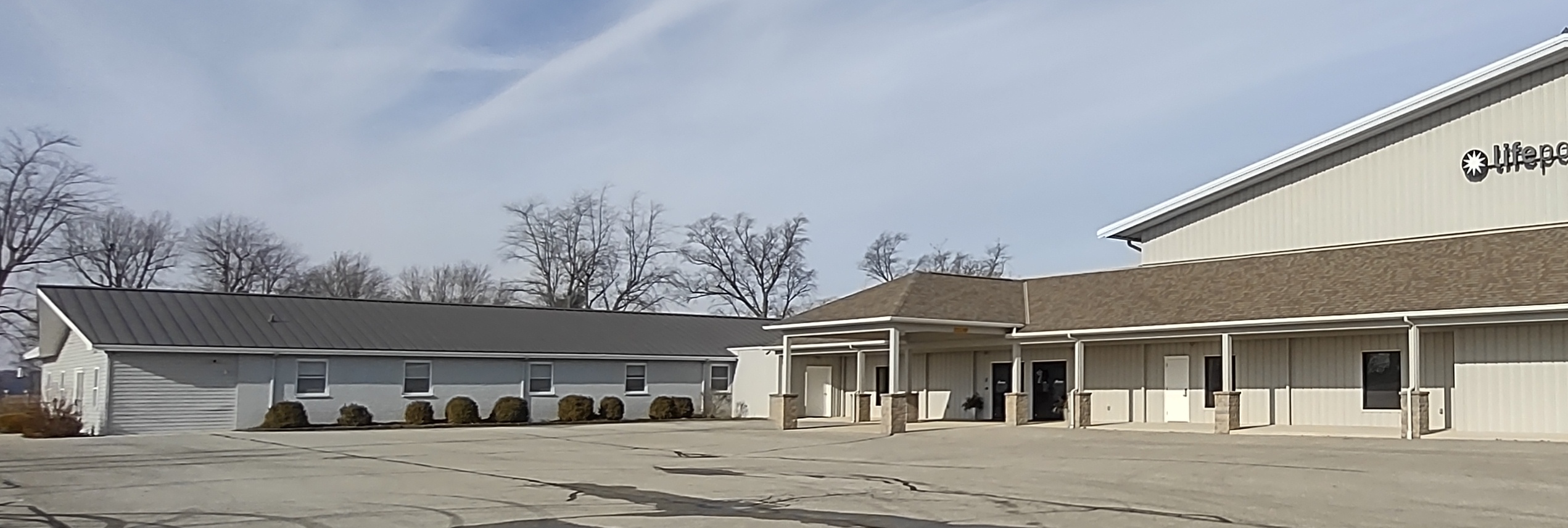
Turning north on Route 42, we pass the tiny church now franchised into a five-campus megachurch. The ethnic community centered there fades into church oblivion. Gone are the lobby bulletin boards thumb-tacked with wedding and graduation invitations, shared wooden pews sliding beneath worshipers, and hymns held in hands rather than on screens.
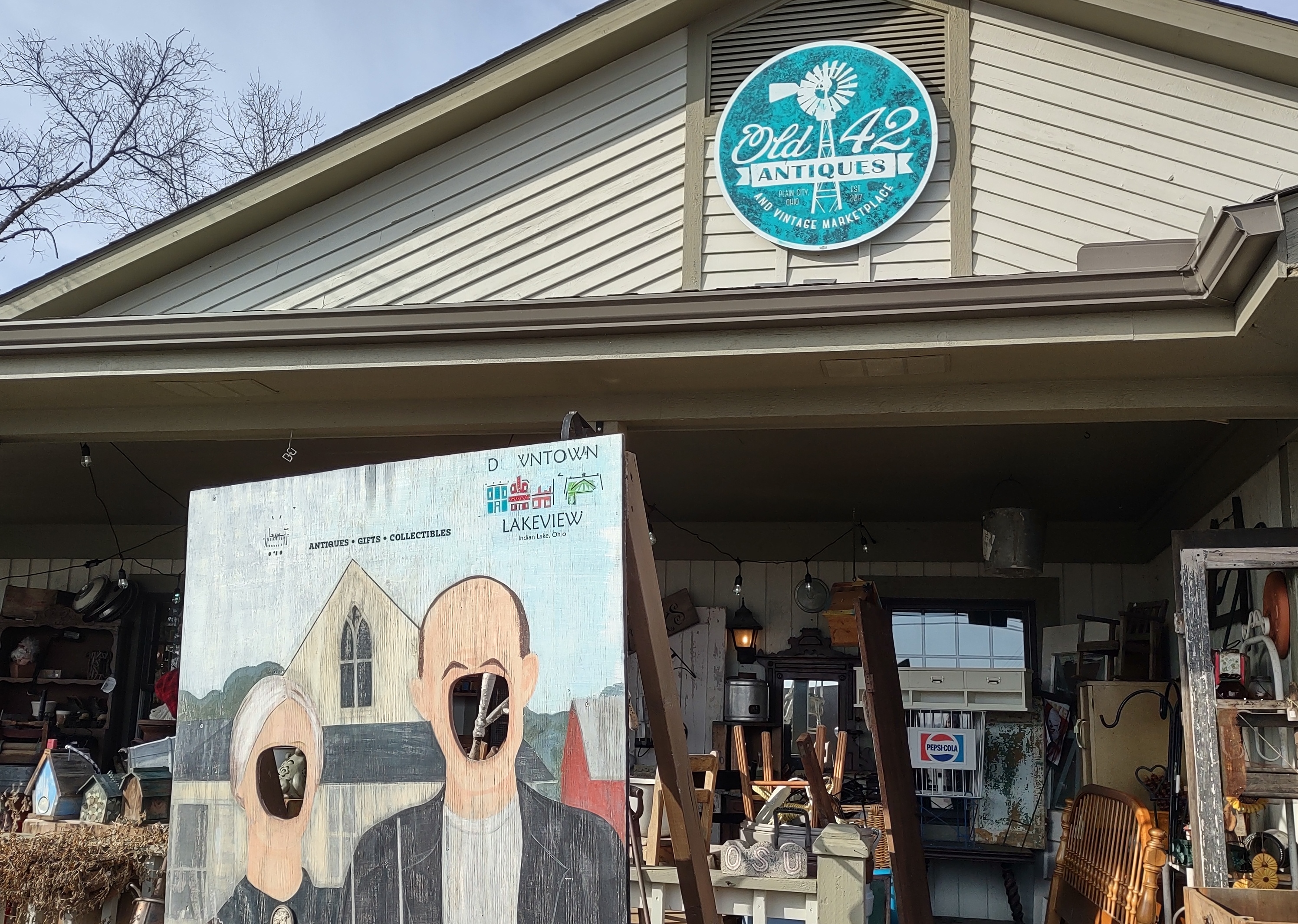
Our coordinates come to rest on Old 42 Antiques, where blank faces mirror the slow dimming of rural identity. Cachers witness the tranformation. In 2012, the last doughnuts are logged and eaten at the Dutch Kitchen.

The restaurant changes owners and reinvents. Timeworn shapes now preserve stories once told over coffee. Myriad memories whisper timeless tenderness and hope, protected and strong.

The Keeper of these ancient treasures also gives sanctuary to a covered bridge, where we must identify AJ pbeare.
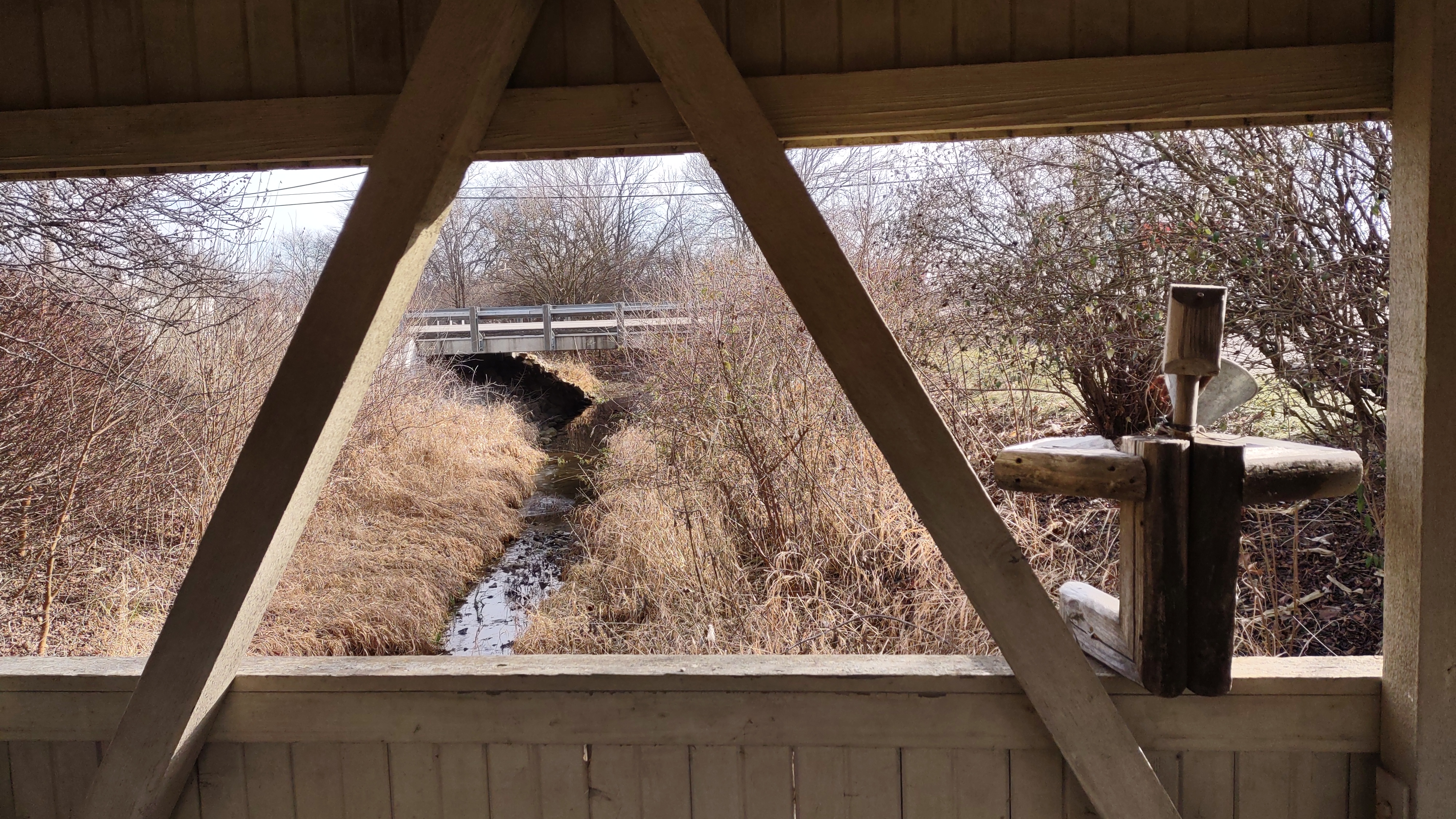
Log Guy is sworn to secrecy, babysitting the creek as it trickles three miles eastward to Big Darby.

Undaunted, we gaze at the sun, frown at Route 42, and maybe even count on our fingers until we locate the NW corner.

A last leaf trembles, as winter’s fruit anticipates new life.
Skip to content