
Placed by Cache Owner sugarbabies12 six years ago, a woods-and-creek cache promises to deliver.
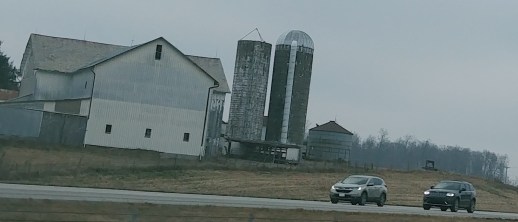
Winter’s coat is cold and cloudy. Rising beside our northbound freeway, aging silos do not let us forget from whom and where good food comes.
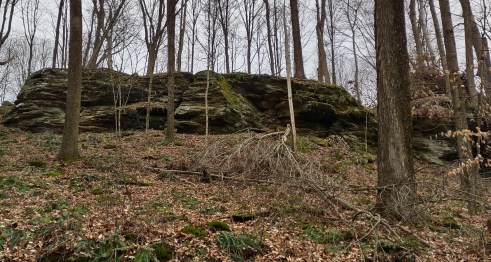
Bubbling forth in majestic rocks and rills, Mohican country leads east.

Our geodetour winds through Malabar Farm State Park, where Louis Bromfield morphs from carefully scripted novelist to gritty, weather-beaten Ohio farmer.

After driving ambulance through flying bullets in WWI, living the Paris life for ten years, and studying small farming methods in India, Louis finds his roots are still deep in the soil of the land, values, and culture of his childhood. The hills of the Mohican Valley call him home.
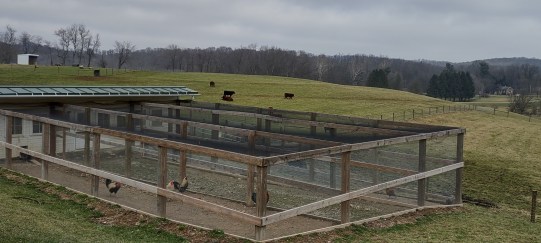
Determined to convince his farming neighbors to shepherd rather than starve their soil, he demonstrates rotational grazing, cover cropping, and no-till planting to restore and regenerate land.

Twenty years after his death in 1956, his farm becomes an Ohio State Park.

The house full of movie star memories, barn brimming with comradely critters, trails high in the rocky forest, waterfalls and caves created for small feet to explore, all shelter under the arm of state protectors.

Children and adults wander, contemplating a reality not choreographed by content producers or web masters. Rumble of purring, brightness of hay, scent of nesting cows, warmth of inquisitive nose harmonize into one deep, long breath.

The Visitors Center combines a volunteer foundation with state park management, in serendipitous weaving of local and state. The third generation of stewards on this land did not forget Louis when they designed his visitor center. The concrete foundation is built using fly ash, a by-product of coal-fired power generation. Floors are made from rubber scraps recycled from commercial construction.
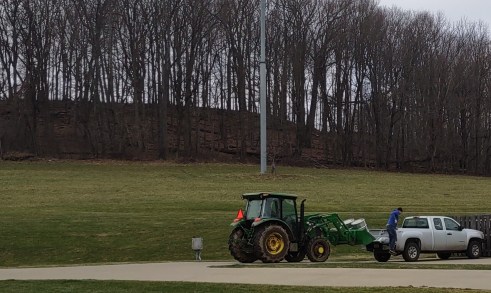
Forests are saved by using small lumber scraps glued together for main structural beams, instead of large single trees. Structural insulated panels are used instead of framing lumber. Reversing the mindset of pioneer farmers taming the land, park staff now apply collective genius to nourishing and guarding fragile ecosystems.

Inside the Visitor Center, Poncho presides. Going the way of all parrots, the old one finally died, and a much chattier one is now in charge. You will know if you are spending too much time not looking at him.
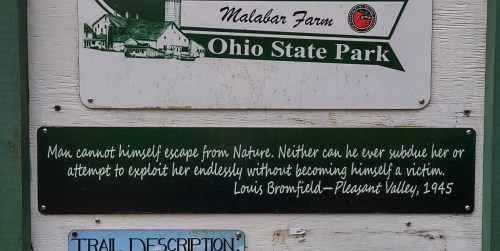
Louis does not let us leave without an admonition, or is it a premonition?
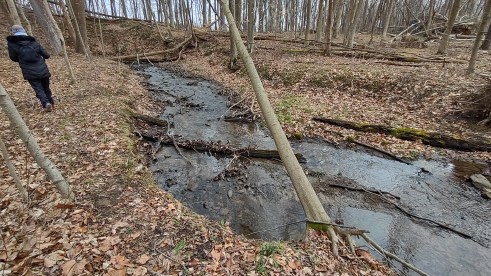
We will follow Switzer Creek south as it journeys from the farm to Pleasant Hill Lake. Waypoints form a dot-to-dot maze playing tag with satellite signals beaming from space . . .
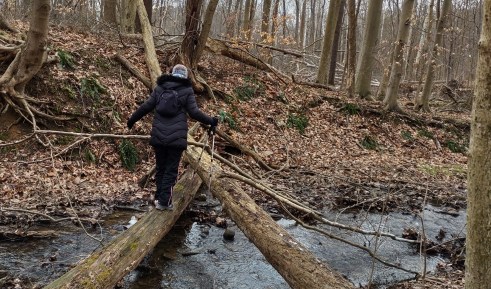
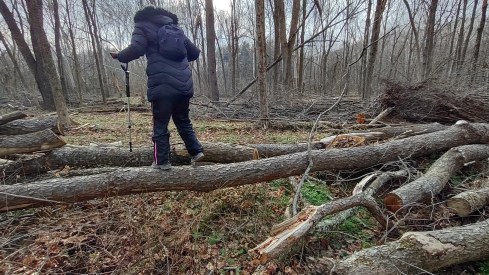
but the creek must be crossed to reach the next dot. Cold, cold water laps below, a fallen trunk escorts us, criss-crossed by tornado-flung barriers. Towering above, trees gaze and grin at the two-leggeds.
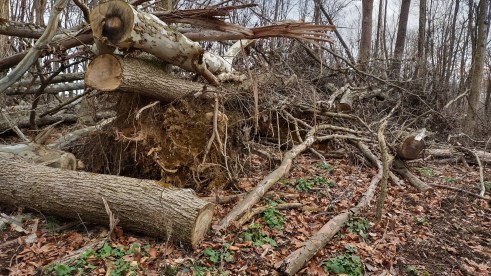
On the other side, unexpected ravage of forest rises.

Battlefield graveyard sits silent over the departed.

The mind stays on the hunt, while the soul studies messengers thrusting through the forest floor. As drilling and fracking blanket the eastern map of Ohio in red dots, fracturing deeprock shale formations to release natural gas and petroleum, township and county officials add up the payoff.
In an eerie recall of Wyandot and Shawnee villages watching forest hunting grounds topple over and die, rural residents and suburban homeowners recoil in horror as water contaminates with fracking waste and becomes undrinkable.
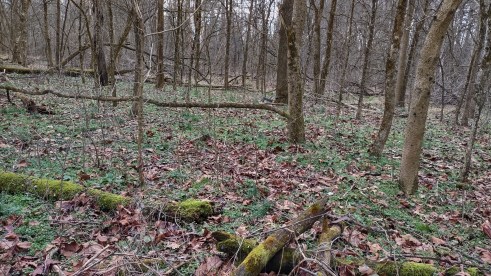
Across the trail, untouched woodland interlaces in wordless invitation. Moss, winter grass, and sleep-tousled leaves enfold, guarding a waiting prize.
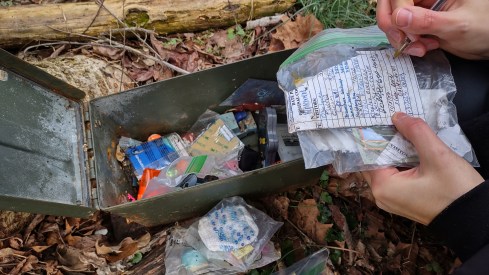
With those who have found before, we see, witness, and sign, touched by the deepening story of years behind this cache, and all such hidden treasures.

Held in the gentle palms of earth, sky, water, and wood, hearts recalibrate, hope restores, play returns.
 OH Love Of Geocaching