
The Steelmaker, placed by Cache Owner Ed_S a decade ago, calls us to a time when steel was king.
Coordinates converge on our neighbor in the northeast.

At Ground Zero, the Youngstown Historical Center of Industry and Labor partners with YSU, training student interns who will advance to museum careers. Traveling educators use story and objects to connect past and future generations with their Youngstown past.

As our geotrail winds inquisitively through the doors, we encounter words like Bessemer, basic oxygen, open hearth, and electric arc, processes for burning impurities out of molten iron to make steel.
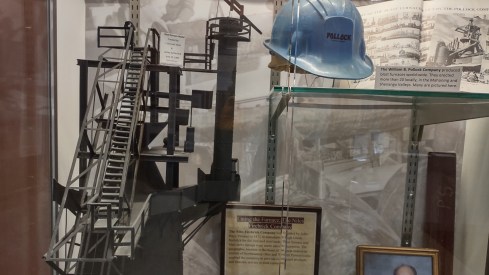
We meet the Pollacks, a three generation iron and steel family. They employed 500 workers in 1920, making 100-ton cars to transport molten iron and steel and by-products. The third generation went to Yale and felt life would go on as usual, in the large mansion built by his father. Markets changed, and the company closed in 1983. An American success story came and went.

Way back in 1620, early colonials built the first iron furnaces, and then began exporting pig iron back to the mother country. From there, the race took off to get the most iron the fastest.

Relentlessly, steam engines, train cars, and railroad tracks all demanded iron. Iron nails, axe heads, kettles, and cannonballs held life together across the colonies and states.

As the Age of Iron depleted New England soils, investors moved to the Ohio and Mahoning Valleys. The Triple Crown of charcoal, limestone, and iron ore was plentiful. Furnaces appeared where raw materials were located and drained them to the last drop.

A community of 500 people sprang up around the 200 men who made the charcoal and ran the furnaces. Management owned everything, paying wages in printed money that could only be used at the company store. Forty-foot circles of charcoal mounds burned 45 cords of wood at a time, consuming 400 acres of wood in a year.

As forests dwindled in the mid-1800s, coal was pulled from the ground to burn instead. By the 1870s when valley coal and iron ore was depleted, raw materials were brought in from other locations.

In 1890, the newly invented Bessamer converter made the US first in global steel production.
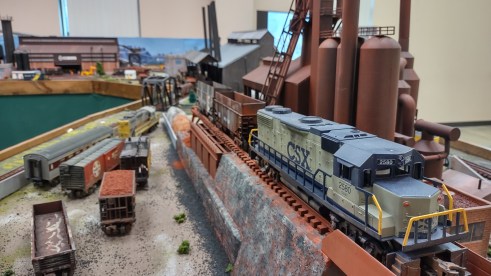
By the early 1900s, 20 miles of steel mills straddled the Mahoning Valley, ranking second only to Pittsburgh in national steel production. A river for cooling, and a railroad for transportation, attached to every mill. Spectacular growth of the industry and the great wealth it created for steel barons would eventually leave devastated forests, polluted waterways, and jobless communities in its wake.
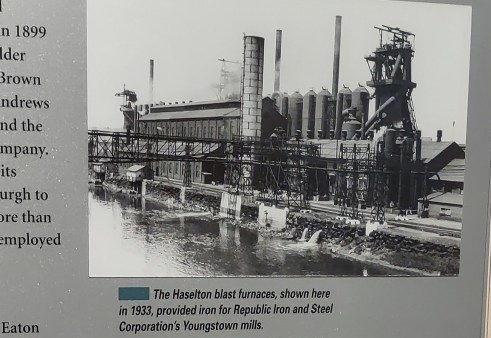
Youngstown Sheet and Tube quickly morphed from iron to steel production as the iron market shifted to steel. Twenty years later, annual sales were $100 million, the highest in the state.
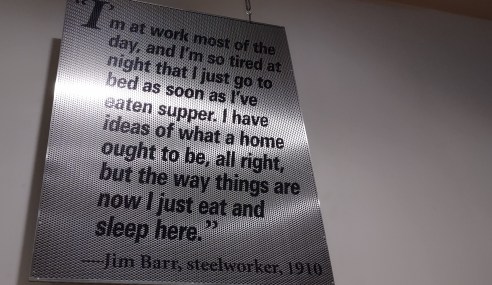
Labor turnover was high, as workers moved among steel companies, seeking better situations for themselves and their families. Poisonous gases, rapidly moving machinery, and 2500 degree molten steel made every day a hazard. Families lived in single rooms, huddled around the steel mill, without running water or transportation.

Company real estate officers controlled rental housing and home ownership, increasing leverage over workers. Ethnicities were carefully separated in company towns and job levels. Managers were English, Irish, Scottish, and German. Workers were Black or eastern/southern European.

Investors backed managers who directed the whole community in order to increase profits. Eventually only large firms, able to combine a variety of production methods and get it to the cities, were able to survive within the shark-eat-shark paradigm.

The Carnegie Steel Company was the first to tie cost accounting to technology, in an ever greedier grasp for profit. Technical managers applied scientific principles to steel production, creating many new steel alloys and finally, stainless steel. This relentless drive to cut production costs undercharged competitors and made Carnegie wealthy, like Amazon drivers delivering profit to the guy at the top.

Consolidation of many small steel producers through cutthroat competition created the industrial giant United States Steel Corp in 1901 (sold to J.P. Morgan who created U.S. Steel) with capital of over a billion dollars, and a vast network of blast furnaces, steel works and rolling mills.
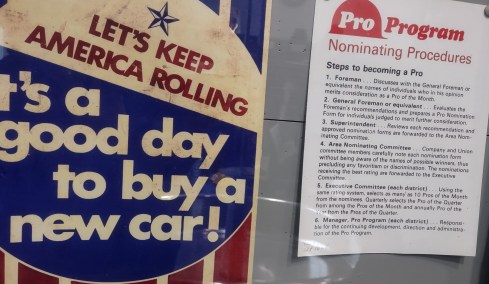
By 1914, the nation’s industrial growth rested on a large, efficient steel industry. WWI became to steel what the pandemic achieved for internet commerce. Several publicly held corporations produced a volume of steel to match the appetite of the public market, on the backs of factory laborers, delivering profits as steadily as black Amazon vans.
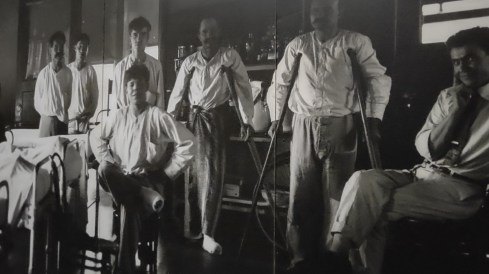
Hundreds of workers lost their lives each year in US steel plants, while thousands more were injured or disabled, as common law held that workers, by entering the plant, assumed liability for injury. Not until 1950 would fully protective regulations and workmen’s compensation offer relief.

By 1915, a deluge of immigrants brought Youngstown’s population to 50% first generation. The mid-1800s brought Welsh, Scottish, English, Irish and German workers, who dreamed of land ownership and the restless search for something better. Italians and Greeks followed 50 years later, with Eastern Europeans close behind.
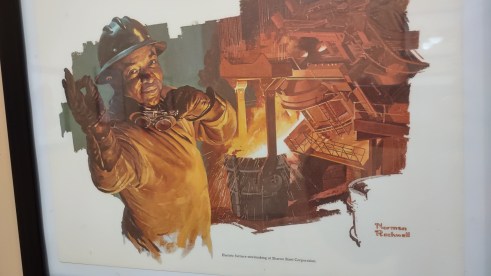
Black immigrants from the South were recruited to fill labor shortages left by WWI. Duplicating the rise of cotton’s demand for coerced labor in the 1800s, the rise of steel became a perfect storm for labor exploitation.

Community groups organized classes, for language and culture lessons, for thousands of immigrants, who formed their own churches and social groups. As descendants fanned out across the state, the rich mixture of cultures created an ever-changing Ohio identity.

A sea of rising humanity prompted 1916 riots to protest lack of housing. Republic Steel and Youngstown Steel, both part of “Little Steel,” which produced specialized steel products independently, adamantly opposed worker unions.
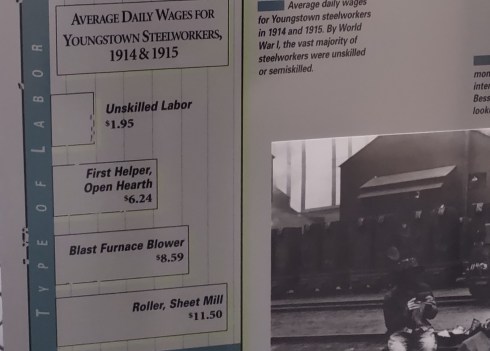
The battle raged between labor and management, as unions sought to win the trust of laborers, and management fought viciously. In June of 1937, workers demanded collective bargaining rights over work conditions. Company managers armed themselves and the police with tear gas, revolvers, shot guns and machine guns. It would not be until 1942 that the United Steel Workers of America would emerge.
By the late 1960s, declining demand, aging facilities, foreign competition, and smaller production facilities were spelling the sunset years of Youngstown steel. Because of harbor access and auto factories, steel production moved westward to Indiana and Chicago. Labor-management conflicts, obsolete technology, depletion of ore, and the new plastics market slowly strangled output.
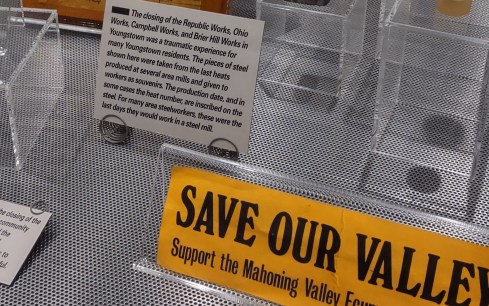
In 1977, Black Monday began the closing of five major steel plants and loss of 25,000 jobs – stockyards, machine shops, powerhouses, carpentry and print shops, repair shops, blacksmiths, and office buildings.
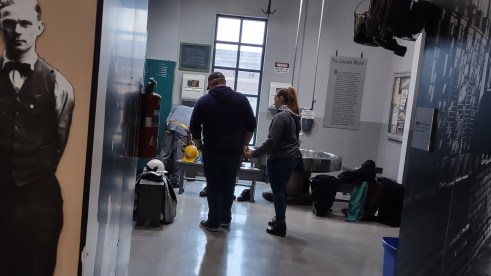
Shock reverberated throughout the Valley. Forty-five years later, the recovery continues, as the proud history of the steel mills that built a nation is remembered with respect and gratitude.
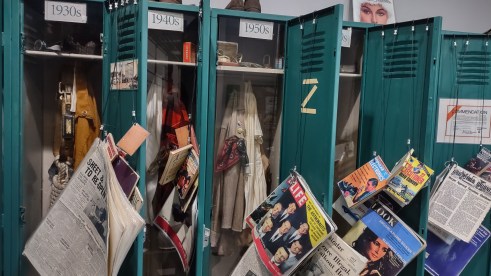
With tender detail, decades of dedicated service fill the lockers left behind.

As we step outside, a gentle drizzle falls. At Ground Zero, two steelmakers are immortalized. Across the street, the faith that sustained through years of turmoil.
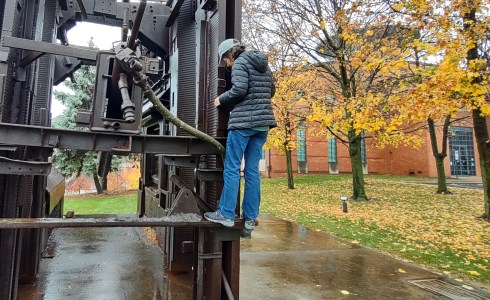
The open hearth furnace sculpture recalls untold memories of lives spent. Someone has moved the cache a teensy bit high.
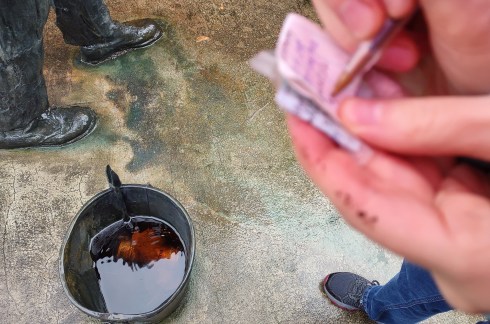
Slowly the water bucket fills with fresh rain.
 OH Love Of Geocaching