Cache Owner hankpixie, only four years ago, dangles the delight of a train station. The whistle is calling, and we must go.

Our geomap travels north on Route 23, where nodding grasses ponder the trade-in of five acres for lucrative return on wealth.

Trees dressed for winter escort us toward Marion. Safe for now in their narrow cages, they remind that, should they go, life will be a barren field of blacktop, blanketed with speeding metal.
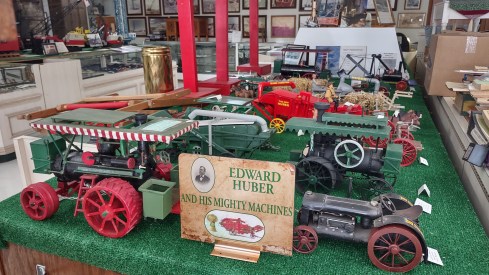
Quite by accident, we are drawn into the Huber Machinery Museum, where 150 years of creative invention follow the rainbow from horse-drawn plow to NASA rocket.

Coming from a creative family, Edward Huber arrives in Marion from Indiana and sets up shop, building new and improved farm wagons, and then inventing an inspired twist on the hay rake. He sells 200,000 rakes, for $5 each.
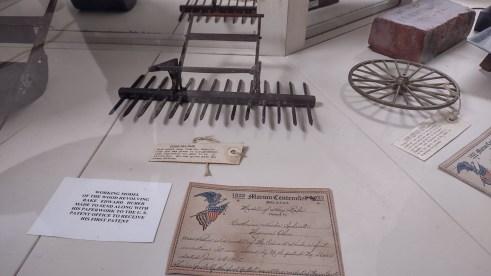
Patents spring from the minds and hands of new Americans as prolifically as wheat and corn from the rich, black soil. Still limited to only Natural Intelligence, inventors learn, improve, and innovate.

Our guide points out the Huber Hay Rake, as simple and complex as the first flip-phone. A Huber great-grandson walks through the museum, getting floors ready to wax. Pride in roots, in place, in achievement glows from the tractors, corn huskers, and threshers around us.
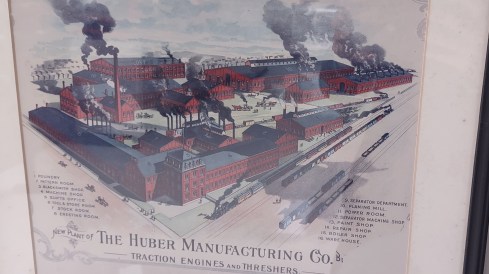
By 1894, Edward’s production has outgrown the barn floor. The name Huber, making the Top Ten as a German surname, derives from “land owner.” As immigrants begin to experience the power of individual ownership, determination, and belief, their communities stumble and rise again, building the muscles of self-governing toddlerhood. Edward becomes president of the bank, the light company, the savings and loan, the opera, and the library. Power shovels for coal mining, malleable iron, tile, brick, milling, and grain join his portfolio. Like all successful businessmen, he faces the happy yet unsettling question, “How much is enough?”

In 1964, less than a hundred birthdays after the hay rake, Marion Power Shovel engineers design and build a six million pound Crawler-Transporter to move Apollo and Saturn Rockets along the first mile of their journey of 230,000 miles. Ohio neighbor Wapakoneta sends Neil to the top of Apollo 11, where he chills on the Marion crawler.
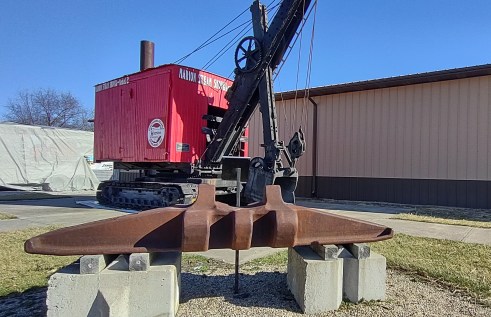
Outside the museum, one 2,000 pound shoe of the Crawler has returned home, dwarfed by Great-Grandpa steam shovel, reminding it where the inspiration for the shoe came from.
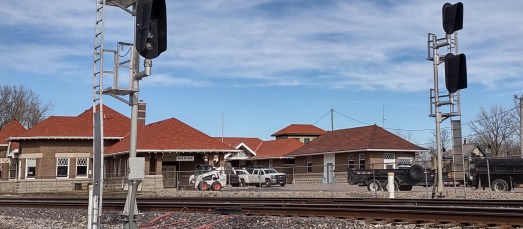
We follow Edward’s footsteps around the corner to the Marion Union Station, where he leads the charge on installing the railroad. Our proud Cache Owner reminds us that a Marion native, Mr. Harding, got the station upgraded, and then ran for President. The trains brought celebrities and common citizens to Marion to hear him speak on his bid for the White House. Only two years later, this station received his funeral procession.

With the speed of clacking wheels on track, American fields are embroidered with steel threads, by business investors skilled in selling stock, raising money, and cultivating oil, steel, and railroad connections. Right on schedule, trains carry thousands of WWII draftees across the country, through this station. Like the Apollo rocket, a human mind still controls and directs these tons of careening steel. From the side window of the train springs a sudden happy message.
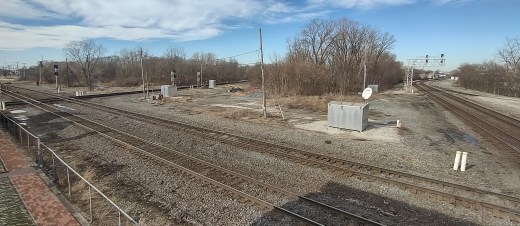
Within minutes, four trains have surrounded us, moving in different directions. Each sings the song of the railway, a whistle far in the distance, a rattle, clap, clap, and then two long, one short, and one long, the universal lullaby of the engineer.

We didn’t know our shopping orders were filling up so many train cars. Hay rakes and threshers give way to Kindles, Ring cameras, and Alexas.
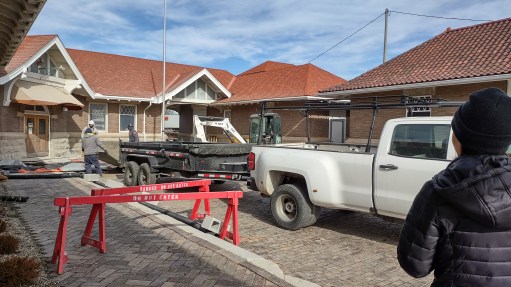
With so much going on at geo-zero, our coordinates are unclear about our next move. As if on cue, our hard-working muggles serendipitously pack up.

Admiring today’s Bobcat iteration of Edward’s shovel and tread shoe, we begin the search. In March of 2020, a cacher logs the joy of having a treasure to hunt, a reason to get the family outside, and an escape from pandemic house arrest. Cache Nation echoes the gratitude through a long, long year.
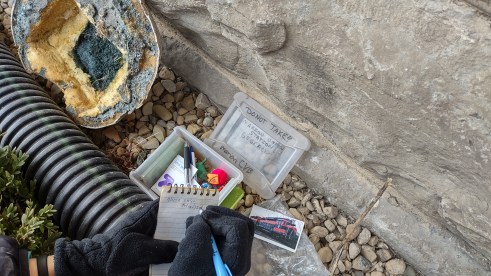
True to the creative minds that have inspired us today, the cache hides under a model railroader’s version of a rock.

In 1971, The City of New Orleans took us for a ride, wondering if trains would disappear like flatboats, steam ships, canal boats and horse-drawn carriages . . .
And the sons of Pullman porters
And the sons of engineers
Ride their fathers’ magic carpets made of steel . . .
And the steel rails still ain’t heard the news . . .
This train’s got the disappearing railroad blues.
No, they ain’t. They still ain’t heard the news.
 OH Love Of Geocaching