Tracking a treasure in this season of shared gifts, we follow the call of Cache Owner boydfamily, placed in 2007.
As winter solstice winds blast, the sun’s warmth and light disappear. In the cosmic game of Crack-the-Whip, our hemisphere flings furiously through the outermost point of orbit.

Driving west, then south, the cloud bank rolls back like dryer lint, conceding defeat. The sun blazes forth, and we embrace it as eagerly as the Ancients.

The mills of the Little Miami River drift by. Built in 1813, Grinnell Mill was one of nine mills powered by the river. Textile mills spun cotton into yarn, gristmills ground cereal grain into flour, paper mills rolled wood pulp into paper, and sawmills cut logs into lumber. The Wars of 1812 and 1865 gobbled up the milled flour and wool. Like Silicon Valley startups, mill operators fought to win the market, only to see it move to railroad towns. Grinnell Mill flourishes today as a bed-and-breakfast, where lumber, flour, paper, fabric, hard work, and a river come full circle.

Upstream, on the other end of John Bryan State Park, Clifton Mill birthed the town of Clifton. Grocery stores, furniture makers, weavers, butchers, churches, and blacksmiths catered to farmers coming into town with grain to grind. In 1849, cholera struck, percolating in contaminated ponds and wells. Forty victims were buried.

Today’s names, Lazorski, Bieri, Rohrbacher, echo the fortitude and tenacity that carried a settlement through grief and terror. Two centuries later, these names rise to the challenges of impending solar and wind farms, ballooning regulations, and the internet’s tug on children of this land.
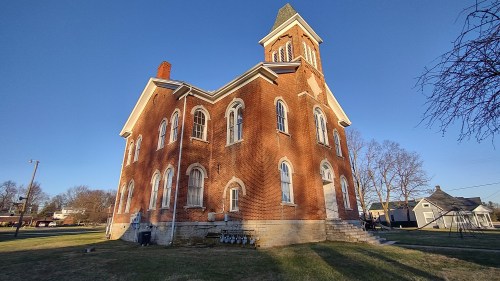
Our coordinates draw us to a monarch still mighty. As parents weathered war, peace, sickness, health, prosperity, and change, children wore out the marble on the schoolhouse steps. Education promised to be the winning lottery ticket, opening opportunity’s window on the world.
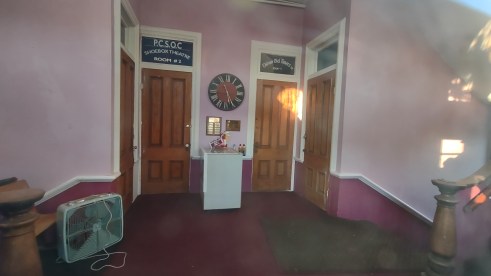
Ghosts flit through with airy shapes, whispering invisible, indelible memories of childhood. As tiny schools consolidated into large repositories, communities began to awaken to the questions of what should be taught, and who should decide.

In 2009, the cache stump turned into mulch. Guardian angels moved it to the sheltering school ramp. Three months ago, a log reports that local muggles will help you find it if you can’t, and will also direct you to the other cache by the mill.

In this friendly town, tidings of peace echo goodwill. Threads of past and present weave strength.

As we sign the cache, our hands are cold, cold as ice, cold as fear, cold as cold salami. We are hungry.
 OH Love Of Geocaching