
With this most respectful of names, Cache Owner cccf1 placed a cache in 2017, on the bicentennial year of the Treaty of the Maumee Rapids.
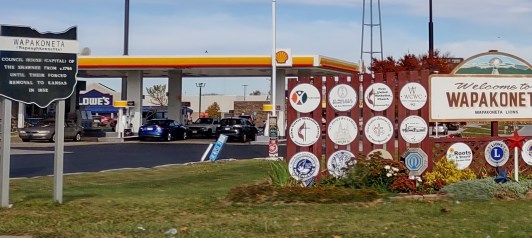
In this treaty, representatives of six tribes relinquished claim to 4.6 million acres of land in northwest Ohio. The Shawnee were then confined to three tracts of land, one being a square of ten miles on each side, around their Council House at Wapaghonetta.

Now this is Space Country, where native son Neil Armstrong extends a hometown welcome. Inquiring minds nudge our geotrail through the Space Museum.
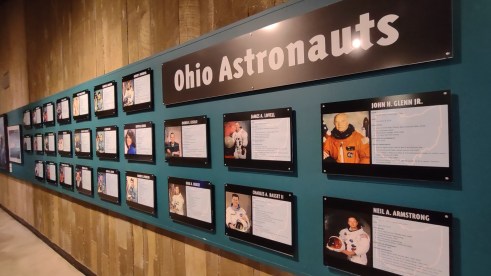
As WW II ended, Americans faced off with Russians across a divided Germany and a rocket missile race. Declaring that they must save the country and the entire Free World, politicians launched NASA, along with hundreds of thousands of jobs and billions of dollars. Technology, engineering, and computers rushed to the challenge. While civil rights and South Vietnam simmered toward a slow boil, the national debt spun into high gear.
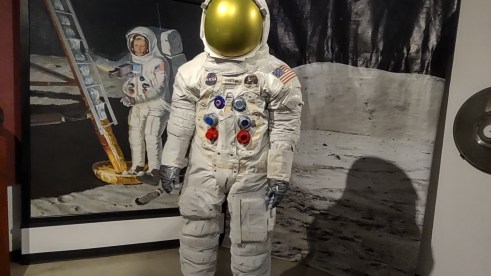
Dozens of Ohio companies would cook up innovative products for the first Gemini missions. Heat shields, space suits, parachutes, fiberglass, space kitchens, batteries, mobile quarantine — the new shopping list was galactic.

In a long series of firsts, Americans entered space, orbited the earth, docked two rockets in space, sent camera probes and landing crafts to the moon, landed a man on the moon, and drove the first moon car. Optimism and adventure distracted from the clouds roiling darkly across the nation.
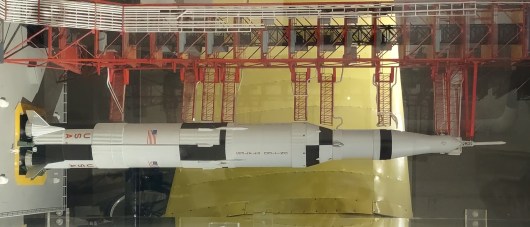
Dwarfing the humans who built it, the Saturn V rocket carried Apollo 8 around the moon. “Magnificent desolation” gazed upon the Earth of Genesis 1:1, a verse recited by the astronauts as they struggled to grasp the beauty of their planet. Suddenly, the measureless resources which fueled the mission reaped a massive public harvest, of environmental responsibility for an irreplaceable Earth.
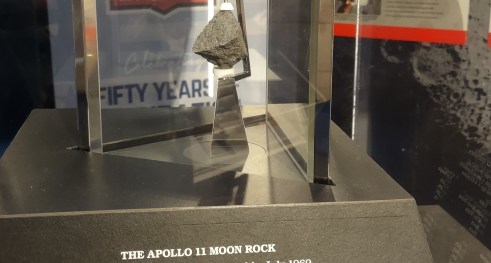
Flying Apollo 11 in 1969, a Navy test pilot manually parked two humans on the surface of the moon, with the immortal announcement, “Tranquility Base here. The Eagle has landed.” Five more Apollo missions would land on the moon, at a cost of today’s $257 billion. Like Lewis and Clark, mission specialists obtained rocks, surveyed ground, and faced hair-raising adventures to tell the folks back home. Unlike Lewis and Clark, the astronauts found no abundant forests, no sparkling rivers, no rich soil. And no current inhabitants.
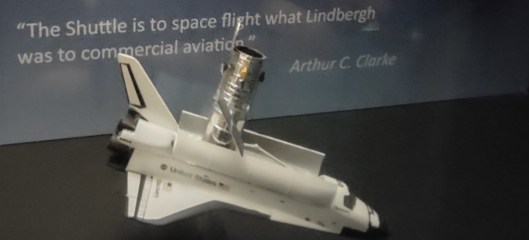
Skylab led to the International Space Station. Space Shuttles ferried satellites into space, bringing space travel ever nearer to the (affluent) masses. Mariners, Vikings and Voyagers send pictures back from distant planets. Over 6,000 satellites now circle our planet, with a projection of 30,000 within ten years, occupying upper and lower layers of orbit. Ten per cent of the light we see will be from satellites rather than stars. Millions of pieces of spacecraft debris join the cosmic dance. Like French and British fur traders, the race is on to skin the most animals the fastest. Earthlings today see the night sky as it will never be seen again.
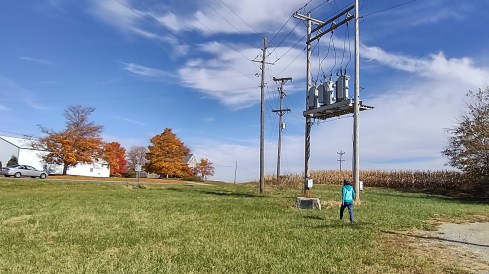
Outside the museum, we gratefully take a deep breath of naturally occurring oxygenated air. Our GPS pilots us to a closer Tranquility Base.
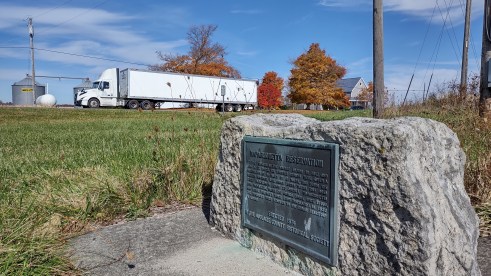
The plaque tells us that, along this fault line, runs the eastern boundary of the 1817 Maumee Treaty. Believing transformation would save them, Shawnees relinquished their culture of hunting and warfare, adopting the ways of farmers, carpenters, and mechanics. Shawnee children relocated from the woods and fields to school houses.
Around the prosperous Shawnee homesteads, migrants from crowded eastern states trickled in. Creeks of new settlers became rivers, and then a flood, washing everything before it. Vast cornfields, large houses, and abundant livestock, belonging to settled Shawnees, were coveted by the surrounding Wasichus, a Sioux word meaning “greedy.” As Shawnee youth turned to alcohol, and poverty overtook the tribe, leaders gathered the dwindling remnant of extended families for the inevitable journey west.

Black-topped roads, electric power grids, and rumbling vehicles now occupy the place of earth and open sky in the lives of the Two-leggeds. On this spot, the Cache Owner has connected us again with the ancestors who also loved this land.

On our way out, an eerie rollback to those vendor-induced addictions of 200 years ago. Global interests push onward with invisible yet invincible wasichu.

On the long trail homeward, the night sky, ever there, winks.
 OH Love Of Geocaching